

Over 90 percent of the human body’s collagen is Type 1, making it a powerhouse protein for skin strength and joint flexibility. For health-conscious British women, finding reliable ways to support natural collagen levels is more than a beauty trend—it is a smart strategy for graceful ageing and active living. This guide explains how the right collagen supplements can help you maintain radiant skin and resilient joints while highlighting safe options trusted by UK skincare enthusiasts.
Table of Contents
- What Is Type 1 Collagen Protein?
- Primary Types of Collagen Compared
- Key Functions In Skin, Bones, And Joints
- Sourcing And Supplement Forms In The UK
- Effectiveness, Safety, And Common Risks
Key Takeaways
| Point | Details |
|---|---|
| Type 1 Collagen Dominance | Type 1 collagen is the most abundant protein in the human body, crucial for maintaining tissue integrity in skin, bones, and connective tissues. |
| Variations Among Collagen Types | Different collagen types serve specific physiological functions, with Type I providing structural strength, Type II cushioning joints, and Type III enhancing tissue flexibility. |
| Benefits of Collagen Supplements | Collagen supplements show potential in improving joint health and mobility, particularly when combined with regular exercise. |
| Safety Profile | Generally, collagen supplements are safe with minimal side effects, making them a low-risk option for most individuals seeking to enhance their nutritional intake. |
What Is Type 1 Collagen Protein?
Type 1 collagen represents the most abundant protein found in the human body, comprising approximately 90% of total collagen. This critical structural protein plays an essential role in maintaining tissue integrity across multiple bodily systems. Critical molecular structure involves a unique triple-helical arrangement formed by two alpha-1 and one alpha-2 protein chains, creating incredibly strong and flexible connective tissues.
The fundamental genetic blueprint for Type 1 collagen emerges from two specific genes: COL1A1 and COL1A2, which encode the protein’s complex molecular composition. These genes produce protein chains that intertwine to generate the characteristic triple helix structure, distinguished by a consistent glycine-X-Y amino acid sequence. This precise molecular configuration enables Type 1 collagen to provide remarkable mechanical resilience throughout various bodily tissues.
Type 1 collagen is predominantly distributed across critical physiological regions including skin, bones, tendons, ligaments, cornea, dentin, and scar tissue. Structural protein distribution ensures mechanical strength and elasticity in these essential body structures. By generating substantial microfibrils and larger fibres, Type 1 collagen delivers crucial tensile strength that supports overall biomechanical functionality.
Pro tip: Consider incorporating protein-rich foods like bone broth, fish, and lean meats to naturally support your body’s Type 1 collagen production and maintenance.
Primary Types of Collagen Compared
Collagens represent a diverse group of structural proteins critical for maintaining tissue stability and integrity across the human body. Collagen classification systems currently recognise 28 distinct types, which are strategically grouped into families based on their molecular structure and specific biological functions. These families include fibrillar collagens, network-forming collagens, and FACIT (Fibril-Associated Collagens with Interrupted Triple Helices) collagens, each serving unique physiological roles.
Amongst these diverse collagen types, several stand out for their specific tissue contributions. Type I collagen remains the most prevalent, predominantly found in skin, bone, tendons, and ligaments. Type II collagen specialises in cartilage structures, providing essential cushioning and support in joints. Type III collagen typically appears in more pliable tissues, contributing to the flexibility of organs and blood vessels. These variations highlight the remarkable specificity of collagen proteins in supporting different bodily systems.
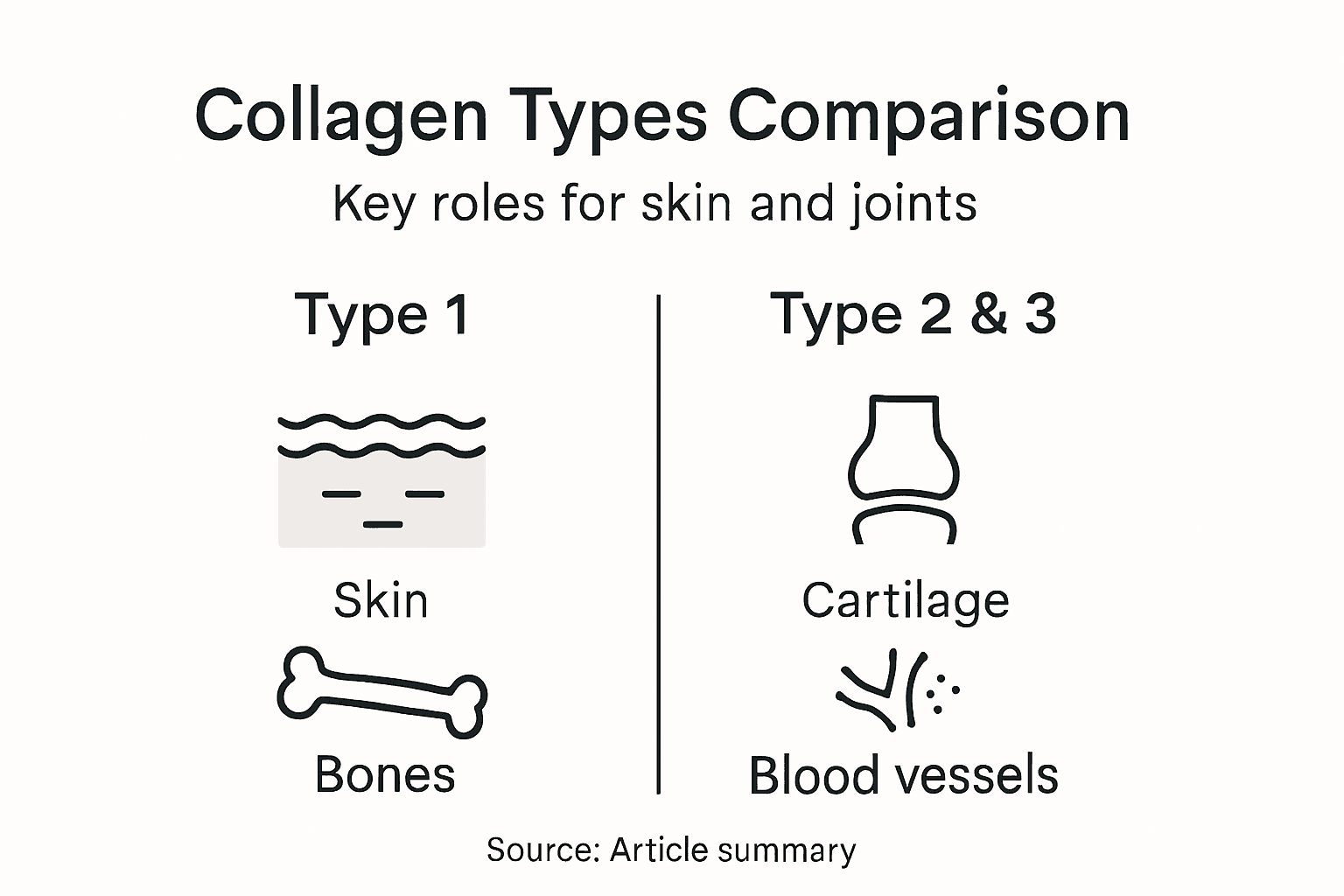
Here is a concise comparison of the three most common collagen types and their principal biological functions:
| Collagen Type | Main Tissue Location | Biological Role |
|---|---|---|
| Type I | Skin, bone, tendon, ligament | Provides tensile strength and structure |
| Type II | Cartilage | Cushions joints and supports cartilage |
| Type III | Organs, blood vessels | Enhances tissue flexibility and repair |
The clustering of collagen alpha-chains plays a crucial role in determining each type’s functional characteristics. By examining the molecular arrangement and genetic encoding, researchers can understand how specific collagen types contribute to tissue mechanics, elasticity, and overall structural integrity. Marine collagen benefits further demonstrate the intricate ways different collagen sources can provide targeted nutritional support for various physiological needs.
Pro tip: Consult with a nutritional specialist to determine which specific collagen type might best address your individual health and wellness goals.
Key Functions in Skin, Bones, and Joints
Type 1 collagen serves as a fundamental structural protein with critical roles across multiple bodily systems. Extracellular matrix composition reveals its exceptional ability to provide tensile strength through crosslinked triple helical fibers. These non-branched fibrils create a robust architectural framework that supports tissue integrity, wound healing, and biomechanical resilience.
In bone tissue, Type 1 collagen acts as a sophisticated scaffold for mineral deposition. The protein’s unique triple helical structure enables hydroxyapatite minerals to integrate seamlessly, creating a complex matrix that balances strength and flexibility. Bone structural mechanics demonstrate how collagen’s organic framework allows bones to withstand significant mechanical stress while maintaining essential elasticity.
For skin and joint health, Type 1 collagen performs equally remarkable functions. In dermal layers, it generates the extracellular matrix responsible for skin’s elasticity and resilience. Within joint structures, collagen forms critical components of tendons and ligaments, facilitating smooth movement and providing resistance against tensile forces. Amino acids in collagen further enhance these biological mechanisms, supporting comprehensive tissue maintenance and regeneration.

Pro tip: Consider incorporating protein-rich foods and targeted supplements to support your body’s natural collagen production and maintain optimal tissue health.
Sourcing and Supplement Forms in the UK
Collagen supplements in the United Kingdom offer diverse sourcing options, primarily derived from bovine and marine origins. Supplement market overview reveals three predominant forms: powders, capsules, and ready-to-drink beverages, each providing unique advantages for consumer convenience and absorption. Marine collagen stands out for its superior bioavailability, while bovine collagen remains a traditional and widely accepted source.
British consumers can select from multiple collagen supplement types, including hydrolysed collagen peptides, which are engineered to enhance digestibility and absorption. Collagen dietary sources encompass animal-derived products from beef, pork, and fish bones and skins, with processing techniques designed to maximise nutritional benefits. Interestingly, vegan alternatives now provide collagen precursors, offering options for those with dietary restrictions or ethical considerations.
The UK supplement market increasingly emphasises combination products that integrate collagen with complementary nutrients. Many formulations now include vitamin C to support natural collagen synthesis, enhancing the potential skin and joint health benefits. Collagen supplement buyer’s guide can help consumers navigate the expanding range of options, ensuring they select products aligned with their specific wellness goals.
The table below summarises popular collagen supplement forms available in the UK and their distinctive features:
| Supplement Form | Typical Source | Key Advantages |
|---|---|---|
| Powder | Bovine, marine | Easily mixed, versatile dosage |
| Capsule | Bovine, marine | Convenient, precise measurement |
| Ready-to-drink | Marine | Portable, quick absorption |
| Vegan precursor | Plant-based | Suitable for restricted diets |
Pro tip: Always verify supplement quality by checking independent certification and consulting healthcare professionals about your specific nutritional needs.
Effectiveness, Safety, and Common Risks
Clinical research on collagen supplementation reveals promising yet nuanced outcomes for joint and mobility health. A comprehensive systematic review indicates that type I collagen hydrolysate demonstrates significant potential in improving joint pain, clinical function, and physical mobility. However, researchers caution that benefits are most pronounced when combined with regular physical exercise, and bone health improvements remain less conclusive.
Safety profiles for collagen supplements are generally favourable, with minimal side effect risks reported across clinical studies. Most individuals tolerate these supplements well, experiencing at most mild digestive discomfort or occasional skin reactions. Importantly, current research suggests no significant drug interactions, making collagen supplements a relatively low-risk nutritional intervention for most healthy adults.
The effectiveness of collagen supplementation varies considerably across different health conditions. While some clinical trials show modest pain relief for osteoarthritis patients, results remain mixed for rheumatoid arthritis. Researchers emphasise the need for more rigorous, standardised studies to definitively establish optimal dosages and long-term benefits. Individual responses can differ significantly, highlighting the importance of personalised nutritional approaches and professional medical guidance.
Pro tip: Consult with a healthcare professional and maintain a consistent supplement routine to maximise potential collagen supplementation benefits.
Unlock the Full Potential of Type 1 Collagen for Your Skin and Joints
Struggling with maintaining youthful skin elasticity or supporting joint mobility is common as natural collagen production declines. This article highlights how Type 1 collagen builds tensile strength and structural integrity in skin, bones, and tendons but also points out the importance of targeted nutritional support to sustain these benefits. If you want to nourish your body with a high collagen content solution that delivers proven advantages for skin resilience, joint comfort, and bone health, KUDU Nutrition offers a scientifically formulated product designed for exactly that.
Discover our specially crafted 20g Collagen Protein Supplements that combine superior quality, excellent taste, and Informed Sport certification to ensure both purity and performance.

Take control of your health today with KUDU Nutrition | 20g Collagen Protein for Performance & Recovery. Our liquid collagen sachets provide easy, convenient absorption to enhance skin elasticity and joint comfort while supporting fitness recovery. Act now and experience the difference that transparent ingredients and high collagen potency can make in your daily routine by visiting https://kudunutrition.com/products/20g-collagen-protein-14-pack.
Frequently Asked Questions
What is Type 1 collagen and what role does it play in the body?
Type 1 collagen is the most abundant protein in the human body, comprising about 90% of total collagen. It serves as a crucial structural protein that maintains tissue integrity in skin, bones, tendons, ligaments, and more.
How does Type 1 collagen benefit skin health?
Type 1 collagen helps maintain skin elasticity and resilience by forming the extracellular matrix in dermal layers, which is essential for skin firmness and overall appearance.
What are the differences between Type 1, Type 2, and Type 3 collagen?
Type 1 collagen is primarily found in skin, bones, and tendons, providing tensile strength. Type 2 collagen is specialised for cartilage, cushioning joints, while Type 3 collagen is present in pliable tissues, enhancing flexibility in organs and blood vessels.
Are there any risks associated with taking collagen supplements?
Generally, collagen supplements are considered safe with minimal side effects, primarily mild digestive discomfort or skin reactions. However, individual responses can vary, and it is advisable to consult a healthcare professional before starting supplementation.