


TL;DR:
- Reading the Supplement Facts panel is essential for understanding a product’s actual contents and dosage.
- Proprietary blends obscure individual ingredient amounts, making informed choices more difficult.
- Trustworthy brands display third-party testing seals and transparent ingredient information for safety assurance.
Picking a supplement based on the front of the packet is one of the most common mistakes health-conscious consumers make. Bold claims like “advanced formula” or “maximum strength” are marketing language, not regulated terms, and they tell you nothing about what’s actually inside. The real information lives on the back, in the small print most people skim past. Whether you’re an athlete chasing recovery, someone focused on skin and joint health, or simply trying to get more from your nutritional routine, learning to read a supplement label properly can mean the difference between a product that genuinely supports your goals and one that quietly wastes your money.
Table of Contents
- Why supplement label literacy matters
- Essential parts of a supplement label
- How to decode ingredients and %DV values
- Quality, trust, and avoiding pitfalls: Verification tips
- The uncomfortable truth about supplement label reading
- Ready to choose supplements with confidence?
- Frequently asked questions
Key Takeaways
| Point | Details |
|---|---|
| Trust the Supplement Facts panel | This section holds the most accurate and actionable information about a supplement’s content. |
| Check ingredients and %DV | Reading the full ingredient list and %DV helps you avoid ineffective or unsafe nutritional choices. |
| Verify supplement quality | Look for third-party testing to confirm accuracy and purity but always consult your healthcare provider for personal safety. |
| Watch for proprietary blends | These can mask the precise amounts of ingredients, so interpret them with caution when comparing products. |
Why supplement label literacy matters
Most people spend more time reading the back of a cereal box than they do a supplement label. That’s a problem, because supplements can interact with medications, contain allergens, or deliver dosages that are wildly off-target for your needs. Without label literacy, you’re essentially making health decisions based on graphic design.
Some of the most common mistakes consumers make include:
- Choosing products based on front-label claims without checking the Supplement Facts panel
- Ignoring the serving size, which can make a product look far more potent than it actually is
- Overlooking the “other ingredients” section, which may contain allergens or unnecessary fillers
- Assuming a higher price means a better or safer product
- Confusing “natural” with “safe” or “effective”
The stakes aren’t trivial. A supplement taken at the wrong dose or with the wrong combination of other products can cause real harm. Conversely, a product with underwhelming ingredient concentrations simply won’t deliver the results you’re expecting. Supplement label transparency is something quality brands actively embrace, and it’s one of the fastest ways to tell a serious manufacturer from one that’s cutting corners.
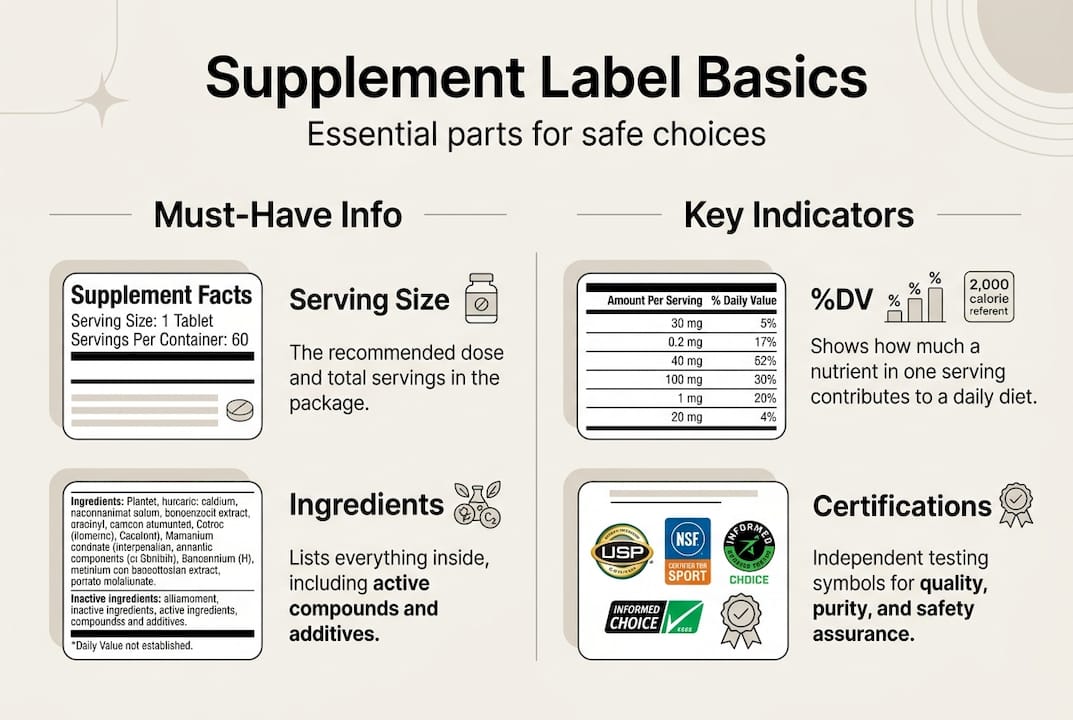
The Supplement Facts panel is the most reliable place to see what’s actually in a product, including serving size, dietary ingredients, and the percentage of your Daily Value for applicable nutrients. This is the single most important section on the label, and it’s regulated. Everything else, from taglines to imagery, is not.
“The Supplement Facts panel is the most reliable place to see what’s actually in the product, including serving size, dietary ingredients, and (for many nutrients) % Daily Value.” — National Center for Complementary and Integrative Health
Understanding this one panel alone puts you well ahead of the average supplement buyer. But there’s more to it than simply finding the panel. Knowing how to read it, and what the data means for your specific goals, is where real label literacy begins.
Essential parts of a supplement label
A supplement label contains several distinct sections, and each one serves a different purpose. Knowing where to look and what to trust will save you time and protect your health.
Here’s a breakdown of the core sections:
| Label section | What it contains | Regulated? |
|---|---|---|
| Supplement Facts panel | Serving size, ingredient amounts, %DV | Yes |
| Ingredients list | All ingredients in descending order by weight | Yes |
| Other ingredients | Fillers, binders, flavourings, allergens | Partially |
| Health claims | Structure/function statements | Partially |
| Front-label marketing | Brand claims, imagery, slogans | No |
| Warnings | Interactions, contraindications, allergens | Yes |
Work through the label in this order:
- Serving size — This is the first line in the Supplement Facts panel and arguably the most important. All the data that follows is based on one serving. If one serving is two capsules but you’re only taking one, every value on that label is effectively halved.
- Dietary ingredients and amounts — These are the active components and how much of each is present per serving. Check these against recommended or studied dosages for each ingredient.
- %DV — This shows how a serving contributes to your recommended daily intake. Not every ingredient will have a %DV listed; for those that don’t, you’ll see “Daily Value not established.”
- Other ingredients — Scan this for anything you’re sensitive to, including lactose, gluten, artificial sweeteners, or colourants.
- Health claims — Read these critically. Structure/function claims (e.g., “supports joint health”) are not the same as approved medical claims and don’t require proof of efficacy.
- Warnings — If you’re on medication or have a health condition, this section can flag critical contraindications.
Under 21 CFR 101.36, the labelling format specifies exactly what must appear and how ingredient information is presented, including rules that govern proprietary blends. This means the structure you’re reading is legally defined, which provides a baseline of reliability.
Proprietary blends deserve special mention. These are groups of ingredients listed together under a single name, with only the total blend weight disclosed, not the individual amounts. This makes it genuinely difficult to know if a key ingredient is present at an effective dose or merely a token quantity included for marketing purposes. It’s a legal practice, but one that rewards cautious, informed label reading.

Pro Tip: If a product relies heavily on proprietary blends without any transparency about individual ingredient amounts, consider whether the brand offers nutritional transparency in other ways, such as detailed FAQs, third-party test results, or direct communication. Transparency elsewhere on the brand’s platform is a good indicator of overall integrity. Also check our supplement safety tips for further guidance on what to look for before purchasing.
How to decode ingredients and %DV values
With the label structure clear, the next skill is interpretation. Ingredients and %DV values are the data points that tell you whether a supplement is actually going to do what it claims, but context is everything.
Understanding %DV
The %DV on Supplement Facts indicates how much of the daily recommended intake a serving provides. For some nutrients, a high %DV is desirable. For others, particularly fat-soluble vitamins like A, D, E, and K, exceeding 100% daily from supplements on top of dietary intake can carry risk over time.
| Nutrient type | High %DV means | Low %DV means |
|---|---|---|
| Water-soluble vitamins (e.g., Vitamin C, B12) | More daily support | Less contribution to daily needs |
| Fat-soluble vitamins (e.g., Vitamin D, A) | Potential accumulation risk | Safer for daily use alongside diet |
| Minerals (e.g., magnesium, zinc) | May approach or exceed safe upper limits | Generally safe range |
| Collagen peptides | No established %DV | Assess grams per serving instead |
The key takeaway: more is not automatically better, and %DV should always be assessed in the context of what you’re already consuming through food. If your diet is rich in red meat and fortified foods, adding a supplement high in iron or zinc without checking your existing intake is a gamble worth avoiding.
Decoding the ingredient list
Ingredients are listed in descending order by weight, so whatever appears first is present in the greatest quantity. If an ingredient you’re specifically seeking (collagen, for example) appears near the bottom of a long list, it’s likely present in a very small amount.
Follow these steps to assess the ingredient list effectively:
- Identify the primary active ingredient and check that it’s near the top of the list.
- Look up studied dosages for your key ingredient. If a supplement contains 500mg of a compound that research supports at 2,000mg, you’re not getting a therapeutic dose.
- Spot the fillers — Silica, magnesium stearate, and cellulose are common binders and fillers. They’re generally safe but worth recognising as non-active components.
- Check for hidden sugars or sweeteners — These often appear under names like sucrose, dextrose, maltodextrin, or acesulfame potassium.
- Flag allergens — Common ones include soy, dairy, gluten, shellfish, and nuts. These may appear in the “other ingredients” section rather than the main Supplement Facts panel.
For products using proprietary blends, regulations require that blend components are disclosed, but individual dosing within the blend does not need to be listed. This means you might see “Recovery Blend: L-glutamine, branched-chain amino acids, taurine (2,000mg)” without knowing how much of each is present. Use the supplement checklist steps to build a consistent framework for evaluating these situations.
Pro Tip: Cross-reference your supplement intake with both your diet and any advice from your GP or sports nutritionist. A label can tell you what’s in a product, but only you and your healthcare provider can determine whether it’s right for your situation. Don’t let collagen myths or misinformation distort how you interpret what you’re reading.
Quality, trust, and avoiding pitfalls: Verification tips
Reading the label is essential. Trusting what’s printed on it is a separate question. Label accuracy varies between manufacturers, and not every brand has the same commitment to quality control. This is where verification tools and informed scepticism become your best assets.
Third-party testing seals
Third-party verification marks are one of the clearest signals of quality available to consumers. Certifications like Informed Sport, NSF Certified for Sport, and USP Verified mean an independent organisation has tested the product for label accuracy, purity, and potency. For athletes subject to anti-doping rules, Informed Sport certification is especially critical because it also screens for banned substances.
What third-party seals can confirm:
- The product contains what the label says it contains
- The product meets purity standards for contaminants
- The potency matches what’s declared on the label
What they cannot guarantee: third-party verification marks help consumers assess label accuracy and quality, but they don’t prove the supplement will work for everyone’s specific goal. A certified product with accurate labelling can still be the wrong product for your individual needs.
“Certification confirms the product is what it says it is. It doesn’t confirm it’s right for you.” — A distinction worth keeping front of mind every time you see a quality seal.
Practical verification checklist before purchasing
- Does the brand display third-party certification prominently and link to test results?
- Is the Supplement Facts panel detailed and clear, with no reliance on vague proprietary blends?
- Are health claims balanced, avoiding language that implies medical treatment?
- Does the product label include clear warnings and allergen information?
- Can you find independent reviews or sports body endorsements?
Supplement interactions with medications are a real and underreported risk. Always cross-check for potential clashes, especially with blood thinners, thyroid medication, or antidepressants, and don’t assume a label claim implies safety for your specific circumstances. Use resources like the collagen supplement safety guide to understand what responsible brands disclose. For a deeper look at what certifications actually mean, the supplement quality certification breakdown is well worth reading.
Pro Tip: Keep a simple log of every supplement you take, including brand, product name, batch number, and when you started. If you experience any unexpected side effects, this record will be invaluable for pinpointing the cause and communicating clearly with a healthcare provider.
The uncomfortable truth about supplement label reading
Here is something most guides won’t tell you: label literacy, as important as it is, has a ceiling. Even if you read every panel perfectly, you are still working with information that the manufacturer chose to disclose. The regulations set a minimum standard, not a guarantee of full transparency. Proprietary blends exist. Ingredient quality varies between batches. And a supplement that worked brilliantly for your training partner may produce no noticeable effect for you at all.
The uncomfortable reality is that the supplement industry rewards confident marketing more than it rewards honest disclosure. A beautifully designed label with bold health claims and a certification seal can still represent a product with mediocre ingredient quality or dosages that fall short of what research would actually support. Learning to read labels gives you a significant advantage over the average consumer, but it doesn’t make you immune to this.
What actually protects you beyond label reading? A few things that most people overlook. First, your own experience and record-keeping. Tracking how you feel, how you perform, and how your body responds over a consistent period is more informative than any panel. Second, the brand’s overall reputation and willingness to engage transparently. Brands that actively publish test results, back their claims with peer-reviewed research, and maintain an honest dialogue with their customers are the ones worth returning to. Third, personalisation. No label can account for your individual biochemistry, diet, training load, or health history. Supplement quality matters enormously, but quality in context matters more.
The goal isn’t to become a label-reading perfectionist paralysed by every unrecognised ingredient. It’s to build enough fluency that you can spot red flags, identify genuine quality signals, and make decisions that align with your actual goals rather than a brand’s preferred narrative.
Ready to choose supplements with confidence?
Knowing how to read a supplement label puts you in a far stronger position as a consumer. The next step is finding brands that make that job easier, not harder.
At KUDU Nutrition, label clarity isn’t an afterthought. Our collagen protein gels are designed with full ingredient transparency, clear dosage information, and Informed Sport certification, giving athletes and health-conscious consumers exactly the reassurance they’re looking for. Our 20g Collagen Protein sachets deliver a high, clearly disclosed dose of collagen peptides per serving, with no ambiguity about what you’re getting or why. Whether your focus is fitness recovery, skin health, or long-term joint support, explore our full range of collagen and beauty supplements and see exactly what responsible labelling looks like in practice.
Frequently asked questions
What is the Supplement Facts panel and why is it important?
The Supplement Facts panel is the regulated section of a supplement label that details serving size, all dietary ingredients, and the % Daily Value, making it the most reliable indicator of what the product actually contains. It’s the first place to look before purchasing any supplement.
What does %DV mean on supplement labels?
%DV shows how much of the recommended daily amount of a nutrient one serving provides, helping you understand whether the supplement contributes a little or a significant portion of your daily nutritional needs.
How do proprietary blends affect label reading?
Proprietary blends group multiple ingredients under one total weight without disclosing individual amounts, making it difficult to assess whether each ingredient is present at an effective dose. Always treat products with extensive proprietary blends with additional scrutiny.
How can third-party testing help verify supplements?
Third-party testing confirms the supplement contains what it claims and meets purity standards, but it does not guarantee the product will produce the results you’re hoping for based on your individual needs and goals.
Should I consult my doctor before starting a new supplement?
Yes. NCCIH recommends discussing supplements with your healthcare provider before starting them, particularly if you take prescription medications, to avoid harmful interactions and ensure the supplement is appropriate for your circumstances.


