


Finding reliable ways to stay active and look your best can feel like a real challenge as everyday pressures build. Joint health affects not just your movement but also your quality of life, making it essential for British adults who value both agility and appearance. This guide explains what genuine joint health means, explores the science of collagen types, and highlights practical steps for maintaining strong, flexible joints with confidence.
Table of Contents
- What Joint Health Really Means
- Key Types of Joints and Collagen
- How Collagen Supports Joint Function
- Risks of Collagen Loss and Joint Decline
- Choosing Quality Collagen Supplements for UK
Key Takeaways
| Point | Details |
|---|---|
| Joint Health Importance | Joint health involves maintaining the interaction between bones, cartilage, ligaments, and muscles for mobility and pain-free movement. |
| Role of Collagen | Collagen is critical for joint integrity, providing strength and elasticity essential for proper joint function. |
| Consequences of Collagen Loss | Collagen depletion leads to cartilage degradation, increased pain, reduced mobility, and higher fracture risk. |
| Proactive Health Strategies | Regular low-impact exercise and a balanced diet rich in protein can significantly improve joint health and support collagen production. |
What Joint Health Really Means
Joint health represents a comprehensive system of mobility, strength, and pain-free movement within the human body. At its core, joint health involves maintaining the complex interaction between bones, cartilage, ligaments, and muscles that enable our daily movements and physical activities.
The National Joint Registry highlights that joint health extends far beyond simple mechanical function. It encompasses several critical elements:
- Structural integrity of joint components
- Pain management capabilities
- Range of motion preservation
- Muscle and ligament flexibility
- Long-term mobility potential
Clinical perspectives emphasise that joint health isn’t just about preventing deterioration, but actively supporting physiological resilience. Clinical guidelines recommend a proactive approach to maintaining joint function, particularly as we age or engage in high-impact activities.
Understanding joint health means recognising that our joints are dynamic, interconnected systems requiring consistent care and attention. They’re not static structures, but living tissues that respond to nutrition, movement, and lifestyle factors.
Pro tip: Regular low-impact exercises like swimming and walking can significantly support joint health and maintain muscular support around key joint areas.
Key Types of Joints and Collagen
Understanding human mobility requires deep insight into the intricate world of joint types and their fundamental protein building blocks. Collagen’s structural role is crucial in maintaining joint integrity and function across different anatomical structures.
The human body contains several distinct joint categories, each with unique characteristics and collagen compositions:
- Synovial Joints: Most mobile joint type, found in knees, hips, and shoulders
- Fibrous Joints: Immovable joints connecting skull bones
- Cartilaginous Joints: Slightly movable joints like spine vertebrae
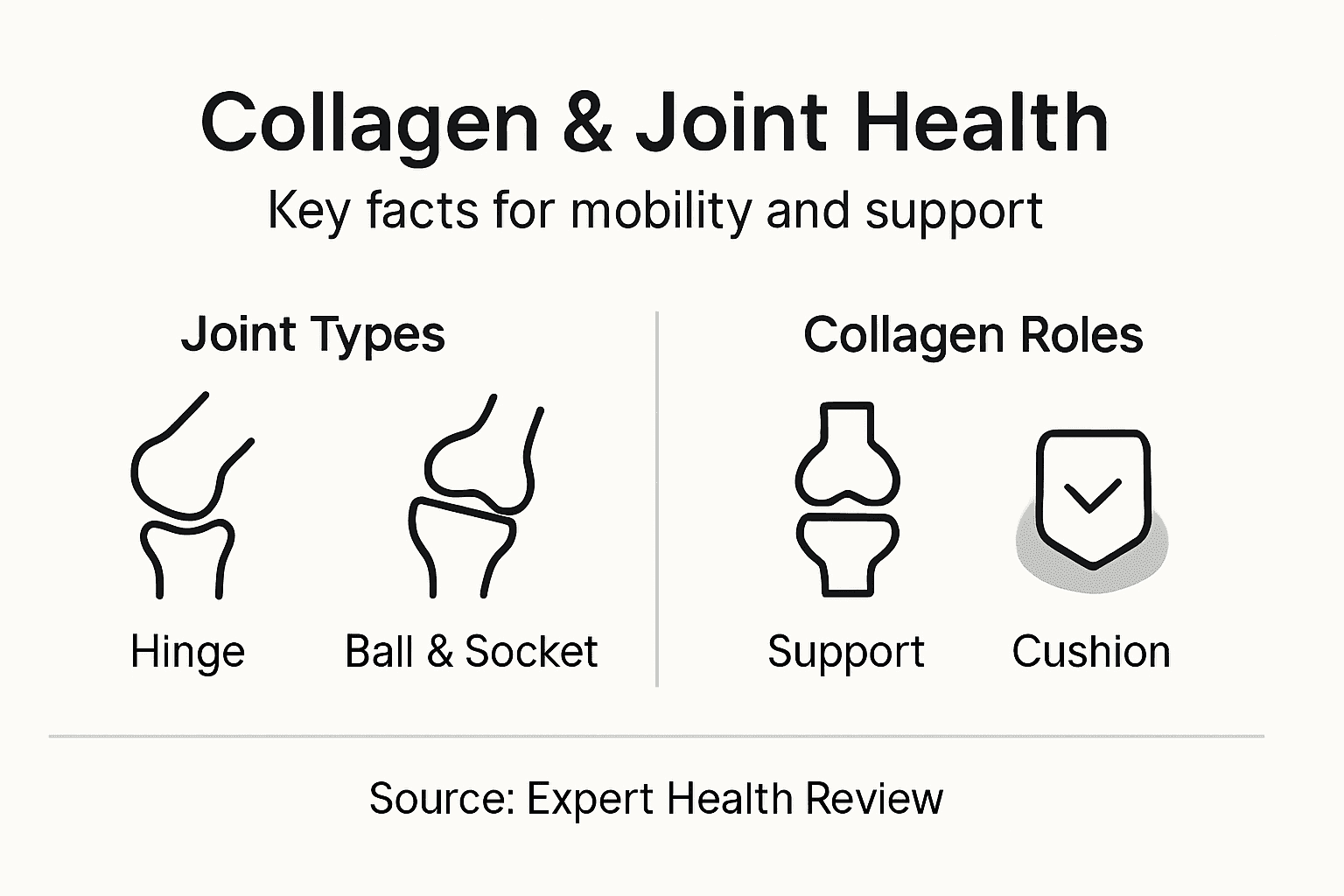
- Ball and Socket Joints: Allowing rotational movement in shoulders and hips
Collagen types play a pivotal role in joint mechanics. Bone and Joint research indicates that different collagen variants contribute uniquely to joint performance:
- Type I Collagen: Provides strength in tendons and ligaments
- Type II Collagen: Predominant in cartilage, offering elasticity
- Type III Collagen: Supports structural flexibility
These collagen variants work synergistically to ensure joint stability, load distribution, and smooth movement. Their complex interactions determine our body’s overall mobility and resilience.

Pro tip: Consume protein-rich foods and consider targeted collagen supplements to support your body’s natural joint maintenance and repair processes.
To clarify the unique roles of joint types and collagen, the following table compares their main features and function:
| Joint Type or Collagen | Location/Structure | Primary Function |
|---|---|---|
| Synovial Joint | Knees, hips, shoulders | Enables free movement |
| Fibrous Joint | Skull, forearm bones | Provides rigid support |
| Cartilaginous Joint | Spine, ribs | Allows limited flexibility |
| Ball and Socket Joint | Shoulder, hip | Permits wide rotational motion |
| Type I Collagen | Tendons, ligaments | Adds tensile strength |
| Type II Collagen | Cartilage | Gives elasticity and cushioning |
| Type III Collagen | Skin, muscles | Supports structural flexibility |
How Collagen Supports Joint Function
Joint function depends critically on collagen’s remarkable structural properties. Collagen’s molecular mechanisms play a fundamental role in maintaining joint health, providing essential support for movement and flexibility.
The primary ways collagen supports joint function include:
- Structural Reinforcement: Creating a robust framework for connective tissues
- Shock Absorption: Cushioning joints during physical activities
- Cartilage Maintenance: Supporting smooth joint movements
- Inflammation Reduction: Helping manage joint-related inflammatory responses
Bone and Joint research demonstrates that collagen’s complex molecular interactions are crucial for joint health. The protein’s unique composition ensures:
- Tensile strength in joint tissues
- Enhanced elasticity
- Effective load distribution
- Improved tissue repair mechanisms
Critical to understanding joint function is recognising collagen’s dynamic nature. It’s not just a static protein, but an active participant in maintaining joint mobility, constantly responding to physical demands and supporting our body’s movement capabilities.
Pro tip: Combine collagen supplementation with regular low-impact exercise to maximise joint health and support natural collagen production.
Risks of Collagen Loss and Joint Decline
Collagen depletion represents a significant threat to joint health and overall mobility. Joint health research reveals that progressive collagen loss can trigger substantial physiological challenges across different age groups.
The primary risks associated with collagen loss include:
- Cartilage Degradation: Weakening of protective joint cushioning
- Increased Joint Pain: Reduced shock absorption capabilities
- Reduced Mobility: Stiffening of connective tissues
- Higher Fracture Risk: Compromised structural integrity
- Inflammation Progression: Enhanced susceptibility to joint diseases
National Osteoporosis Guidelines highlight several critical mechanisms driving joint decline:
- Natural ageing processes
- Hormonal changes
- Chronic inflammatory conditions
- Nutritional deficiencies
- Genetic predispositions
Understanding these risks empowers individuals to take proactive measures in maintaining joint health. Early intervention and targeted nutritional support can significantly mitigate the potential long-term consequences of collagen loss.
Pro tip: Implement a comprehensive strategy including targeted nutrition, regular low-impact exercise, and periodic health assessments to counteract natural collagen degradation.
The following summary table highlights lifestyle actions with their impact on long-term joint health:
| Action | Impact on Joints | Ideal Frequency |
|---|---|---|
| Low-impact exercise | Maintains flexibility and strength | 3-5 times per week |
| High-protein nutrition | Supports collagen synthesis | Daily meal planning |
| Periodic health checks | Early identification of issues | Annually |
| Supplement assessment | Ensures proper product choice | At purchase renewal |
| Hydration management | Promotes tissue lubrication | Throughout the day |
Choosing Quality Collagen Supplements for UK
Collagen supplementation requires careful consideration to ensure maximum effectiveness and value. Consumer supplement research indicates that selecting the right product involves understanding several critical factors.
Key considerations when choosing collagen supplements include:
- Source Quality: Marine or bovine collagen origins
- Absorption Potential: Hydrolysed collagen forms preferred
- Additional Nutrients: Presence of vitamin C and supporting cofactors
- Third-Party Testing: Independent verification of product claims
- Purity Standards: Minimal additives or unnecessary fillers
Pharmacy experts recommend examining specific collagen types matching individual health goals:
- Type I: Skin and connective tissue support
- Type II: Joint health and cartilage maintenance
- Combination Formulas: Comprehensive wellness approach
Understanding supplement labels, checking ingredient transparency, and verifying scientific formulation can significantly impact the potential benefits of collagen supplementation. Consumers should prioritise products with clear sourcing information and proven bioavailability.
Pro tip: Consult healthcare professionals and compare multiple supplement reviews to make an informed collagen product selection tailored to your specific health requirements.
Strengthen Your Joints with Targeted Collagen Support
The article highlights a critical challenge: collagen loss deeply impacts joint health, leading to pain, reduced mobility, and cartilage degradation. If you want to protect your joints and maintain natural resilience for everyday movement and fitness, focusing on high-quality collagen intake is essential. KUDU Nutrition’s collagen protein sachets deliver potent Type I and II collagen designed to reinforce connective tissues and support joint function as explained in the article.

Experience the difference of superior collagen sourced and certified for purity and efficacy. Act now to support your joints, reduce inflammation, and enhance mobility with daily collagen supplementation backed by nutritional transparency and scientific insight. Visit KUDU Nutrition’s collagen protein 14 pack to start your journey to stronger, more flexible joints today. Don’t wait for joint decline to slow you down – make collagen maintenance part of your health routine.
Frequently Asked Questions
What is joint health and why is it important?
Joint health refers to the functional and structural integrity of joints, which is crucial for mobility, strength, and pain-free movement. It involves managing pain, preserving range of motion, and maintaining muscle and ligament flexibility.
How does collagen support joint health?
Collagen supports joint health by providing structural reinforcement, cushioning during physical activities, maintaining cartilage, and reducing inflammation. Its molecular properties ensure joint stability and enhance elasticity.
What are the risks associated with collagen loss in joints?
Collagen loss can lead to cartilage degradation, increased joint pain, reduced mobility, a higher risk of fractures, and worsening inflammation. Factors such as ageing and nutritional deficiencies can exacerbate these risks.
What should I consider when choosing collagen supplements for joint health?
When choosing collagen supplements, consider the source quality, absorption potential (preferably hydrolysed forms), the presence of additional nutrients like vitamin C, third-party testing for safety, and the purity of the product with minimal additives.