


TL;DR:
- Performance nutrition involves fueling the body with precise nutrients at specific times to enhance athletic performance and recovery. It emphasizes individualized, periodized plans that prioritize carbohydrate and protein intake aligned with training demands, avoiding general diet trends unsuitable for athletes. Proper application of the 4Ps and 4Rs frameworks optimizes long-term adaptation, prevents energy deficiency, and supports sustained performance.
Performance nutrition is the practice of fuelling the body with specific nutrients, at precise times, to improve athletic output and accelerate recovery. It goes well beyond eating healthily. Where general nutrition aims to maintain energy and long-term wellbeing, performance nutrition, known formally as sports nutrition, is built around training demands, individual physiology, and competition goals. The frameworks guiding this field, particularly the 4Ps and 4Rs, give athletes a structured method to plan what they eat, when they eat it, and why. If you train with purpose, this discipline is worth understanding in full.
What is performance nutrition and how does it differ from everyday eating?
Performance nutrition is not simply a stricter version of a healthy diet. The goals are fundamentally different. Everyday nutrition targets energy stability, disease prevention, and general health. Performance nutrition targets fuel for training, recovery from effort, and physiological adaptation over time. The distinction matters because applying the wrong approach to the wrong context produces poor results.

The most telling difference lies in carbohydrate and protein priorities. Recreational eaters are often advised to moderate carbohydrates. Athletes in heavy training phases need them in abundance to sustain glycogen stores and delay fatigue. Protein requirements also diverge sharply. Sports nutrition research shows approximately 2.2g of protein per kilogram of body weight per day is needed to support muscle repair and growth in resistance-trained athletes. That figure is considerably higher than general population guidelines.
Knowing when performance nutrition principles apply is equally important. Training volume and fatigue determine whether you need a performance approach, not simply whether you identify as an athlete. If you are training four to six or more hours per week at meaningful intensity, your nutritional needs have shifted beyond what a standard healthy diet addresses.
Common mistakes arise when people import diet trends into a performance context. Low-carbohydrate approaches designed for metabolic health can actively undermine training quality when applied to high-volume sport. Equally, athletes sometimes under-eat protein because general wellness messaging underplays its role. Understanding sports nutrition explained as a distinct discipline prevents these category errors.
- High training volume requires higher carbohydrate and protein intake than general guidelines suggest
- Nutrient timing matters in performance contexts in ways it rarely does for general health
- Diet trends designed for sedentary or low-activity populations often conflict with athletic needs
- Fatigue and recovery quality are the clearest signals that your nutrition strategy needs adjusting
Pro Tip: If your training sessions are leaving you consistently flat or your recovery is slow, review your carbohydrate intake before cutting calories. Under-fuelling is far more common among serious athletes than over-fuelling.
What are the core components of performance nutrition?
The 4Ps framework organises performance nutrition into four practical principles: Personalise, Periodise, Prefuel, and Prepare. Each addresses a distinct phase or dimension of athletic nutrition.
-
Personalise. Nutrition plans built on individual phenotype and genotype outperform generic templates. Sweat rate, gut tolerance, food preferences, and training history all shape what works. A marathon runner with high sweat sodium losses needs a different electrolyte strategy than a cyclist with low sweat rates. Personalisation removes the guesswork that generic plans leave behind.
-
Periodise. Nutrient intake should shift across training cycles. During high-volume blocks, carbohydrate intake rises. During recovery or deload weeks, it drops. Periodised nutrition targets long-term adaptations including muscle growth, body composition shifts, and competition readiness. It is now standard practice among elite athletes and their support teams.
-
Prefuel. Carbohydrate loading and energy preparation before exercise directly influence output. Arriving at a training session or competition with depleted glycogen stores is the nutritional equivalent of starting a race with a flat tyre. Prefuelling strategies vary by sport duration and intensity, but the principle is consistent: arrive fuelled.
-
Prepare. Hydration and supplement timing before and during events protect performance. Hydration guidelines recommend consuming around 16oz of water two to three hours before exercise, then approximately 4oz every 15 to 20 minutes during activity. Supplements including caffeine, creatine, and electrolytes each have evidence-based roles within this phase.
“Structured frameworks guide nutritional planning before, during, and after exercise. Without them, athletes are making educated guesses at best.”
Pro Tip: Caffeine consumed 45 to 60 minutes before training is one of the most consistently supported ergogenic aids in sports science. A dose of 3 to 6mg per kilogram of body weight is the evidence-based range for most athletes.
How does nutrition support recovery after training?
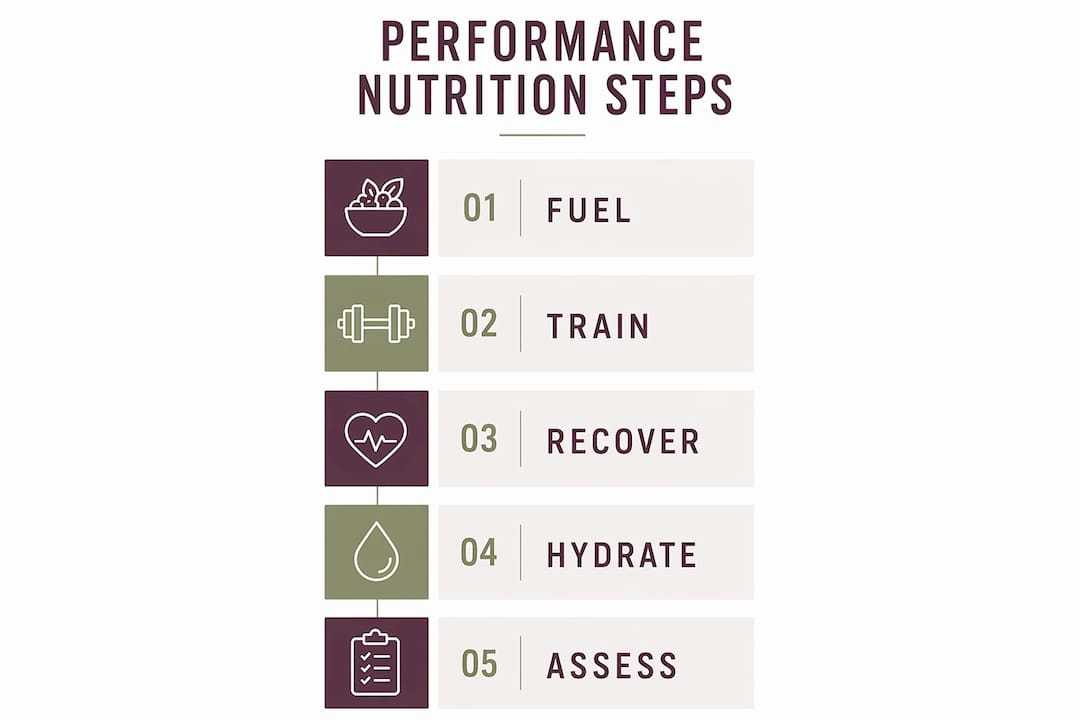
Recovery nutrition is where performance gains are either locked in or lost. The 4Rs framework, covering Rehydration, Refuel, Repair, and Recuperate, provides a clear structure for the post-exercise window.
Post-exercise recovery requires replacing at least 150% of body mass lost in fluids, combined with electrolytes to restore sodium and potassium balance. This means if you lose 1kg during a session, you need to consume 1.5 litres of fluid in the hours that follow. Thirst alone is not a reliable guide.
Carbohydrate restoration is equally time-sensitive. Consuming 1.2g of carbohydrate per kilogram of body weight per hour for up to four hours post-exercise restores glycogen at the fastest physiologically possible rate. For a 75kg athlete, that is 90g of carbohydrate per hour. Delaying this intake by even two hours meaningfully slows glycogen resynthesis.
Protein’s role in the repair phase is well established. Distributing roughly 2.2g per kilogram of body weight across the day, with doses concentrated around training, supports muscle protein synthesis. Pre-sleep protein intake, particularly casein, extends this repair window through the night. For a deeper look at structuring this, the recovery nutrition strategies guide from Kudunutrition covers the evidence in practical detail.
| Recovery component | Target intake |
|---|---|
| Fluid replacement | 150% of body mass lost, with electrolytes |
| Carbohydrate restoration | 1.2g per kg body weight per hour, up to 4 hours |
| Protein for muscle repair | ~2.2g per kg body weight per day, timed around activity |
| Supplement support | Creatine, tart cherry, omega-3 have evidence-based recovery roles |
- Rehydrate with electrolytes, not plain water alone, after intense sessions
- Prioritise carbohydrate intake within 30 minutes of finishing exercise
- Spread protein across four to five meals rather than concentrating it in one sitting
- Consider evidence-based supplements like creatine and omega-3 as additions to, not replacements for, whole food nutrition
What practical pitfalls should athletes avoid?
The importance of performance nutrition is clearest when things go wrong. The most serious consequence of chronic under-fuelling is Relative Energy Deficiency in Sport, known as RED-S. RED-S occurs when calorie intake consistently fails to meet the combined demands of metabolism and exercise. It impairs bone density, hormonal function, immune response, and ultimately performance itself. It affects both male and female athletes across all sports.
Nutrient timing errors are the next most common problem. Eating the right foods at the wrong times, such as consuming the bulk of daily carbohydrates in the evening rather than around training, reduces their effectiveness. Fibre intake also requires management during high training loads. High-fibre meals close to training sessions can cause gastrointestinal distress, particularly in endurance athletes.
Individual variability means no single plan works for everyone. A sports dietitian removes the guesswork by building a plan around your specific training cycle, body composition goals, and food preferences. Partnering with a qualified sports dietitian is the most direct route to a nutrition strategy that actually fits your life and your sport.
- Avoid treating performance nutrition as a weight-loss tool during heavy training blocks
- Do not restrict carbohydrates during high-intensity or high-volume training phases
- Moderate fibre intake in the two to three hours before training to reduce gut issues
- Seek professional guidance before making significant dietary changes around competition
Pro Tip: Track your energy and mood across a training week before consulting a dietitian. Patterns of afternoon fatigue, poor sleep, or slow recovery are nutritional signals, not just training ones.
How do personalisation and periodisation drive long-term gains?
Personalised nutrition, built on individual phenotype, genotype, sweat rate, and food preferences, consistently outperforms generic dietary advice for athletic outcomes. Two athletes of identical weight and training volume can have meaningfully different carbohydrate needs based on metabolic efficiency and gut microbiome composition. Generic plans ignore this. Personalised plans exploit it.
Periodisation operates across three time scales. Microcycles cover weekly training variation, adjusting daily carbohydrate intake to match session intensity. Mesocycles span four to eight week training blocks, shifting macronutrient ratios to target specific adaptations such as fat oxidation or glycogen capacity. Macrocycles align nutrition with the full competitive season, peaking fuel availability around key events and allowing strategic recovery phases in between.
| Periodisation level | Timeframe | Nutrition focus |
|---|---|---|
| Microcycle | Weekly | Match daily carbohydrate to session intensity |
| Mesocycle | 4 to 8 weeks | Shift macronutrient ratios for targeted adaptation |
| Macrocycle | Full season | Peak fuelling around competition, strategic recovery phases |
Periodised nutrition as a modern approach is now standard among elite programmes because it produces measurably better outcomes than static dietary plans. Injury risk reduces when energy availability is matched to training load. Body composition shifts are more sustainable when nutrition is phased rather than abruptly changed. Collaboration between athletes, coaches, and nutritionists is what makes this level of precision achievable in practice.
Pro Tip: Use a simple training log that includes energy levels and hunger ratings alongside session data. After four weeks, patterns emerge that make periodisation decisions far more precise than any generic template can offer.
Key takeaways
Performance nutrition works because it aligns specific nutrients, precise timing, and individual physiology with the exact demands of training and competition, producing outcomes that general healthy eating cannot replicate.
| Point | Details |
|---|---|
| Performance vs everyday nutrition | Performance nutrition targets fuel, recovery, and adaptation. General nutrition targets long-term health and energy stability. |
| The 4Ps framework | Personalise, Periodise, Prefuel, and Prepare structure every phase of athletic nutrition planning. |
| Recovery is time-sensitive | Replace 150% of fluid lost and consume 1.2g carbohydrate per kg per hour for up to four hours post-exercise. |
| Protein distribution matters | Approximately 2.2g per kg per day, spread across meals and timed around training, maximises muscle repair. |
| Under-fuelling carries serious risk | RED-S is a clinically recognised consequence of chronic energy deficiency in athletes and affects health across multiple systems. |
Why performance nutrition changed how I think about training
Sam here. I spent years treating nutrition as an afterthought, something to sort out after the training plan was locked in. That was the wrong order entirely. The training stimulus is only half the equation. Nutrition is what determines whether your body actually adapts to it.
The most common misconception I encounter is that performance nutrition is about eating more. It is not. It is about eating the right things at the right times for the specific demands you are placing on your body. A rest day and a two-hour threshold session require completely different nutritional responses. Treating them identically is leaving adaptation on the table.
What changed my perspective was understanding periodisation not as a competitive athlete’s luxury, but as a logical response to how the body works. Your muscles do not care about your diet philosophy. They respond to energy availability, protein timing, and hydration status. When you align nutrition with those biological realities, the results are not subtle. Recovery improves within days. Training quality follows within weeks.
The other shift was accepting that nutrition supports long-term health as much as it supports performance. RED-S, chronic fatigue, and stress fractures are not just bad luck. They are often the downstream consequences of ignoring nutritional signals for too long. Getting this right protects your ability to keep training for years, not just to perform well this season.
— Sam
Support your performance nutrition with Kudunutrition

Recovery is where performance is built, and collagen protein is one of the most underused tools in an athlete’s nutrition plan. Kudunutrition’s 20g collagen protein supplements deliver a high-dose, Informed Sport certified collagen protein in a convenient liquid sachet format, designed to fit directly into your post-training recovery window. Each sachet provides 20g of collagen protein to support muscle repair, joint health, and connective tissue recovery. For athletes who want to combine collagen with creatine, the collagen protein and creatine sachets offer both in a single daily format. Clean ingredients, transparent nutritional data, and a taste that makes compliance easy.
FAQ
What is performance nutrition in simple terms?
Performance nutrition is the practice of tailoring food intake, nutrient timing, and supplementation to support athletic training, recovery, and competition. It differs from general healthy eating by targeting specific physiological demands rather than broad wellness goals.
How do I know if I need a performance nutrition approach?
If you are training four to six or more hours per week at meaningful intensity, standard dietary guidelines are unlikely to meet your recovery and adaptation needs. Consistent fatigue, slow recovery, or declining training quality are the clearest signs that a performance-focused approach is warranted.
What should I eat immediately after exercise?
Post-exercise, consume carbohydrates at 1.2g per kilogram of body weight per hour for up to four hours, alongside protein to support muscle repair. Rehydrate with fluids containing electrolytes, replacing at least 150% of the body mass lost during the session.
Are supplements necessary for performance nutrition?
Supplements including creatine, caffeine, and omega-3 have strong evidence behind them, but they do not replace a well-structured diet. They are additions that address specific gaps or provide targeted benefits within an already solid nutritional foundation.
What is the biggest mistake athletes make with nutrition?
Under-fuelling during high training loads is the most common and most damaging error. Chronic energy deficiency leads to RED-S, which impairs bone health, hormonal function, and performance. Matching calorie and carbohydrate intake to training demands is the single most important habit to establish.