


TL;DR:
- Non-GMO collagen from grass-fed animals offers improved nutritional profiles and fewer inflammatory residues.
- Verification through third-party testing and certifications like AGA ensures product quality and transparency.
- Daily, well-sourced collagen supplementation supports skin, joint, and recovery benefits effectively.
Not all collagen supplements are created equal, and if you care about what goes into your body, the source matters as much as the dose. Many health-conscious shoppers assume that any collagen product will deliver the same skin, joint, and recovery results, but the origin of that collagen, whether the animals were grass-fed, raised without GMO feed, and processed under rigorous standards, can shape both the quality and the cleanliness of what you ultimately consume. This guide walks through the science, the sourcing realities, and the practical steps to choosing a non-GMO collagen that genuinely supports your goals.
Table of Contents
- What makes non-GMO collagen different?
- Health and beauty benefits: What does the science say?
- GMO feed, contaminants and common misconceptions
- How to choose a quality non-GMO collagen supplement
- Why the non-GMO collagen debate deserves nuance
- Ready to try non-GMO collagen?
- Frequently asked questions
Key Takeaways
| Point | Details |
|---|---|
| Non-GMO collagen basics | Non-GMO collagen is sourced to avoid genetically modified feed, promising cleaner nutrition and fewer theoretical risks. |
| Proven health gains | Collagen is evidence-backed for improving skin, joint health, and recovery, with nutrient density maximised through higher sourcing standards. |
| Risks and labels explained | Not all non-GMO claims are regulated; look for third-party certification and transparent testing for real assurance. |
| Smart supplement selection | A practical label and certification checklist helps you choose safe, effective collagen for health or beauty results. |
What makes non-GMO collagen different?
Collagen is a structural protein found in animal connective tissue, skin, and bones. When you take a collagen supplement, you are consuming hydrolysed collagen peptides derived from those animal sources. The term non-GMO refers to products sourced from animals that were not fed genetically modified organisms. This distinction sits at the heart of what separates premium collagen from the standard shelf option.
Understanding collagen supplement terminology helps here. Non-GMO and grass-fed are frequently paired together because they reflect the same underlying commitment: animals raised on natural pasture diets, free from synthetic feed modifications. Grass-fed cattle, for instance, produce hides and connective tissue with a notably different nutritional profile compared to grain-fed, conventionally farmed animals.
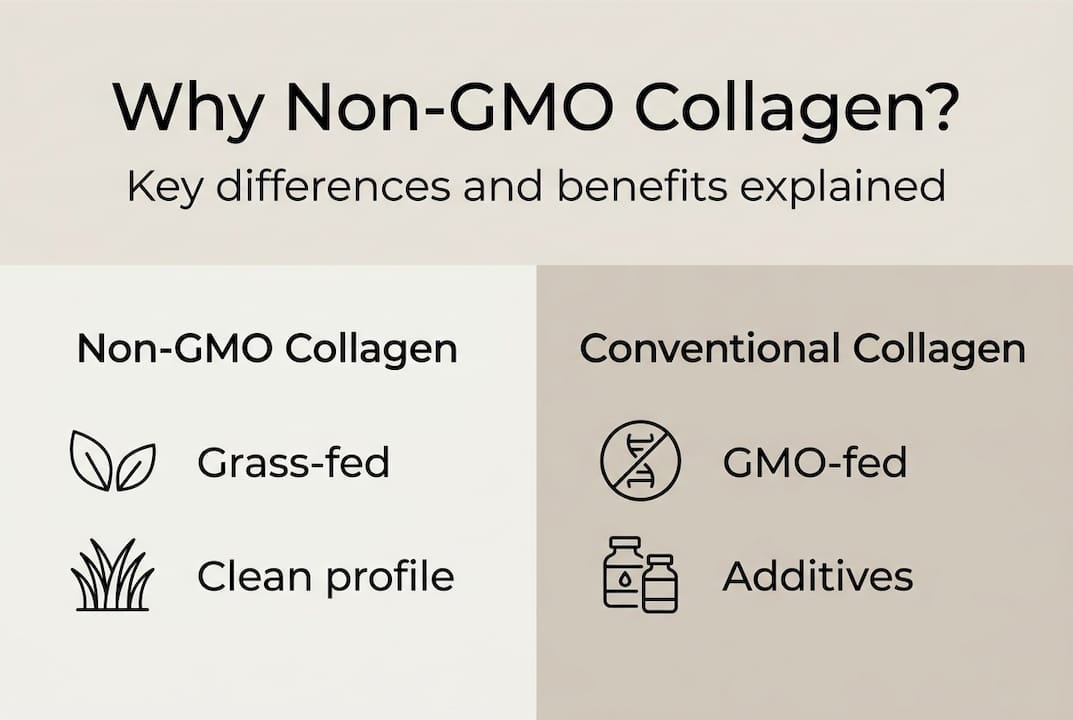
Research shows that grass-fed collagen offers a better omega-3 to omega-6 ratio, higher conjugated linoleic acid (CLA) content, a cleaner amino acid profile, and a lower overall inflammatory burden, alongside fewer residues from antibiotics or hormones. These differences are not trivial for someone prioritising genuine wellness over convenience.
Here is a quick comparison to make the distinction concrete:
| Feature | Non-GMO / grass-fed collagen | Conventional collagen |
|---|---|---|
| Feed source | Natural pasture, no GMO crops | GMO grain-based feed |
| Antibiotic use | Typically absent | Commonly used |
| Omega-3 content | Higher | Lower |
| Amino acid profile | Cleaner, more complete | Variable |
| Third-party testing | More common | Less consistent |
Where things get complicated is regulation. There is currently no legally enforced standard for non-GMO labelling on collagen products in the UK or EU. This means that marketing claims can outpace the actual sourcing reality.
Key things to look for when assessing a product:
- American Grassfed Association (AGA) certification on the source material
- Informed Sport or equivalent third-party testing certification
- Full transparency on the country of origin and animal species used
- Clear hydrolysis and processing documentation
Pro Tip: Do not take a brand’s word for grass-fed or non-GMO status. Look for AGA certification or a named third-party testing body on the label. If neither is present, treat the claim with scepticism.
Health and beauty benefits: What does the science say?
Having covered the sourcing, the next concern is results: does non-GMO status actually influence health and beauty outcomes?
The short answer is that collagen supplementation, regardless of source, is backed by a growing body of clinical evidence. Studies consistently show improvements in skin elasticity and hydration alongside measurable reductions in joint pain, typically within eight to twelve weeks of consistent daily use. The source quality then adds a secondary layer of benefit by improving bioavailability and reducing the risk of side effects such as gastrointestinal discomfort.
For a clearer picture of the timeline, here is what the research generally shows:
| Benefit | Typical onset | Study duration |
|---|---|---|
| Skin hydration | 4 to 6 weeks | 8 to 12 weeks |
| Skin elasticity | 6 to 8 weeks | 12 weeks |
| Joint pain reduction | 8 to 12 weeks | 12 to 24 weeks |
| Fitness recovery | 2 to 4 weeks | 8 weeks |
For everyday beauty enthusiasts, the skin benefits are particularly compelling. Collagen peptides support the dermis by stimulating fibroblast activity, which is the process your skin uses to rebuild its own collagen matrix. For fitness-focused users, the amino acids glycine and proline in collagen are critical for tendon and ligament repair after training.

The collagen for skin and joints evidence base is solid. Where non-GMO sourcing adds value is in what it removes: potential pesticide residues, synthetic hormone traces, and inflammatory inputs that could subtly undermine the results you are working towards. Grass-fed collagen benefits extend beyond marketing, particularly for those who are sensitive to additives or managing inflammatory conditions.
How non-GMO collagen supports your goals:
- Cleaner amino acid delivery supports faster skin cell turnover
- Reduced inflammatory residues may improve joint recovery speed
- Better omega-3 content from grass-fed sources complements anti-inflammatory diets
- Lower risk of digestive side effects makes daily supplementation more sustainable
- Higher bioavailability means more of each dose reaches the target tissue
For a broader look at the collagen supplement evidence, it is worth noting that the most consistent results come from hydrolysed collagen taken daily, rather than sporadic high doses.
GMO feed, contaminants and common misconceptions
The science is promising, but misconceptions about GMOs and the purification process continue to circulate. It is worth separating what is established from what remains theoretical.
The concern about GMO feed originates from a reasonable question: if an animal eats genetically modified grain, does that genetic material or associated pesticide residue transfer into its collagen? The honest answer is that rigorous processing removes most contaminants, and there is currently no strong evidence that GMO feed meaningfully alters the final collagen product. Hydrolysis, the process that breaks collagen into absorbable peptides, is aggressive enough to eliminate most feed-derived impurities.
That said, the concern about glyphosate, a herbicide widely used on GMO crops, is not entirely without basis. Glyphosate health risks have been hypothesised in broader health research, though no collagen-specific data currently confirms a direct pathway from GMO feed to harmful residue levels in the final supplement.
“There is no legal requirement for non-GMO certification on collagen products, and grass-fed claims remain largely unregulated. Rigorous hydrolysis and purification during manufacturing removes the majority of contaminants, meaning the sourcing narrative is partly about precaution and partly about broader nutritional quality rather than confirmed toxicological risk.”
For those assessing collagen quality certification, the practical takeaway is this:
- GMO feed does not automatically make collagen dangerous
- Hydrolysis significantly reduces contaminant transfer
- Grass-fed sourcing improves nutritional quality beyond just GMO avoidance
- Third-party testing is the most reliable indicator of actual product purity
- Vague label claims are not a substitute for documented certification
The distinction between source and process is important. A well-processed collagen from a conventional source may outperform a poorly processed product from a grass-fed source. Both factors matter, and neither should be evaluated in isolation.
How to choose a quality non-GMO collagen supplement
Understanding the theory and evidence is helpful, but selecting the right supplement amidst marketing noise requires clear criteria. Here is an actionable framework.
Start with the label, but do not stop there. Marketing language like natural, premium, or clean carries no regulatory weight. What you need to see is specific, verifiable information about sourcing and testing.
- Check the source animal and region. Bovine collagen from grass-fed, pasture-raised cattle in low-pesticide regions is generally the gold standard. Marine collagen from wild-caught fish is another strong option.
- Look for named certifications. Informed Sport, NSF Certified for Sport, or AGA certification on the source material are meaningful markers of quality and safety.
- Verify hydrolysis method. Enzymatic hydrolysis produces more bioavailable peptides than acid hydrolysis. Look for brands that disclose this.
- Assess the amino acid profile. A quality product will list glycine, proline, and hydroxyproline prominently. These are the structural amino acids that drive collagen’s core benefits.
- Demand transparency on testing. A reputable brand will share batch-level testing results, not just a general quality claim.
For those focused on collagen for wellbeing, aligning your supplement choice with your specific goals matters. Skin-focused users benefit most from Type I collagen peptides, while joint and recovery users often see better results from Type II or a multi-type blend. Understanding the amino acids in collagen and how they map to your goals removes the guesswork from the buying decision.
For health-conscious users, non-GMO grass-fed collagen minimises theoretical risks from pesticide exposure while maximising nutrient density. Prioritising third-party tested, AGA-certified products is the most defensible approach available right now.
Pro Tip: Ignore any grass-fed claim that is not backed by a named certification body. Ask the brand directly for their testing documentation. A brand confident in its sourcing will share it without hesitation.
Why the non-GMO collagen debate deserves nuance
Here is an honest perspective: the non-GMO collagen conversation is often framed as a binary, either it is meaningfully better or the whole thing is marketing noise. Neither extreme is accurate, and both miss the point.
Choosing a non-GMO, grass-fed collagen is not purely about avoiding a confirmed danger. It is about applying a reasonable precautionary principle when the evidence is still developing. It is also about the nutritional upside, the cleaner amino acid profile, the better omega-3 content, the reduced inflammatory load. These are real advantages, even if they are not dramatic.
There is also a psychological dimension worth acknowledging. When you make intentional, well-researched choices about your supplements, you are more likely to build consistent habits around them. That consistency, taking your collagen daily, pairing it with a balanced diet and active lifestyle, is what actually drives results. Understanding collagen digestion and how your body processes these peptides reinforces why daily, sustained use matters far more than any single sourcing decision.
The risk is becoming so focused on label perfection that you overlook the bigger picture. A high-quality, third-party tested collagen taken consistently will outperform the theoretically perfect product taken sporadically. Supplements are one part of a broader self-care routine, not a shortcut to results on their own.
Ready to try non-GMO collagen?
If you are ready to put these insights into action, starting with a trusted, third-party tested non-GMO collagen is the most straightforward next step. At KUDU Nutrition, our liquid collagen protein sachets are Informed Sport certified, sourced with full transparency, and designed to fit seamlessly into your daily routine.
Explore our 20g collagen protein gels for a convenient, high-dose daily option, or start with our collagen protein trial pack to experience the quality before committing. If you prefer a larger supply, the 20g collagen protein 14 pack offers excellent value. Every product is built around the same principle: clean sourcing, verified quality, and results you can feel.
Frequently asked questions
Is non-GMO collagen really better for health than regular collagen?
Non-GMO collagen offers a higher nutritional quality and cleaner amino acid profile, but rigorous clinical studies do not currently show dramatic differences in health outcomes for most users compared to well-processed conventional collagen.
Are all collagen supplements labelled ‘non-GMO’ trustworthy?
No. There is no legal certification required for non-GMO labelling on collagen, and grass-fed claims remain unregulated, so always verify through named third-party testing bodies before purchasing.
Does GMO animal feed end up in the final collagen supplement?
Current evidence suggests that hydrolysis and purification during manufacturing removes the vast majority of feed-derived impurities, making the final product virtually free from GMO material.
Are there specific side effects tied to GMO content in collagen?
No direct evidence links GMO content in collagen to unique side effects, but higher-quality sourcing may reduce general digestive discomfort by delivering a cleaner, more bioavailable product.


