


TL;DR:
- Current science shows collagen supports joint and skin health with long-term consistent use.
- BCAA mainly aid recovery when dietary protein is insufficient, but offer limited performance benefits.
- The synergy of stacking BCAA and collagen is unproven; focusing on diet and consistency is best.
Stacking branched-chain amino acids with collagen sounds like a compelling strategy — muscle repair, glowing skin, and happy joints all from one routine. It’s a combination that’s grown enormously popular in the fitness and beauty supplement market, and for understandable reasons. But the idea that these two supplements create some special, amplified effect when combined is far ahead of what the science currently supports. Before you invest your money and morning routine into a stack built on marketing language, it’s worth understanding what each supplement actually does, where the research genuinely points, and how to use them smartly for your specific goals.
Table of Contents
- What are BCAA and collagen? Core functions explained
- Exploring the evidence: where do BCAA and collagen actually overlap?
- Debunking myths: the limits of BCAA and collagen synergy
- Applying the evidence: how to personalise BCAA and collagen for your goals
- Why the real value is individual strategy, not trendy stacks
- Exploring trusted collagen options for your goals
- Frequently asked questions
Key Takeaways
| Point | Details |
|---|---|
| Synergy not proven | Research does not confirm that stacking BCAA and collagen is better than adequate protein alone. |
| Collagen for joints and skin | Consistent collagen supplementation may support joint and skin health, with effects seen over weeks to months. |
| BCAA context matters | BCAA supplements may offer small benefits for muscle soreness but require context and often are unnecessary if you eat enough protein. |
| Personalise your approach | Your supplement routine should fit your diet, lifestyle, and goals—not just follow popular stacks. |
What are BCAA and collagen? Core functions explained
With the central question laid out, it’s important to clarify exactly what BCAA and collagen are and how they are believed to work in the body.
Branched-chain amino acids are three essential amino acids: leucine, isoleucine, and valine. “Essential” means your body cannot produce them independently, so dietary intake is your only source. Leucine, in particular, plays a critical signalling role in triggering muscle protein synthesis via the mTORC1 pathway, which tells your muscle cells to begin repair and growth after training. Isoleucine supports glucose uptake during exercise, and valine assists with energy production. Together, they are most frequently used as a recovery aid.
Collagen is a structural protein and the most abundant protein in the human body. It forms the scaffolding of your skin, tendons, ligaments, cartilage, and bone. Unlike BCAA, which are individual amino acids, hydrolysed collagen provides bioactive peptides and amino acid precursors that directly influence tissue remodelling. The amino acid profile of collagen is unusual: it is rich in glycine, proline, and hydroxyproline, and crucially, it is low in leucine and tryptophan. This means collagen is not a complete protein and cannot replace your overall protein intake for muscle building.
Here is a quick comparison of their core properties:
- BCAA: Essential amino acids, signalling molecules for muscle protein synthesis, sourced from food or supplements
- Collagen: Structural protein, rich in unique peptides, supports joints, skin, and connective tissue
- BCAA profile: High in leucine (triggers mTOR signalling)
- Collagen profile: High in glycine, proline, hydroxyproline (supports connective tissue matrix)
- Completeness: BCAA are three of nine essential amino acids; collagen is incomplete (lacks adequate tryptophan)
You can read more about collagen’s benefits for athletes and its broader role in collagen for holistic health if you want a deeper foundation before comparing the two.
Pro Tip: Don’t let supplement labels do your thinking for you. A product claiming “synergistic recovery” should cite human trial data, not just list ingredients side by side.
Exploring the evidence: where do BCAA and collagen actually overlap?
Having defined their functions, it’s time to dig into the head-to-head evidence so you can see where each supplement excels, or falls short.
The human trial data for collagen is genuinely encouraging, particularly for joint health. A 24-week collagen trial in adults experiencing joint discomfort showed significant musculoskeletal improvement, reinforcing collagen’s role as a connective tissue support tool. Studies in athletic populations have also suggested that collagen taken before exercise, combined with vitamin C, may support tendon and ligament tissue synthesis. These findings are meaningful, particularly for anyone dealing with recurring joint issues or training through high-impact sport. For further reading, our article on collagen for injury prevention breaks this down clearly.

The evidence for BCAA is more mixed. Supplementation can reduce perceived muscle soreness in some populations, particularly when total protein intake is below optimal. However, BCAA alone do not consistently improve strength, power output, or overall athletic performance. Their benefit is most noticeable when dietary protein is insufficient — meaning their effect is largely about making up a gap rather than adding something special.
What about stacking both together? Here is where it gets important:
| Outcome | BCAA evidence | Collagen evidence | Combined stack evidence |
|---|---|---|---|
| Muscle protein synthesis | Moderate (leucine signalling) | Weak (incomplete protein) | Not established |
| Muscle soreness | Moderate (when protein is low) | Minimal | Not established |
| Joint discomfort | None | Strong (24-week trials) | Not established |
| Skin and connective tissue | None | Promising | Not established |
| Recovery speed | Moderate (variable) | Limited but growing | Not established |
“Mechanistically, BCAA and collagen target different tissues and pathways. BCAA operate on muscle-protein signalling; collagen peptides influence connective tissue remodelling. These roles may be complementary in theory, but direct synergy between the two has not been established in robust human trials. Variable trial outcomes mean we cannot claim a combined stack is superior to optimising each independently.”
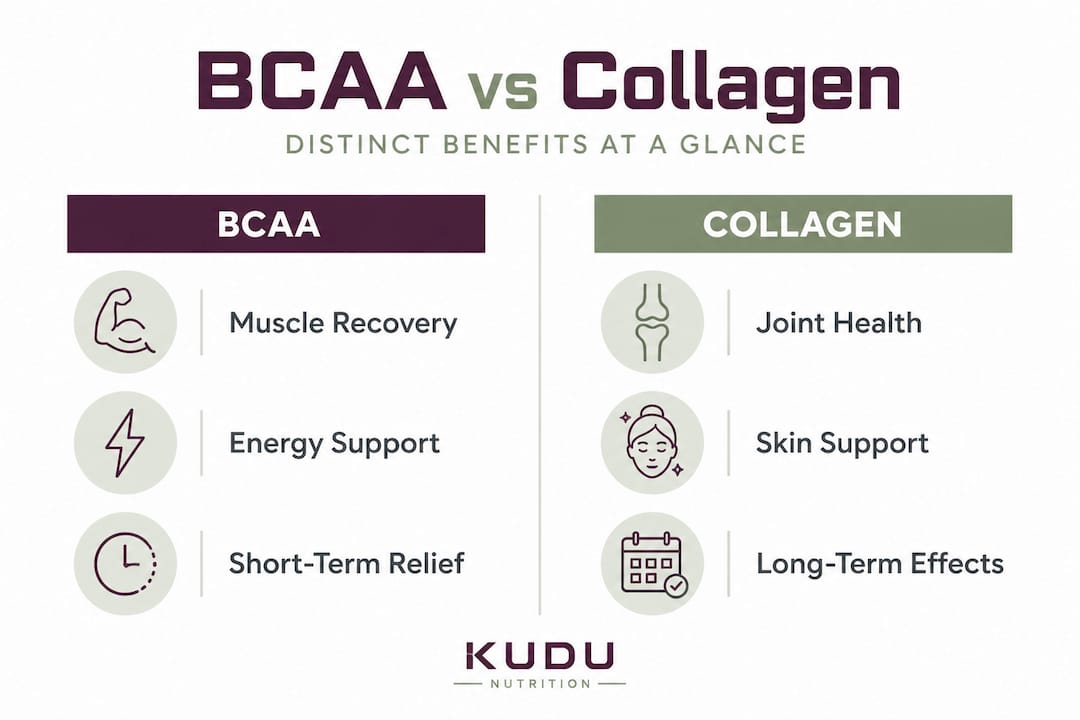
The takeaway? Each supplement has a distinct lane. Collagen addresses connective tissue and skin. BCAA address short-term muscle signalling, primarily when protein intake is suboptimal. Their lanes run parallel rather than merging into something greater. For a practical guide on timing and dosage, see our step-by-step collagen intake resource.
Debunking myths: the limits of BCAA and collagen synergy
With the research contrasts in mind, let’s cut through persistent myths and clarify what actually works according to experts and studies.
The fitness supplement industry has a commercial interest in promoting stacks, and the BCAA-plus-collagen combination is a prime example. Here are three myths worth addressing directly.
Myth 1: BCAA always improve muscle recovery, regardless of diet. This is simply not supported. Research shows that BCAA supplementation offers little extra benefit when total dietary protein is already adequate. If you are hitting your protein targets through whole foods and a quality protein supplement, adding standalone BCAA is mostly redundant spending. Your money and focus are better directed at ensuring consistent, adequate complete protein intake from sources containing all nine essential amino acids.
Myth 2: Collagen immediately repairs joints and reverses skin ageing. Collagen’s benefits are real, but they are not rapid. The tissue-remodelling process takes time. Studies show improvements emerging over weeks to months of consistent use, not days. Skin health benefits from collagen nutrition are similarly gradual. Treating collagen as a quick fix will only lead to disappointment and early abandonment.
Myth 3: BCAA plus collagen creates a synergistic “super stack” for both muscle and beauty. There is currently no high-quality evidence showing that BCAA and collagen combined outperform optimised dietary protein plus standalone collagen for any specific outcome. The stack is not harmful, but it is not proven to be superior either.
Here are three numbered takeaways to anchor this:
- Total protein first. Ensure you reach your daily protein target from complete sources before adding BCAA or any other amino acid supplement.
- Collagen is a long game. Use it consistently and measure outcomes over months, not days.
- “Synergy” requires evidence. Look for human trial data before assuming two supplements work better together than separately.
Pro Tip: Keep a simple wellness log for four to twelve weeks when trialling any supplement. Track training quality, joint comfort, and skin appearance. Actual data from your own body beats marketing copy every time.
Useful context on how your wider habits affect collagen’s effectiveness can be found in our guide to collagen-friendly lifestyle tips, which covers sleep, nutrition, and movement alongside supplementation.
Applying the evidence: how to personalise BCAA and collagen for your goals
Now that misconceptions are addressed, here’s how you can apply the actual science to personalise your own routine for beauty, joint health, or muscle goals.
The most useful question to ask is not “should I stack BCAA and collagen?” but rather “what is my primary goal, and what does the evidence suggest for that outcome specifically?” Let’s break this down by goal type.
| Goal | Recommended supplement | Optimal dose | Expected timeline |
|---|---|---|---|
| Skin and beauty | Hydrolysed collagen | 10g per day | 8 to 24 weeks |
| Joint comfort and support | Hydrolysed collagen | 10g per day | 12 to 24 weeks |
| Muscle recovery (low protein intake) | BCAA or complete protein | 5 to 10g around training | Weeks |
| Muscle recovery (adequate protein) | Complete protein source | Per daily target | Ongoing |
| Holistic fitness and recovery | Collagen plus complete protein | Collagen 10g plus protein target | Weeks to months |
Consistent collagen dosing of around 10g per day for 24 weeks has demonstrated genuine improvements in joint discomfort in human trials. That’s a meaningful signal. For skin and beauty outcomes, research similarly points to months of daily use rather than short bursts.
For BCAA, timing and dose effects are inconsistent across trials, and practical value is highest for people whose dietary protein intake is suboptimal, such as those in a calorie deficit, older adults eating less, or athletes with very high training loads and inconsistent nutrition.
Watch out for these red flags in your supplement routine:
- Spending heavily on isolated amino acid supplements before confirming your total protein intake is consistent
- Expecting visible joint or skin changes within a week or two of starting collagen
- Ignoring your overall diet quality while focusing exclusively on supplement timing
- Not tracking any markers of progress, making it impossible to know if what you are doing is working
- Rotating through different supplement stacks every few weeks without giving any single approach enough time to show results
For recovery-focused athletes, our breakdown on collagen for recovery explores the practical application in more detail.
Why the real value is individual strategy, not trendy stacks
Here at KUDU Nutrition, we think the supplement industry has made “stacking” sound more sophisticated than it often is. The truth is less exciting but far more useful: what works is what fits your lifestyle, your dietary baseline, and your actual goals, measured over time with honest attention.
The BCAA-plus-collagen stack is not a bad idea. It is simply an unproven one for most specific outcomes. If you already eat enough complete protein and you add BCAA, you are likely adding cost without adding meaningful benefit. If you add collagen consistently and with realistic expectations, you stand a solid chance of noticing real improvements in joint comfort and skin quality over several months. That is a genuinely worthwhile investment.
What concerns us is the tendency to treat supplement combinations as a shortcut to outcomes that actually require dietary discipline, training consistency, and patience. The importance of collagen for overall health is well supported, but no supplement operates in isolation from the rest of your habits.
The most evidence-based approach is this: get your protein intake right first, add collagen consistently for joint and connective tissue goals, and only add BCAA if you have a genuine gap in essential amino acid intake. Then track your results. That is it. No complicated stacks required.
The research is still catching up to the marketing. Most claims about combined supplement synergy outpace what human trials have actually tested. Watch for that gap, and favour products backed by independent quality certification and transparent ingredient labelling over products backed only by compelling copy.
Exploring trusted collagen options for your goals
Ready to put evidence-based collagen strategies into practice? Here’s where you can start exploring tailored options.
KUDU Nutrition’s collagen products are designed with this evidence-led thinking in mind. We focus on high collagen content, great taste, and independent quality verification through Informed Sport certification, so you can trust exactly what you are putting into your body.

Whether your priority is joint support, skin health, or fitness recovery, our 20g collagen protein gels deliver a meaningful dose in a convenient, portable format. Not sure where to begin? Our collagen protein starter box is the ideal way to find the flavour and format that fits your daily routine, without committing to a large order before you know what works for you. Because the best supplement routine is one you actually stick to.
Frequently asked questions
Is there strong evidence for BCAA and collagen working better together than separately?
Current research does not establish a proven synergy. Direct synergy between BCAA and collagen has not been demonstrated in robust human trials, and their effects are complementary rather than multiplicative.
How long does it take to see results from collagen for joints or skin?
Improvements typically take weeks to months of consistent daily use. 24 weeks of supplementation showed measurable musculoskeletal benefits in human trials, so patience and consistency are essential.
Does taking BCAA help if I already eat enough protein?
If your daily protein needs are met through food and supplementation, additional BCAA offers little if any extra benefit. Evidence shows BCAA are largely redundant when total protein intake is sufficient.
What’s the main advantage of collagen supplements?
Collagen’s primary strength lies in supporting joint comfort, connective tissue integrity, and skin health over time. Hydrolysed collagen provides bioactive peptides that support connective tissue remodelling in ways that standard protein supplements do not replicate.
Recommended
- Bioactive collagen: science, benefits, and how it works
- Collagen bioactivity: optimise your health in 2026
- Collagen stabilisers explained: Better skin and joints
- Amino acid profile: optimise nutrition and collagen benefits
- Protein Timing: What the Research Actually Shows | Fueled Framework
- Forstå kollagen: Effekter, fordele og myter forklaret – Vitaminone.dk