


Many people consume collagen supplements without knowing if they’re taking the right amount for genuine health benefits. Understanding proper daily collagen intake is essential for supporting skin elasticity, joint mobility, and overall wellness. This guide explains what daily collagen intake means, why it matters for your body, and how to optimise your consumption for maximum skin, joint, and recovery benefits. Whether you’re an athlete seeking faster recovery or someone focused on maintaining youthful skin, knowing the optimal collagen amounts can transform your supplementation strategy.
Table of Contents
- Key takeaways
- Understanding collagen and its role in your body
- How much collagen should you take daily? recommendations and factors
- Types of collagen supplements and how to choose the right one
- Tips for maximising collagen intake benefits in your daily routine
- Enhance your collagen routine with KUDU Nutrition supplements
- What is the best time of day to take collagen supplements?
Key Takeaways
| Point | Details |
|---|---|
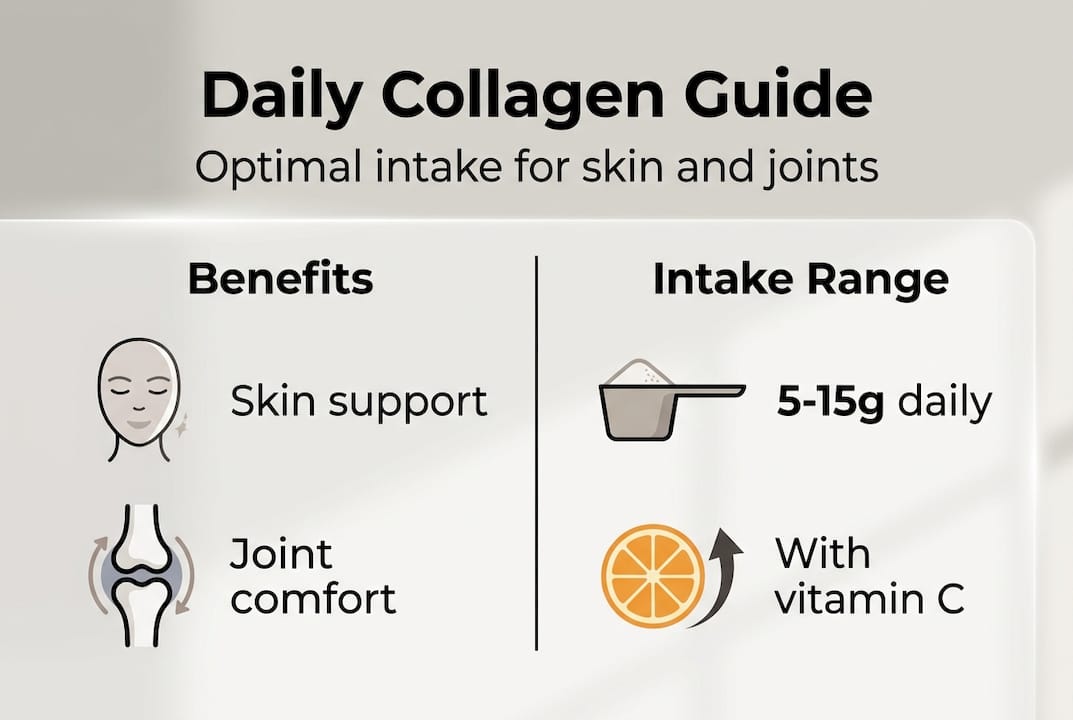
| Daily collagen range | Most adults benefit from 5 to 15 grams of collagen peptides daily to support skin elasticity and joint comfort. |
| Intake varies by individual | Age, activity level and health goals shape the ideal amount you should take. |
| Vitamin C support | Combining collagen with vitamin C rich foods at the same time enhances absorption and synthesis. |
| Consistency matters | Being consistent over time yields better results as natural collagen production declines with age. |
Understanding collagen and its role in your body
Collagen is the most abundant structural protein in your body, forming the foundation of skin, joints, bones, and connective tissues. This essential protein provides structural support that maintains tissue integrity throughout your life. Why collagen matters for skin, joints, and fitness becomes increasingly clear when you understand its diverse functions.
Your body contains several collagen types, but type 1 collagen comprises approximately 90% of your body’s total collagen content. This particular type is crucial for skin strength and elasticity, whilst also supporting bone density and tendon resilience. Type 1 collagen benefits extend across multiple body systems, making it the primary focus for supplementation.
Collagen performs several vital functions:
- Maintains skin hydration and elasticity, reducing visible signs of ageing
- Supports joint cartilage integrity and mobility, particularly important for active individuals
- Promotes muscle recovery and tissue repair after physical activity
- Strengthens bones and connective tissues throughout your skeletal system
- Provides essential amino acids including glycine, proline, and hydroxyproline
The amino acids in collagen create a unique protein profile that your body uses specifically for structural repair and maintenance. Unfortunately, natural collagen production begins declining around age 25, with production dropping approximately 1-1.5% annually. By age 40, you may have lost up to 15% of your natural collagen, making supplementation increasingly valuable for maintaining skin quality and joint health.
This age-related decline explains why many people notice changes in skin texture, joint comfort, and recovery time as they grow older. Understanding this biological reality helps you appreciate why consistent collagen intake becomes more important with each passing year.
How much collagen should you take daily? recommendations and factors
Research indicates that daily doses of 5-15 grams collagen peptides support skin and joint health effectively for most adults. However, your optimal intake depends on several individual factors that influence how your body uses this protein.

Collagen needs vary by age, activity level, and health goals, making personalised approaches more effective than one-size-fits-all recommendations. Athletes and highly active individuals often benefit from higher intakes, whilst those focused primarily on skin health may achieve results with moderate amounts.
| Group | Recommended daily intake | Primary benefits |
|---|---|---|
| General adults | 5-10g | Skin hydration, basic joint support |
| Active individuals | 10-15g | Enhanced recovery, joint mobility |
| Athletes | 15-20g | Muscle repair, injury prevention |
| Seniors | 10-15g | Bone density, joint comfort |
| Beauty focus | 5-10g | Skin elasticity, hair and nail strength |
Several factors influence your ideal collagen intake:
- Physical activity intensity and frequency affect tissue breakdown rates
- Age-related collagen decline requires higher supplementation in older adults
- Specific health goals such as injury recovery or skin improvement
- Body weight and overall protein requirements
- Existing joint conditions or skin concerns
The collagen daily dosage guide emphasises that absorption and utilisation matter as much as total intake. Your body must break down collagen into peptides and amino acids before using them for tissue repair. This process explains why hydrolysed collagen supplements offer advantages over whole collagen sources.
Pro Tip: Always combine your collagen intake with vitamin C-rich foods like oranges, strawberries, or bell peppers to enhance absorption and synthesis. Vitamin C acts as a cofactor in collagen production, making your supplementation significantly more effective.
For those following a step-by-step collagen intake approach, starting with 10g daily provides a balanced middle ground. You can then adjust based on your response and specific wellness objectives. Athletes preparing for competitions or recovering from injuries might temporarily increase intake, whilst maintenance phases may require less.
Types of collagen supplements and how to choose the right one
Collagen supplements come from various animal sources, each offering distinct benefits and characteristics. Understanding these differences helps you select the most appropriate option for your needs.
Marine and bovine collagen offer different benefits and absorption rates, making source selection an important consideration. Marine collagen primarily contains type 1 collagen and is often preferred for skin-focused benefits, whilst bovine collagen provides both type 1 and type 3, supporting broader applications.
| Collagen source | Primary types | Key benefits | Best for |
|---|---|---|---|
| Marine (fish) | Type 1 | Superior skin absorption, smaller peptides | Skin elasticity, beauty goals |
| Bovine (cow) | Types 1 & 3 | Joint support, muscle recovery | Athletes, joint health |
| Porcine (pig) | Types 1 & 3 | Similar to bovine, cost-effective | General wellness |
| Chicken | Type 2 | Cartilage support | Specific joint conditions |
Supplement forms also vary significantly:
- Powders offer versatility for mixing into drinks and foods
- Liquid sachets provide pre-measured, convenient doses
- Capsules suit those preferring no-taste options
- Gels combine portability with easy consumption
The collagen digestion process reveals why hydrolysed collagen peptides deliver superior results. Hydrolysis breaks collagen into smaller peptides before consumption, reducing digestive work and improving bioavailability. Your body can absorb these smaller peptides more efficiently, leading to better utilisation for skin and joint benefits.
Pro Tip: Check supplement labels for “hydrolysed collagen” or “collagen peptides” to ensure optimal digestion and bioavailability. These forms are pre-broken down, making them easier for your body to absorb and use effectively.
When selecting a collagen supplement, consider:
- Your primary health goals (skin versus joints versus overall wellness)
- Dietary restrictions or preferences (pescatarian, halal, kosher)
- Convenience and portability requirements
- Additional ingredients like vitamin C that enhance effectiveness
- Third-party testing and quality certifications
The relationship between vitamin C and collagen synthesis means supplements containing both ingredients offer synergistic benefits. Vitamin C enables your body to convert collagen peptides into functional collagen structures within your tissues. Without adequate vitamin C, even high-quality collagen supplementation produces diminished results.
Quality certifications matter significantly for athletes and those concerned about supplement purity. Look for products tested by organisations like Informed Sport, which screen for banned substances and verify label accuracy. This testing provides confidence that supplements contain what they claim without contaminants.
Tips for maximising collagen intake benefits in your daily routine
Consistent daily habits amplify collagen supplementation effectiveness far beyond simply taking a supplement. Strategic timing, complementary nutrition, and lifestyle factors all influence how well your body uses collagen for skin and joint health.
Combining vitamin C with collagen optimises synthesis and skin benefits, making this pairing essential for maximum results. Your body cannot produce collagen without adequate vitamin C, regardless of how much collagen protein you consume.
Follow these five practical steps to increase collagen benefits:
- Take collagen at the same time daily to establish consistency and maintain steady amino acid availability for tissue repair
- Pair your collagen supplement with vitamin C-rich foods or a supplement containing at least 50mg vitamin C
- Stay well-hydrated throughout the day, as collagen works with water to maintain skin plumpness and joint lubrication
- Consume collagen on an empty stomach or with a light meal for optimal absorption without competition from other proteins
- Schedule intake around physical activity, taking collagen within two hours post-workout to support muscle and connective tissue recovery
The step-by-step collagen intake guide emphasises that results accumulate over weeks and months rather than days. Most people notice initial skin improvements within 4-8 weeks of consistent daily intake, whilst joint benefits may require 8-12 weeks to become apparent. This timeline reflects the natural rate of tissue turnover and collagen integration.
Pro Tip: Avoid excessive UV exposure and smoking to preserve your natural collagen stores. These factors accelerate collagen breakdown, undermining your supplementation efforts and reducing overall effectiveness.
Athletes can strategically time collagen intake to maximise recovery benefits. Taking collagen immediately after training provides amino acids when muscles and connective tissues are most receptive to repair signals. This timing may enhance adaptation to training stress and reduce injury risk over time.
Supporting habits that enhance collagen production and preservation:
- Maintain a balanced diet rich in protein, healthy fats, and antioxidants
- Prioritise quality sleep, when tissue repair and collagen synthesis peak
- Manage stress levels, as chronic stress hormones can impair collagen production
- Include resistance training to stimulate collagen synthesis in tendons and ligaments
- Limit sugar intake, as excess glucose can damage collagen through glycation
Understanding collagen for joint health helps you appreciate why consistency matters more than occasional high doses. Your body continuously breaks down and rebuilds collagen structures, requiring steady amino acid supplies to maintain this balance. Missing days or taking irregular amounts reduces the cumulative benefits that make collagen supplementation worthwhile.
Tracking your progress helps maintain motivation and adjust your approach. Take baseline photos of your skin, note joint comfort levels, and monitor recovery times from workouts. Review these markers monthly to assess whether your current collagen intake and routine are producing desired results.
Enhance your collagen routine with KUDU Nutrition supplements
KUDU Nutrition offers convenient, high-quality collagen solutions designed specifically for active individuals and wellness-focused consumers. Our liquid collagen protein sachets deliver 20g of premium collagen per serving, exceeding the optimal daily intake recommendations for comprehensive support.

Each sachet provides a precise, travel-friendly dose that fits seamlessly into busy lifestyles. Whether you’re heading to the gym, office, or travelling, our portable sachets ensure you never miss your daily collagen intake. Available in delicious flavours, KUDU Nutrition products make consistent supplementation enjoyable rather than a chore.
Our 20g collagen protein supplements combine quality, convenience, and taste in formats designed for modern wellness routines. The orange liquid collagen protein sachets offer refreshing flavour alongside comprehensive nutritional support, whilst our 20g liquid collagen protein pack provides excellent value for consistent users. Explore our range to find the perfect collagen solution for your wellness journey.
What is the best time of day to take collagen supplements?
Collagen can be consumed at any time during the day without significantly affecting its benefits. Many people prefer taking collagen in the morning mixed into coffee or smoothies for convenience, whilst others choose post-workout timing to support recovery. The most important factor is consistency rather than precise timing. Choose a time that fits naturally into your daily routine, making it easy to maintain regular intake without forgetting doses.
Can I get enough collagen from food alone?
Whilst certain foods like bone broth, meat with connective tissue, and fish skin contain collagen, obtaining therapeutic amounts through diet alone proves challenging for most people. Food sources provide variable collagen quantities that are difficult to measure accurately. Supplements offer controlled, consistent doses typically ranging from 10-20g per serving, far exceeding what most people consume through food. For reliable collagen intake supporting skin and joint health, supplements provide the most practical solution.
Does vitamin C really boost collagen production?
Vitamin C is absolutely essential for collagen synthesis within your body, acting as a required cofactor in the biochemical process that creates collagen structures. Without adequate vitamin C, your body cannot effectively convert collagen peptides from supplements into functional tissue collagen. Research consistently demonstrates that combining collagen supplementation with vitamin C enhances results for skin elasticity and joint health. Aim for at least 50-100mg of vitamin C alongside your daily collagen intake, either through supplements or vitamin C-rich foods like citrus fruits, strawberries, and peppers.
Are there risks or side effects to daily collagen intake?
Collagen supplements are generally recognised as safe with minimal side effects for most people when taken at recommended doses. Some individuals may experience mild digestive symptoms like feelings of fullness, but these typically resolve as your body adjusts. People with allergies to specific protein sources should carefully check supplement ingredients, avoiding marine collagen if allergic to fish or bovine collagen if sensitive to beef. Pregnant or breastfeeding women should consult healthcare providers before starting any new supplement regimen, though collagen is typically considered safe during these periods.


