


TL;DR:
- Liquid collagen supplements are not inherently more effective than powders; quality, dose, and duration Matter most. Clinical evidence shows that adequate peptide dosage over 8 to 24 weeks improves skin, joints, and bones, regardless of format. Trustworthy products prioritize proven peptide quality, transparent sourcing, and sufficient dosing for real results.
Not every supplement in a liquid bottle deserves the premium price tag that comes with it. The idea that liquid always means faster or better absorbed is one of the most persistent myths in sports nutrition, yet many buyers base their purchasing decisions entirely on format. When it comes to collagen specifically, the research tells a more nuanced story: what determines results is not whether your supplement sloshes around in a sachet, but whether it contains the right peptides at the right dose for a meaningful duration. This article takes the clinical evidence seriously, so you can stop guessing and start choosing intelligently.
Table of Contents
- What does efficacy mean for liquid collagen supplements?
- How liquid collagen compares to other forms
- Clinically proven benefits: Skin, joint, and bone efficacy
- Optimising your results: Dosing, timing and synergy
- What are the limits? Myths, edge cases and research gaps
- The uncomfortable truth most brands won’t tell you about liquid supplement efficacy
- Shop trusted liquid collagen for real results
- Frequently asked questions
Key Takeaways
| Point | Details |
|---|---|
| Evidence-backed benefits | Liquid collagen consistently improves joint pain, with promising effects for skin and bone when dosed correctly. |
| Format matters less than peptides | Choose supplements with clinically tested hydrolysed peptides regardless of being liquid or powder. |
| Optimise with vitamin C | Combining collagen with vitamin C and exercise maximises absorption and effectiveness. |
| Consistency is key | Daily, regular use over at least two to three months is crucial for seeing real results. |
| Know the limits | Collagen is not a substitute for protein or clinical therapy and results are best with realistic expectations. |
What does efficacy mean for liquid collagen supplements?
Efficacy is not a feeling. It is a clinically measurable change in a specific biological outcome, tracked using validated tools and compared against a placebo group. When researchers evaluate collagen supplements, they are looking for objective improvements in skin hydration, skin elasticity, joint pain scores, functional mobility, or bone mineral density. These markers are not interchangeable, and a supplement that performs brilliantly for skin hydration may show only modest effects on bone density.
For practical purposes, here is how each outcome category is typically assessed:
- Skin hydration and elasticity: Measured using corneometry (moisture) and cutometry (elasticity and firmness), often combined into standardised mean difference scores across trials
- Joint pain and function: Assessed via the WOMAC scale, visual analogue pain scores, and functional performance tests
- Bone mineral density: Evaluated using DXA scans comparing femoral neck and lumbar spine density over time, alongside bone turnover markers in blood
Meta-analyses confirm that collagen supplements improve skin hydration (SMD 1.25) and elasticity (SMD 0.61) across well-designed trials. That SMD of 1.25 for hydration is considered a large effect in clinical research. It signals that results are not marginal or anecdotal.
Duration matters significantly. Most skin benefits appear between weeks eight and twelve, while joint and bone improvements tend to require twelve to twenty-four weeks of consistent daily use. Anything shorter is unlikely to show measurable change, and this is where many users go wrong.
| Outcome | Validated measure | Minimum effective duration |
|---|---|---|
| Skin hydration | Corneometry / SMD | 8 weeks |
| Skin elasticity | Cutometry / SMD | 8–12 weeks |
| Joint pain relief | WOMAC / VAS | 12 weeks |
| Bone mineral density | DXA scan | 24 weeks |
If you want to understand the full scope of what collagen supplementation actually is before evaluating evidence, the guide on what is liquid collagen offers a solid foundation.
Pro Tip: If a supplement brand promises visible skin improvement in under two weeks, treat that as a marketing signal rather than a scientific one. Collagen synthesis is a biological process that cannot be meaningfully accelerated below a certain threshold.
How liquid collagen compares to other forms
Once you understand what outcomes to look for, the next natural question is whether the format you choose actually changes anything. It is tempting to assume that a ready-to-drink liquid sachet delivers collagen more efficiently than a powder you mix yourself. The reality is more measured.
Research confirms that efficacy is driven primarily by low molecular weight hydrolysed peptides, ideally below 3kDa, rather than by whether the product is liquid or powder. Liquid collagen has a practical advantage in that the peptides are already dissolved, meaning the digestive process begins immediately. This may offer marginally faster absorption in the early phases of digestion. However, if a powder contains identically hydrolysed peptides at the same dose, the overall bioavailability is functionally similar once absorbed.
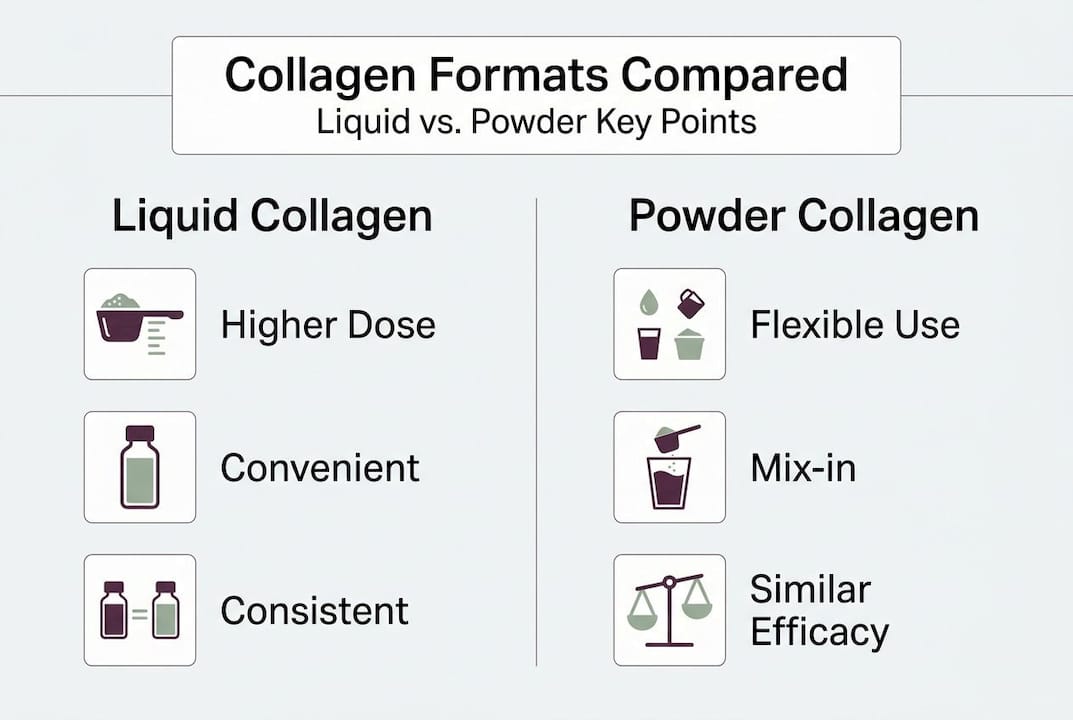
Where liquid collagen genuinely wins is in convenience and consistency. You are more likely to stick to a daily protocol when it requires no measuring, mixing, or preparation. For athletes, this matters enormously. A sachet you can consume immediately after training is one you will not skip.
| Format | Typical dose per serving | Absorption speed | Convenience | Collagen quality |
|---|---|---|---|---|
| Liquid sachet | 10–20g | Fast (pre-dissolved) | Very high | Depends on brand |
| Powder | 10–20g | Moderate | Moderate | Varies widely |
| Capsule/tablet | 1–5g | Slower | High | Often under-dosed |
The capsule form is the most notable underperformer here. Most capsule-based collagen products contain far too little collagen per serving to reach the clinically studied dose range of 2.5–15g daily. You would need a substantial number of capsules to replicate what one good liquid sachet delivers.
The deeper comparison between these two leading formats is worth reading in detail: the breakdown of liquid vs powder collagen covers formulation quality, price per gram, and real-world usage patterns. For a side-by-side product assessment, the review of top liquid collagen sachets is particularly useful for comparing brands.
Clinically proven benefits: Skin, joint, and bone efficacy
With format out of the way, the evidence for specific health outcomes is where the conversation gets genuinely interesting. The clinical literature is not uniformly positive, but when trials are well-designed and adequately dosed, the results are compelling.
Skin benefits are the most studied. Bioactive collagen peptides improve skin hydration, elasticity, and dermal density in women over twelve weeks, with effects persisting for weeks after supplementation ends in some participants. The mechanism involves collagen-derived dipeptides, particularly prolylhydroxyproline, stimulating fibroblast activity in the dermis. These are not surface-level cosmetic effects. They represent structural changes in the skin’s deeper layers, which explains why results are more pronounced and longer-lasting than topical creams. This benefit is closely examined in the context of beauty collagen impact on overall skin and joint health.

Joint benefits show the most consistent clinical signal across trials. Low-molecular-weight collagen peptides improve WOMAC pain and function scores in patients with early knee osteoarthritis, a result replicated across multiple research groups. The proposed mechanism is that collagen peptides accumulate in cartilage and stimulate chondrocyte activity, the cells responsible for maintaining joint tissue. For athletes with chronic joint load, this is arguably the most practically relevant benefit.
Bone benefits are the most recently established and still developing. Collagen peptides increase bone mineral density in the femoral neck and lumbar spine and improve bone turnover markers, particularly in postmenopausal women and older adults. The effect is meaningful but should be understood as complementary to established interventions like calcium, vitamin D, and resistance training, not a standalone fix.
Key evidence summary:
- Skin: Hydration and elasticity improvements after 8–12 weeks, dermal density increases confirmed in double-blind trials
- Joints: WOMAC pain reduced by 30–40% in some knee OA trials, function scores improved alongside pain
- Bones: Femoral neck and lumbar spine BMD gains in postmenopausal women over 12–24 weeks
For a broader view of how these benefits translate to everyday health and activity, the article on liquid nutrition benefits for skin and joints puts the clinical picture into a practical lifestyle context. It is also worth noting that while dermal regeneration from supplements is different in mechanism from liquid facelift anti-ageing treatments, the underlying goal of stimulating collagen renewal is shared.
Optimising your results: Dosing, timing and synergy
Knowing that collagen works is only half the picture. Understanding how to get the most out of it in your specific routine is where most people fall short. The research is clear on several key variables.
Optimal dosing ranges from 2.5 to 15g daily, with duration of eight to twenty-four weeks depending on the target outcome. Skin benefits are often achievable at the lower end (2.5–5g daily), while joint and bone benefits typically require 10–15g for the clearest effects. Athletes aiming for connective tissue support tend to sit at the upper range.
How to maximise your supplementation protocol:
- Choose your goal first and match the dose accordingly. Skin goals allow for lower doses; joint or bone goals need more
- Time your sachet around a meal or vitamin C source. Vitamin C is essential for hydroxylation of proline and lysine, the steps needed to produce stable collagen fibres. Without adequate vitamin C, even the best peptides cannot be utilised fully
- Combine with exercise, particularly resistance training or targeted tendon loading for joint benefits. Precision medicine approaches to athlete recovery increasingly point to nutrient timing alongside exercise as a multiplier for connective tissue adaptations
- Set a twelve-week minimum commitment. Many people stop at six weeks when they see no obvious change, not realising that biological change in collagen-dense tissues takes longer than for muscle or fat
- Be consistent over episodic. Daily supplementation outperforms sporadic high doses in all studied protocols
Pro Tip: Taking your liquid collagen alongside a small glass of orange juice or a meal rich in bell peppers achieves the vitamin C synergy without buying a separate supplement. It is a simple, practical combination that the research consistently supports.
The full breakdown of vitamin C and collagen synthesis explains the biochemistry in accessible terms, and if you are just starting out, the practical guide on how to start a collagen regimen walks through a sensible introduction plan.
What are the limits? Myths, edge cases and research gaps
Collagen is genuinely effective in specific circumstances, but it is not a cure-all and being realistic about its limits is essential to using it wisely.
The most relevant finding for athletes is this: collagen peptides show no additional benefit for connective protein synthesis over equivalent free amino acids after exercise. If your primary goal is muscle growth or post-exercise repair, a broader protein supplement may serve you better. Collagen is rich in glycine, proline, and hydroxyproline, but it is not a complete protein and lacks sufficient leucine to stimulate muscle protein synthesis effectively.
The evidence landscape for skin, while promising, is complicated by industry funding. Several positive trials are sponsored by collagen manufacturers, which does not invalidate them but does warrant scrutiny. As the BBC Future investigation reports, benefits are more consistent for joints, where the pain-relief data is robust, than for skin, where trial quality and independence vary.
Key limitations to understand clearly:
- Results depend on peptide molecular weight, dose, and your individual health baseline
- Skin results are variable and partly contingent on trial quality and funding source
- Collagen supplements do not substitute for exercise, sleep, or a nutrient-rich diet
- Bone benefits are most relevant for postmenopausal women or older adults with existing concerns
“Being ‘liquid’ is not the efficacy factor. Peptide quality, clinically relevant dosing, and duration of supplementation are the variables that determine results. Format is secondary.”
Understanding hydrolysed collagen benefits in detail will help you evaluate product labels more critically and spot underdosed or poorly formulated options before you spend money on them.
The uncomfortable truth most brands won’t tell you about liquid supplement efficacy
Here is what most supplement marketing deliberately obscures: the format of your collagen is the least important decision you will make. Whether your collagen comes in a liquid sachet, a powder, or a gel is largely irrelevant if the peptide quality is poor, the dose is insufficient, or you use it for three weeks and stop.
The real differentiators are unglamorous. They are things like the molecular weight of the hydrolysed peptides, whether the product is third-party certified (Informed Sport certification, for example, matters for athletes who are tested), how transparent the brand is about ingredient sourcing, and whether the dose per sachet actually aligns with the doses used in positive clinical trials.
We see this pattern constantly in the supplement market. Brands invest in aesthetics, taste, and format while quietly under-dosing the key active ingredient to reduce costs. A 5g collagen sachet marketed for joint health is not going to deliver the 10–15g that clinical studies consistently use to achieve measurable improvements. The gap between marketing and formulation is where most products fail.
The deeper insight in the liquid vs powder collagen comparison is that smart consumers stop asking “which format is best?” and start asking “does this product contain what it claims, at the dose the evidence supports, in a form my body can actually use?” That shift in question leads you to far better purchasing decisions.
Shop trusted liquid collagen for real results
For those ready to act on the evidence rather than just read about it, choosing the right product from a transparent, well-dosed range is the natural next step.
KUDU Nutrition’s 20g liquid collagen protein sachets deliver a clinically relevant dose in every serve, with Informed Sport certification that matters for athletes and serious fitness enthusiasts. The full range of 20g collagen protein gels is designed for convenience without compromise on peptide quality. If skin, joint, and bone benefits are your priority, the collagen and beauty section of the site breaks down exactly which products align with each specific health goal. Transparent labelling, proven peptides, and the right dose. That is where results start.
Frequently asked questions
How quickly can I expect results from liquid collagen supplements?
Clinical studies show that most users notice measurable benefits after eight to twelve weeks of daily supplementation, with joint improvements sometimes appearing earlier in those with existing discomfort.
Are the effects of liquid collagen supplements permanent?
No. Research on bioactive peptides indicates that skin and joint benefits gradually diminish over several weeks once supplementation stops, making consistent long-term use the most effective strategy.
Do liquid collagen supplements help with muscle building?
Studies confirm that collagen peptides offer no additional connective or muscle protein synthesis benefit over equivalent free amino acids after exercise, making standard protein supplementation the better choice for pure muscle-building goals.
Is it safe to take collagen supplements long term?
Yes. Doses of 2.5–15g daily have been assessed in clinical trials lasting up to twenty-four weeks with no significant safety concerns reported in healthy adults.
Can vegetarians or vegans use collagen supplements for similar benefits?
Most collagen supplements are derived from bovine, porcine, or marine animal sources. Vegan collagen boosters that support your body’s own production exist, but direct vegan collagen replacements are still under active research and are not yet supported by the same level of clinical evidence.