


TL;DR:
- A simple and consistent morning supplement routine can improve joint mobility, skin, and recovery by focusing on five core supplements. Proper timing and pairing with food enhance absorption, especially for fat-soluble vitamins like D3 and omega-3. Prioritizing habit formation and simplicity ensures long-term adherence and optimal health benefits.
You wake up stiff, moving slowly to the bathroom, joints quietly protesting the night before. Sound familiar? A well-structured morning supplement routine changes that pattern, and the science behind it is more compelling than most people realise. This guide walks you through exactly which supplements to take, in what order, and why each one earns its place in your mornings. Whether you’re chasing clearer skin, better joint mobility, or faster recovery after training, every recommendation here is grounded in evidence and built for consistency.
Table of Contents
- What you need for an effective morning supplement routine
- Step-by-step instructions for your morning routine
- Special considerations for women and active adults
- How to troubleshoot, optimise, and track your results
- The uncomfortable truth about morning supplement routines
- Get started with premium collagen for your morning routine
- Frequently asked questions
Key Takeaways
| Point | Details |
|---|---|
| Consistency is key | Routine adherence matters more than perfect timing for most supplements. |
| Pair with food | Take vitamin D and omega-3 with healthy fats in your breakfast to boost absorption. |
| Personalise your plan | Test for deficiencies and adjust according to your unique needs and goals. |
| Track your progress | Journaling helps identify benefits and fine-tune your supplement routine. |
What you need for an effective morning supplement routine
Before you start swallowing capsules at random, it helps to know what you’re actually working with. The foundation of a strong morning routine sits on five core supplements, each with a distinct role.
The essential five:
- Collagen (10 to 20g daily): Supports skin elasticity, joint cushioning, and connective tissue repair. Liquid collagen, like KUDU Nutrition’s sachets, absorbs quickly and delivers a high dose without any digestive fuss.
- Vitamin D3 (1,000 to 2,000 IU): Critical for bone density, immune function, and mood regulation. Most people in the UK are deficient, particularly in autumn and winter.
- Omega-3 fatty acids (1 to 3g EPA/DHA): Reduce inflammation, support cardiovascular health, and amplify the effects of collagen on joint tissue.
- Creatine monohydrate (3 to 5g): Supports muscle strength, power output, and cognitive performance. One of the most researched supplements in existence.
- Caffeine and/or beta-alanine (optional): For pre-workout energy and muscular endurance. Best used selectively, not as a daily crutch.
Before you begin, a few prerequisites matter. If you’re on medication, particularly blood thinners or heart drugs, omega-3 supplementation needs a GP sign-off. Blood testing for vitamin D and omega-3 levels is genuinely useful, not just a nice-to-have, especially for women. Allergies to marine collagen are rare but worth checking if you react to fish-based products.
Women specifically benefit from prioritising collagen and vitamin D3, both of which play outsized roles in bone density and skin structure as oestrogen levels shift during perimenopause and beyond. The bone health supplement list for women lays this out in useful detail.
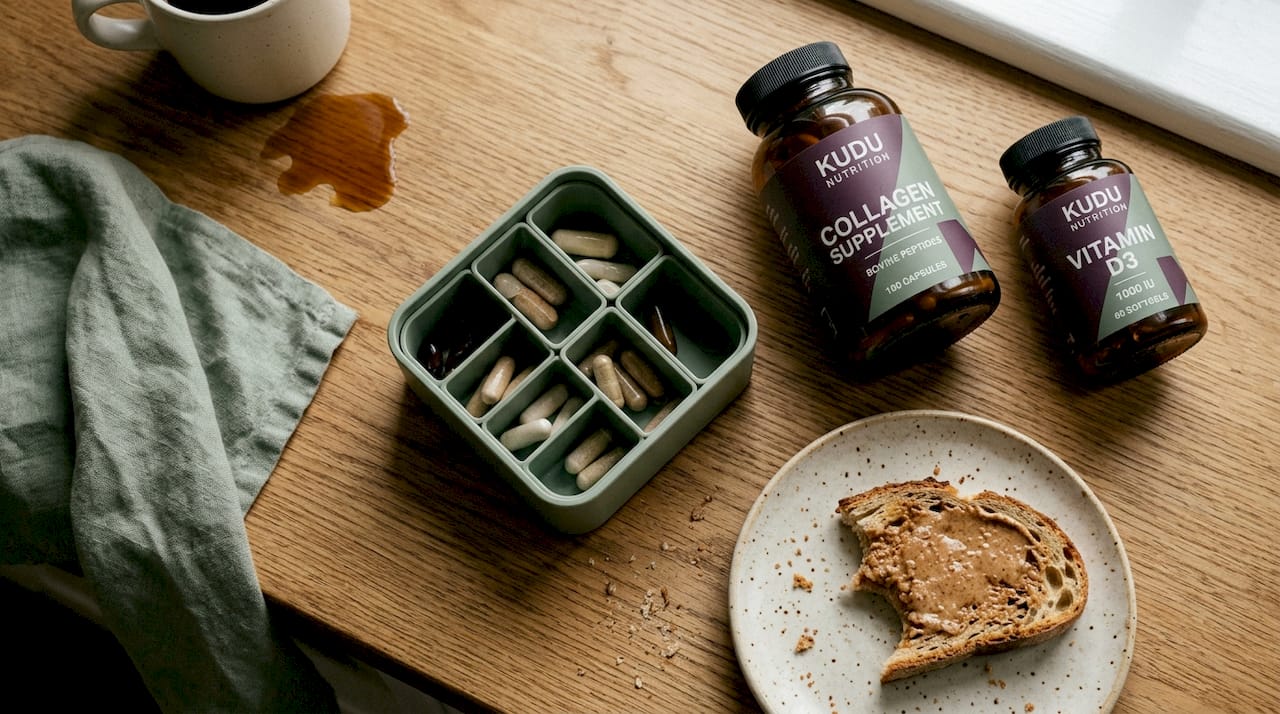
| Supplement | Key benefit | Typical dose | Best suited for |
|---|---|---|---|
| Collagen | Skin, joints, connective tissue | 10 to 20g | Everyone, especially women |
| Vitamin D3 | Bone health, immunity, mood | 1,000 to 2,000 IU | Most adults, essential in UK |
| Omega-3 | Inflammation control, heart health | 1 to 3g EPA/DHA | Active adults, joint concerns |
| Creatine | Muscle, strength, cognition | 3 to 5g | Athletes, active adults |
| Caffeine | Energy, focus, endurance | 100 to 200mg | Pre-workout users |
| Beta-alanine | Muscular endurance | 2 to 5g | Endurance athletes |
Pro Tip: Vitamin D absorption increases by as much as 32 to 57% when taken with dietary fat. Always pair vitamin D3 and omega-3 with a meal that contains healthy fats, such as eggs, avocado, or nut butter. Taking them on an empty stomach means a significant portion never reaches your bloodstream.
Step-by-step instructions for your morning routine
Now that you know what you’ll need, here’s how to put it all together for seamless integration into your mornings. The order matters more than most people appreciate, particularly for absorption and how each supplement interacts with an empty or fed stomach.
Your five-step morning protocol:
-
Rehydrate first (within five minutes of waking): Drink 400 to 500ml of water. Sleep is a mild dehydration event. Every supplement you take absorbs better in a hydrated body. This step takes 30 seconds and matters more than most people think.
-
Take collagen on an empty stomach (minutes 5 to 15): Collagen peptides absorb efficiently before food. KUDU Nutrition’s liquid sachets are ideal here because they’re ready instantly, taste good, and deliver 20g in a single serve. No blending, no measuring. Stir or drink straight, and you’re done.
-
Eat breakfast, then take vitamin D3 and omega-3 (within 30 minutes of eating): As covered above, fat-soluble supplements need dietary fat to absorb properly. A breakfast with eggs or a tablespoon of olive oil on toast provides exactly what’s needed. Take both capsules with your last few bites.
-
Add creatine any time during the morning (flexible): Daily consistency matters far more than the exact timing with creatine. Stir it into water, juice, or your morning smoothie. Creatine is tasteless in small amounts and dissolves well in cold liquids. Athletes sometimes split the dose, taking half at breakfast and half post-workout.
-
Take caffeine and/or beta-alanine 30 to 45 minutes before training (if applicable): Not everyone needs this step. Caffeine and beta-alanine offer real performance benefits but results vary considerably between individuals. Start low, assess your response, and never exceed recommended doses. If you’re sensitive to caffeine, consider skipping it entirely and relying on the natural energy boost that comes from good hydration and collagen.
The daily supplement guide offers an extended breakdown of how to layer supplements for skin and joint health together.
Comparison: standard approach vs. optimised athlete tweak
| Step | Standard approach | Optimised for athletic recovery |
|---|---|---|
| Collagen | Any time in the morning | Immediately after waking, before food |
| Vitamin D3 | With any meal | With a fat-rich breakfast |
| Omega-3 | Once daily with food | Split into morning and evening doses |
| Creatine | Mixed in water at any point | Post-workout with carbohydrates |
| Caffeine | As desired | 30 to 45 minutes pre-training only |
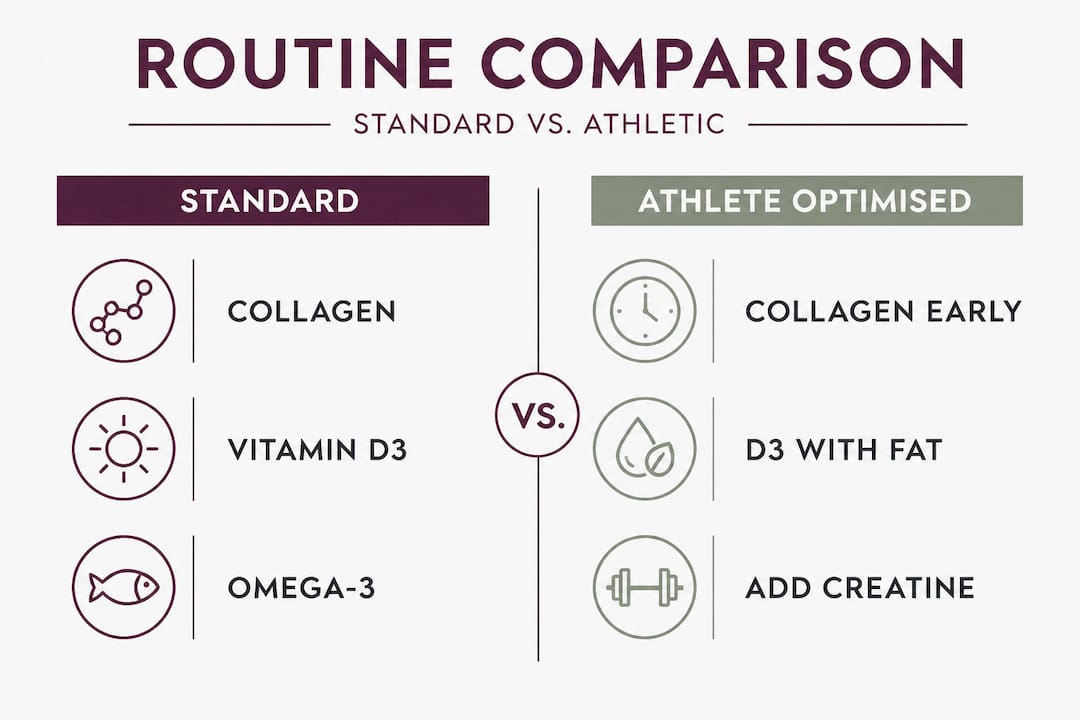
Pro Tip: Consistency beats perfection every single time. Taking every supplement at a slightly imperfect time is vastly superior to skipping days because the timing wasn’t ideal. Build the habit first, then fine-tune the protocol.
Special considerations for women and active adults
While this protocol gives a solid foundation for everyone, adjustments based on sex and activity level can meaningfully boost results. This is not about overcomplicating things. It’s about making the routine actually fit your biology and lifestyle.
For women specifically:
- Collagen is non-negotiable. Women benefit significantly from higher collagen intake, particularly in their 30s and beyond when natural collagen production declines by roughly one percent per year. Skin texture, joint comfort, and bone structure all rely on adequate collagen levels.
- Vitamin D3 requires monitoring. Women with darker skin tones, those who spend limited time outdoors, and perimenopausal women are particularly at risk for deficiency. A blood test is the only reliable way to know your actual baseline.
- Omega-3 testing is worth considering. Most people assume they get enough from diet alone, but unless you eat oily fish three or more times per week, you’re likely falling short.
For active adults and athletes:
- Creatine, caffeine, and beta-alanine all earn their places here, but only when used with honest self-assessment. If beta-alanine causes an uncomfortable tingling sensation called paraesthesia, split your dose into smaller portions spread across the day.
- Recovery-focused training benefits enormously from combining collagen with vitamin C, as this pairing actively supports collagen synthesis in muscle and connective tissue.
- Joint and bone support from consistent supplementation builds cumulatively over months, not days. Understanding the full picture of joint support benefits for active women helps set realistic expectations.
For those prioritising skeletal strength alongside performance, the evidence on bone health options is worth reading before finalising your stack.
Important note: Not all supplement results are immediate. Collagen improvements in skin and joints typically become noticeable after four to eight weeks of consistent daily use. Vitamin D benefits, especially mood and immune support, often take several weeks to register. Commit to the routine for at least eight weeks before evaluating outcomes. Patience here is not optional; it’s the mechanism.
How to troubleshoot, optimise, and track your results
Even the best plan needs occasional tweaking. Supplements are not passive. Your body responds to them dynamically, and real-world life will throw curveballs at even the most disciplined routine.
Step-by-step troubleshooting guide:
-
GI upset or nausea: Almost always caused by taking supplements on a fully empty stomach or at too high a dose. Move vitamin D, omega-3, and creatine to mid-breakfast. Reduce doses temporarily and build back up over two weeks.
-
Headaches after starting caffeine: Scale back to 50 to 75mg and assess. Headaches can also result from dehydration compounding the diuretic effect of caffeine. Double your water intake on training days.
-
No visible results after four weeks: Check adherence first. Missing two or more doses per week significantly blunts outcomes. Next, assess whether you’re pairing fat-soluble supplements with adequate dietary fat. Finally, confirm your collagen dose is at least 10g per day, as lower doses show weaker effects in clinical trials.
-
Feeling wired or anxious: This points to caffeine sensitivity. Remove it entirely for two weeks and reassess. Many people get superior results from collagen, creatine, and omega-3 alone without any stimulants involved.
-
Inconsistent routine due to travel or schedule changes: Individualised protocols and monitoring matter more than rigid timing rules. On travel days, prioritise collagen and vitamin D above all else. Single-serve sachets like KUDU’s liquid collagen are genuinely practical here, fitting easily into any bag without refrigeration or measuring equipment.
Common mistakes worth avoiding include combining too many new supplements at once, making it impossible to identify what’s working or causing issues, and skipping food with fat-soluble vitamins because you’re in a rush.
Pro Tip: Keep a simple three-week supplement journal. Each morning, note what you took, when you ate, and how you feel physically and mentally. By week three, patterns emerge clearly. You’ll see which combinations improve your energy, which do nothing, and whether joint stiffness is trending down. A journal transforms vague impressions into actionable data.
When to consult a professional: if you have a diagnosed condition, take prescription medication, or experience persistent symptoms, see a GP or registered dietitian before continuing. Supplementation is powerful, but it works within your unique physiology, not despite it. More specific joint health tips for active adults may also help refine your approach.
The uncomfortable truth about morning supplement routines
Here’s what we’ve seen time and again, and what most supplement guides won’t tell you plainly. People fail at supplement routines not because they lack the right product or the correct timing protocol. They fail because the routine becomes too complex to sustain in real life.
The supplement industry profits from complexity. More products, more protocols, more biohacking. But the evidence consistently points to a simpler conclusion: adherence is everything. A person who takes three core supplements every single morning without fail will, over six months, outperform someone who follows a perfect twelve-step protocol but misses three or four days per week because it’s too demanding to maintain.
Decision fatigue is real, and mornings are already full of friction. If your supplement routine requires measuring powders, stacking multiple capsules, and hitting specific timing windows, you are designing failure into the habit. The science on bone health routines backs this up consistently: the gains come from months of repetition, not from optimising a single morning.
Social events, travel, early meetings, and busy family mornings will all interfere. The people who maintain their routines through disruption are not more disciplined than everyone else. They’ve made their routine simpler, smaller, and easier to execute under pressure. A single liquid collagen sachet and a vitamin D capsule takes under ninety seconds. That’s a routine you can actually keep.
We’d encourage you to resist the pull of the perfectly optimised stack. Build with three supplements first. Master the habit. Then add. The long-term health outcomes we see from routine consistency far outpace any short-term gain from chasing the latest ingredient trend.
Get started with premium collagen for your morning routine
Putting this routine into practice starts with getting the right collagen into your daily habit. KUDU Nutrition’s liquid collagen sachets deliver 20g of high-quality collagen protein per serve, are Informed Sport certified, and taste genuinely good, making them easy to reach for every morning without reluctance.
Whether you prefer a classic flavour or something fresher, the collagen protein pack gives you a fortnight’s supply to establish the habit properly. If you enjoy a bright, clean taste to start your morning, the orange collagen sachets are a particularly popular choice among athletes and beauty-focused users alike. Quality ingredients, transparent labelling, and a format that fits any morning. That’s the starting point worth committing to.
Frequently asked questions
Do I need to take all these supplements every morning?
No. Focus on the supplements most relevant to your specific goals, and individualised consistency with a smaller stack will outperform a large, inconsistently followed routine.
Should I eat before or after taking my morning supplements?
Take collagen before eating, but take vitamin D3 and omega-3 with a meal containing healthy fat, since vitamin D absorption rises by 32 to 57% when consumed alongside dietary fat.
Can I take creatine before breakfast?
Yes. Creatine timing is far less important than taking it daily, so fit it wherever it feels easiest in your morning without worrying about the exact window.
How long before I’ll notice results from this routine?
Allow two to four weeks of consistent use to notice initial improvements in energy and recovery, while skin and joint results typically become more apparent after six to eight weeks of daily supplementation.