


TL;DR:
- Total daily protein intake and proper distribution across meals are more important than post-exercise timing for muscle growth. Collagen supplements support connective tissue health but do not replace complete proteins and should be taken regularly rather than at specific times. Prioritizing consistent nutrition, sleep, and training yields better results than obsessing over narrow timing windows.
Most people training seriously have obsessed over chugging a shake within 30 minutes of finishing a workout, convinced that missing this window would cost them hard-earned muscle. At the same time, collagen supplements have been marketed as the anti-ageing answer to everything from wrinkled skin to creaky joints. The reality, as ISSN position guidance makes clear, is that total daily protein and spreading intake across the day matter far more than obsessing over any narrow post-exercise window. This article unpacks the evidence so you can make smarter decisions about both protein and collagen timing.
Table of Contents
- What protein timing really means
- Does protein timing impact recovery and muscle growth?
- Where does collagen fit in: Recovery, skin, and anti-ageing evidence
- Realistic strategies for protein and collagen timing
- What most people miss about protein timing and anti-ageing
- Explore collagen and protein options for your goals
- Frequently asked questions
Key Takeaways
| Point | Details |
|---|---|
| Daily protein is vital | Consistently meeting your total protein needs is more important than the exact timing. |
| Timing helps in context | Post-exercise protein can support quicker recovery but is less critical than regular spacing. |
| Collagen serves special roles | Collagen may benefit joint and tissue health, but evidence is mixed for anti-ageing effects. |
| Collagen differs from whey | Collagen is not a complete protein and should not replace traditional muscle-building proteins. |
| Focus on the basics | Getting the basics right—diet, sleep, total protein—is more effective than chasing timing perfection. |
What protein timing really means
Protein timing refers to the strategic distribution of protein intake around exercise and throughout the day. It is not simply about drinking a shake the moment you rack the barbell. The distinction between timing and total intake is crucial, and mixing the two up leads to a lot of wasted effort and unnecessary anxiety at the gym.
When you train, you create micro-damage to muscle fibres. Muscle protein synthesis (MPS), the process of rebuilding and strengthening those fibres, is stimulated by both resistance exercise and the availability of amino acids in the bloodstream. The idea behind the “anabolic window” was that MPS is at its peak for a narrow 30 to 60 minutes post-exercise, so you must feed amino acids into the system immediately. Research has significantly softened this view.
The ISSN position guidance on muscle gain and recovery confirms that spreading protein across the day and hitting your total daily target are the primary drivers of progress. The window is real, but it is much wider than the fitness industry has historically suggested, often two to four hours rather than 30 minutes, and it matters less if you ate a protein-rich meal before your session.
“The anabolic window is not a narrow slot that slams shut after your last set. It is a broad period of heightened protein sensitivity, shaped by what you ate before training as much as what you eat afterwards.”
What genuinely influences muscle repair and growth is a combination of factors, not timing alone:
- Total daily protein: Most active adults benefit from 1.6 to 2.2 g per kilogram of body weight
- Protein distribution: Spreading intake across three to five meals sustains MPS throughout the day
- Leucine threshold: Each meal should contain enough leucine (roughly 2 to 3 g) to fully activate MPS
- Training stimulus: No amount of perfect timing compensates for inadequate training intensity
- Sleep: Overnight MPS is substantial, and a pre-sleep protein dose can be surprisingly effective
- Overall diet quality: Micronutrients, calories, and hydration shape how effectively the body uses protein
Understanding collagen and holistic health adds another layer here because connective tissue, skin, and bone have different protein requirements than muscle, a point we will return to shortly.
Does protein timing impact recovery and muscle growth?
With a clearer sense of what protein timing is, let’s examine whether it truly moves the needle for recovery and muscle growth.
The short answer is: yes, sometimes, but far less dramatically than marketing suggests. A recent systematic review on supplement timing confirmed that protein timing can still matter because the body’s anabolic signalling and amino acid availability are not constant across time. However, the effect size is modest when total protein and meal frequency are already well managed.
When does post-workout timing matter most?
Timing has a measurable impact in two specific scenarios. First, when you train fasted or more than four to five hours after your last protein-containing meal, your muscle protein balance is likely in a negative state and a post-workout dose accelerates recovery. Second, when you are an elite or high-frequency athlete training twice daily, the recovery window between sessions is tight and faster protein delivery genuinely helps.
| Scenario | Immediate intake (0 to 30 min) | Delayed intake (2 to 3 hrs) |
|---|---|---|
| Fasted training | Notably beneficial | Meaningful deficit in MPS |
| Fed state (meal within 3 hrs pre-session) | Minor advantage | No significant difference |
| Twice-daily training | Important for recovery | Can compromise second session |
| Recreational exercise, once daily | Negligible advantage | Adequate if daily total is met |
| Strength building, long-term | Marginal contribution | Total intake drives outcomes |
For most recreational athletes and fitness enthusiasts, the table above tells a clear story. Arriving at your total daily protein target and spacing it sensibly across meals will take you 90% of the way there. Fine-tuning exact post-workout timing is a marginal gain, not a foundation.
Building a consistent supplement regimen for collagen health follows a similar logic: the routine matters more than the minute-by-minute execution. You can read more detail on this in our collagen recovery guide.
Pro Tip: Before stressing about whether you drank your protein within 20 minutes post-workout, ask yourself whether you are consistently hitting your total daily target. Most people are not, and that gap is costing them far more than any timing detail.
Where does collagen fit in: Recovery, skin, and anti-ageing evidence
Having explored protein strategies for muscle growth, we now need to put the spotlight on collagen. Does timing matter here too, or is it different?
Collagen is the most abundant structural protein in the human body, making up most of your tendons, ligaments, cartilage, skin, and bone. Collagen supplements, typically hydrolysed into peptides for better absorption, have surged in popularity for everything from post-workout joint support to wrinkle reduction. The evidence, however, deserves a more careful reading than many brands provide.

Collagen versus other proteins for muscle and connective tissue
| Outcome | Whey or EAAs | Collagen peptides |
|---|---|---|
| Muscle protein synthesis | High (complete amino acid profile, leucine-rich) | Low (incomplete, very low leucine) |
| Tendon and ligament support | Moderate | Emerging positive evidence |
| Joint cartilage support | Limited | Some positive trials, especially with vitamin C |
| Skin hydration and elasticity | Indirect (via overall protein) | Mixed but some positive signals |
| Skin anti-ageing (wrinkles) | Not studied | Evidence is mixed and inconsistent |
Research published in Medicine & Science in Sports & Exercise highlights that timing collagen for connective tissue recovery does not behave like timing whey or essential amino acids for muscle. Collagen peptides influence the extracellular matrix, which turns over slowly, meaning that daily consistency and accumulation over weeks matters far more than hitting a precise window post-exercise.
What collagen supplementation may genuinely help with:
- Tendon and ligament resilience: Several trials show improved tendon stiffness and function with collagen plus vitamin C taken around loading exercise
- Joint discomfort: Collagen for joint health has a growing evidence base, particularly for those with osteoarthritis
- Bone mineral density: Some evidence supports a role in maintaining bone density, particularly in post-menopausal women
- Skin hydration: Short-term improvements in skin moisture and elasticity appear more consistently in trials than wrinkle reduction
Where the evidence is weaker is the anti-ageing skin claim. A rigorous ScienceDirect review on collagen supplementation confirmed the evidence for preventing or treating skin ageing is mixed and not strongly supported by high-quality data. Skin hydration effects are more consistent, but attributing fewer wrinkles to collagen supplementation alone requires a level of evidence that trials have not reliably delivered.
Understanding the nuance here matters, which is why our detailed collagen and anti-ageing guide and our broader effective anti-ageing supplements resource are worth reading alongside this article.
Realistic strategies for protein and collagen timing
With collagen’s role clarified, let’s move from theory to practical steps for optimised protein and collagen timing.
General rules for meal timing:
- Set your daily protein target first. For active adults, aim for 1.6 to 2.2 g per kilogram of body weight from whole food and supplement sources combined.
- Distribute across three to five meals. Each meal should deliver 25 to 40 g of quality protein to reliably activate MPS multiple times across the day.
- Train in a fed state when possible. Eating a protein-containing meal two to three hours before training reduces the urgency of immediate post-workout intake.
- Consume protein within two hours post-exercise. This is a sensible, achievable window rather than a frantic 30-minute countdown.
- Add a pre-sleep protein dose. 30 to 40 g of casein or a slow-digesting protein source before bed supports overnight repair.
- Take collagen separately to your main protein meals. Because collagen lacks leucine and other essential amino acids, it does not activate MPS. Treat it as a connective tissue supplement rather than a protein source.
A practical morning training routine might look like this. Wake up and take a collagen protein sachet with vitamin C 30 to 60 minutes before your session to support tendons and connective tissue during loading exercise. Train. Within two hours, eat a balanced, protein-rich meal (eggs, Greek yoghurt, chicken, or similar) that delivers 30 g or more of complete protein. Throughout the rest of the day, hit your remaining protein target across two or three further meals. The evening is a good time for a casein-based snack if you are in a muscle-building phase.
Pro Tip: Collagen is additive to your nutrition plan, not a replacement for high-quality complete protein sources. Think of it as targeted support for your joints, tendons, and skin, working alongside rather than instead of whey, eggs, or other complete sources.
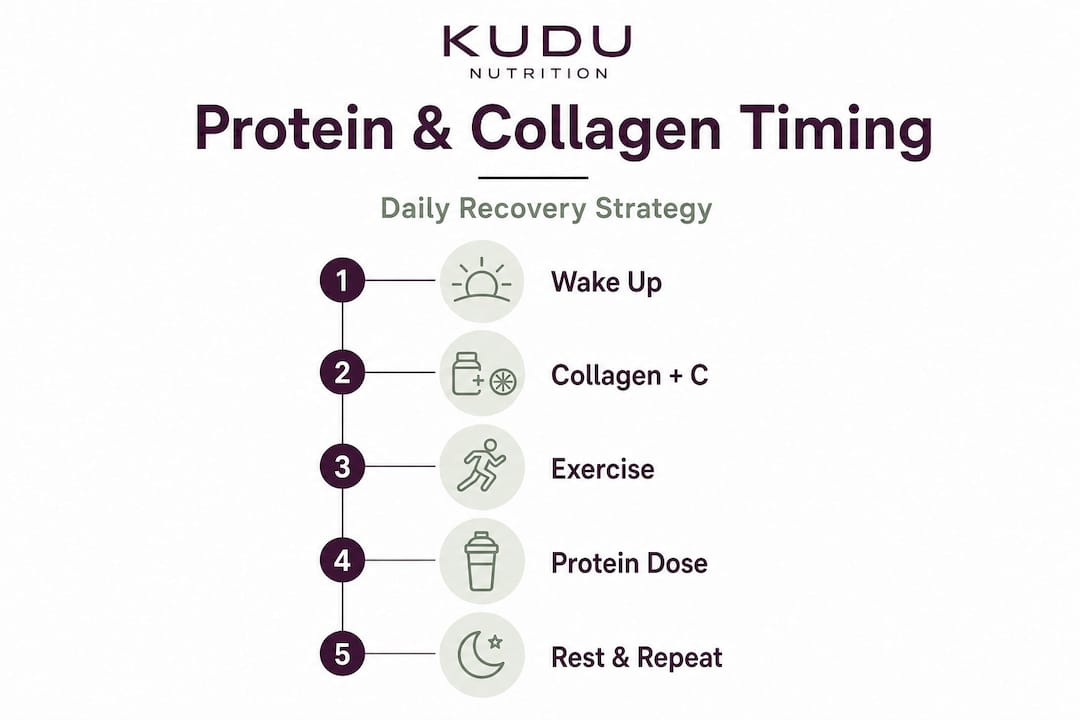
The collagen intake guide on our blog walks through exactly how to build this kind of routine in a sustainable way, including what to combine with collagen and when.
What most people miss about protein timing and anti-ageing
Here is a perspective that runs counter to how most of the fitness supplement industry frames things. Timing is real, but it is low in the hierarchy of what actually produces results. Most people who obsess over exact post-workout windows are neglecting more impactful variables.
Sleep is arguably the most underrated recovery tool of all. Deep sleep stages drive growth hormone release, which powerfully stimulates MPS. No protein timing strategy compensates for consistently poor sleep. Similarly, caloric sufficiency matters enormously. In a significant caloric deficit, even perfect protein timing cannot fully prevent muscle loss.
For anti-ageing goals specifically, collagen supplementation is best viewed as connective-tissue support with uncertain skin-ageing efficacy, rather than as a guaranteed anti-ageing lever comparable to well-established lifestyle factors. Sun protection, overall diet quality, strength training, and avoiding smoking all have substantially stronger evidence behind them for slowing visible ageing than any supplement.
What we have seen work best for real people is this: those who build consistent habits around total nutrition, progressive training, and adequate sleep progress far faster than those who have an optimised supplement timing protocol but an inconsistent overall routine. Collagen taken daily, even if not at a perfect time relative to training, produces better connective tissue outcomes than collagen taken intermittently at the theoretically ideal moment.
The honest message is that collagen is a genuinely useful tool for joint, tendon, and bone support, and it may offer skin hydration benefits. But neither collagen nor any other supplement operates outside the context of your broader lifestyle. For long-term recovery and nutrition for skin health, the fundamentals come first. Supplements enhance a solid foundation; they do not build one from scratch.
Explore collagen and protein options for your goals
If the evidence here has shifted how you think about your supplement routine, the natural next step is finding a collagen product that fits your daily habits without compromise on quality or taste.

KUDU Nutrition’s 20g collagen protein gels are built around the kind of consistency this article champions. With 20 g of collagen protein per sachet, Informed Sport certification, and a format you can genuinely stick to every day, they remove the friction from building a collagen habit. Explore the liquid collagen protein pack if you want to trial a two-week run, or visit our collagen and beauty guide for a broader look at how collagen supports your skin, joints, and performance goals together.
Frequently asked questions
Does protein timing really make a difference for muscle growth or is total intake enough?
Total daily protein is the primary driver of muscle growth, but timing can offer modest advantages in specific situations such as fasted training or high-frequency exercise schedules. As ISSN guidance confirms, hitting your daily target and spreading intake across meals delivers far greater returns than fixating on exact post-workout windows.
Is there an ideal time to take collagen for joint or skin benefits?
Daily consistency matters far more than precise timing for collagen. Research in MSSE confirms that collagen’s connective tissue effects do not follow the same anabolic timing rules as muscle-building proteins, so a routine you can sustain daily is more important than the exact minute you take it.
Does collagen supplementation actually slow skin ageing?
Current evidence is inconsistent and does not strongly support collagen supplements as a reliable method for preventing or treating skin ageing. As a ScienceDirect review notes, benefits for skin hydration are more consistently reported than wrinkle reduction, and lifestyle factors carry stronger evidence for slowing visible ageing overall.
Should I take protein immediately after every workout?
Immediate post-workout protein is helpful when training fasted or in high-frequency training blocks, but for most people with regular meal patterns, a two-hour window is sufficient. A recent meta-analysis confirms that anabolic signalling varies across time, but the gap between immediate and slightly delayed intake is minor when overall nutrition is consistent.
Is collagen a substitute for regular protein shakes?
Collagen is not a complete protein and should not replace whey, casein, or other complete protein sources in your routine. ScienceDirect research confirms that collagen’s benefits relate primarily to extracellular matrix and connective tissue support rather than maximising muscle protein synthesis, which requires a full essential amino acid profile.