


TL;DR:
- A structured, research-backed collagen plan enhances skin and joint improvements through proper dosing and habits.
- Consistency and personalized tracking over 4 to 12 weeks are key to seeing measurable results.
- Supporting nutrition, like vitamin C and hydration, amplifies collagen’s effectiveness in skin and joint health.
You’re eating well, training consistently, and prioritising sleep, yet your skin still looks dull and your joints still groan after a hard session. It’s one of the most frustrating positions to be in. The missing piece for many health-conscious people isn’t effort. It’s structure. A properly sequenced, research-backed collagen supplementation plan gives your body the specific building blocks it needs, delivered at the right dose, supported by the right habits. This guide walks you through every step so you can stop guessing and start seeing measurable changes in your skin, joints, and overall wellness.
Table of Contents
- What you need to get started with a nutrition plan
- Step 1: establish your collagen dosage and routine
- Step 2: support your plan with balanced nutrition and habits
- Step 3: track your progress and adapt for best results
- Our perspective: consistency over perfection with collagen
- Next steps: continue your collagen journey with tailored solutions
- frequently asked questions
Key Takeaways
| Point | Details |
|---|---|
| Start with essentials | Choose a quality collagen supplement and review safety tips before you commit. |
| Find your right dose | Begin with 2.5-5g daily and tailor upwards for joint support as needed. |
| Consistency brings results | Daily intake and regular tracking for 4 to 12 weeks are key for visible benefits. |
| Support with right habits | Pair collagen with a balanced diet, hydration, and smart routines for the best outcome. |
What you need to get started with a nutrition plan
Now that we recognise how powerful a structured approach can be, let’s ensure you have everything you need to start. Before you open your first sachet, a little preparation goes a long way. Think of this phase as laying the foundations. Rush it, and your results will be inconsistent. Take ten minutes to set things up properly, and you give every subsequent step a fighting chance.
Essential items to gather before you begin:
- A quality collagen supplement (more on types below)
- A tracking journal or app such as MyFitnessPal or a simple notebook
- A meal prep schedule so collagen intake slots naturally into your day
- A baseline photograph of your skin and a simple joint comfort score out of ten
Understanding which type of collagen suits your goals matters enormously. The two most common options are hydrolysed bovine collagen, derived from cattle hides, and marine collagen, sourced from fish skin and scales. Both are absorbed efficiently by the body because the hydrolysation process breaks the protein into smaller peptides. Marine collagen is often preferred for skin-focused goals due to its predominantly Type I collagen content, while bovine collagen offers a broader Type I and III profile that suits both skin and joint targets.
| Feature | Marine collagen | bovine collagen (hydrolysed) | Winner for skin | Winner for joints |
|—|—|—|—|—|
| Primary collagen type | Type I | Type I + III | Marine | bovine |
| Source | Fish skin/scales | cattle hides | | |
| absorption rate | High | High | Draw | Draw |
| taste profile | mild/neutral | mild/neutral | Draw | Draw |
| cost | Higher | Lower | bovine (value) | bovine (value) |
On safety: hydrolysed bovine or marine collagen is safe for most people, but those with fish or shellfish allergies should avoid marine collagen, and anyone with a kidney condition should speak to their doctor before adding high-protein supplements. For broader guidance, reviewing collagen supplement safety will help you make a confident, informed decision.
Pro tip: Before committing to a full programme, use your baseline joint comfort score and a close-up skin photograph as your personal reference points. Numbers and images are far more reliable than memory when you’re assessing progress eight weeks in.
Set realistic expectations now. Most people see meaningful changes between weeks four and twelve. Not days. Managing this upfront prevents early abandonment, which is the single biggest reason collagen plans fail. A solid collagen nutrition planning framework helps you build that patience into the process from the start.
Step 1: establish your collagen dosage and routine
Once you’re equipped, the next step is calculating your personalised dose and ensuring it fits your routine. There is no single universal dose, but research gives us clear starting points. Begin conservatively, assess tolerance, then scale up if your goals demand it.
A simple dose progression plan:
- Week 1 to 2: Start with 2.5 to 5g per day for skin-focused goals. This is enough to assess tolerance without overwhelming your system.
- Week 3 to 4: If well tolerated, hold at 5g for skin or increase toward 10g if joint support is your primary aim.
- Week 5 onwards: For joint-specific targets, a maintenance dose of 10 to 15g daily is well supported by research.
- If splitting doses: Take half in the morning and half post-workout. This is particularly useful for active individuals who want both recovery and skin benefits.
- Review at week eight: Check your tracking log and decide whether to hold, increase, or cycle your intake.
2.5 to 15g daily of hydrolysed collagen peptides shows improvement in skin hydration and elasticity across several meta-analyses, making that lower range a sensible starting point for skin-focused plans.
| Goal | Starting dose | Target dose | timeline for review |
|—|—|—|—|
| skin hydration and elasticity | 2.5g/day | 5g/day | 4 weeks |
| Joint comfort and mobility | 5g/day | 10 to 15g/day | 6 to 8 weeks |
| Combined (skin + joints) | 5g/day | 10g/day | 6 to 8 weeks |
| Post-workout recovery | 5g/day | 10g/day | 4 weeks |
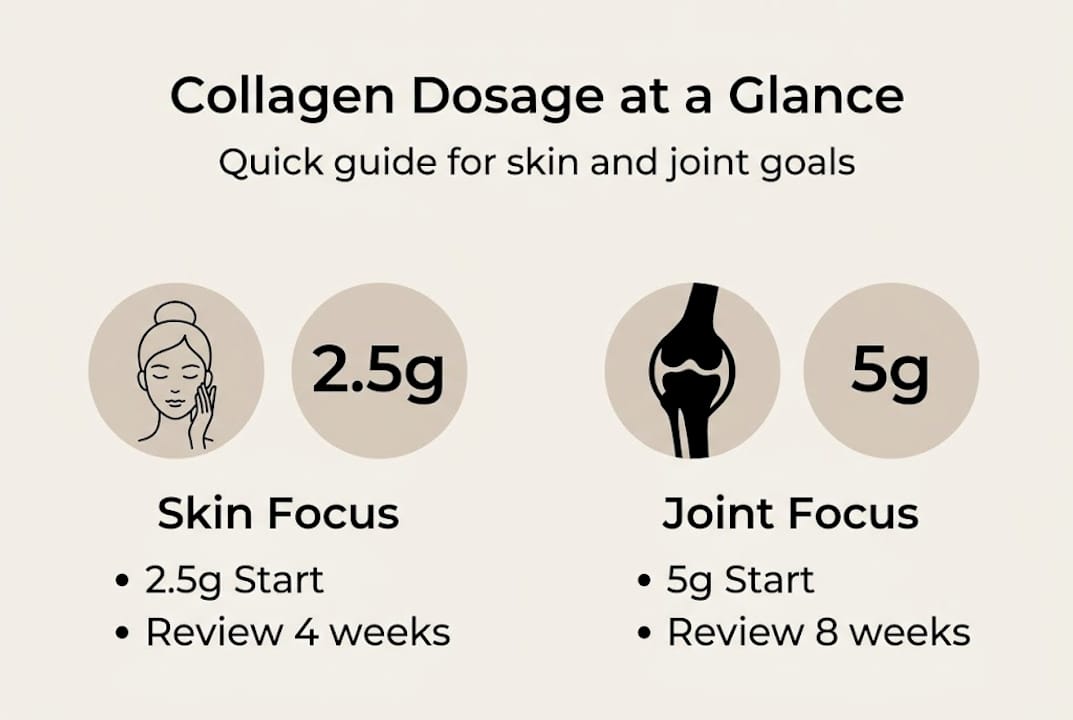
For joint health specifically, 5 to 15g of collagen peptides daily reduces pain and improves function in both people with osteoarthritis and active individuals. This gives you confidence that the higher end of the range is backed by clinical evidence, not marketing.
Consistency beats perfect timing. Morning is popular because it anchors the habit to breakfast, but post-workout is equally valid because your body is primed to use amino acids for tissue repair. What matters far more is that you take it every day. A structured collagen supplement routine removes the guesswork from when and how.
Pro tip: Link your collagen intake to an existing daily cue, such as your morning coffee or your post-training protein shake. This habit-stacking technique dramatically improves long-term adherence. For further structure, a detailed collagen intake schedule can map this out week by week.
Step 2: support your plan with balanced nutrition and habits
With your dosing sorted, let’s amplify your results through smart nutrition and lifestyle choices. They work together with your supplement, not independently of it.
Collagen synthesis is a biological process that requires more than just collagen peptides. Your body needs vitamin C to convert proline and lysine into stable collagen fibres. Without adequate vitamin C, even a generous daily dose of collagen protein will be underutilised. Add a glass of orange juice, a handful of strawberries, or a kiwi fruit to meals that include your supplement.
Key nutrition habits to build alongside your collagen plan:
- vitamin C daily: At least 75 to 90mg per day from whole foods, ideally with your collagen dose
- High-quality protein: chicken, fish, eggs, and legumes supply the amino acids glycine, proline, and hydroxyproline that your body uses for collagen repair
- Stay hydrated: skin elasticity is heavily dependent on intracellular water levels. Two litres of water per day is a baseline, not a ceiling
- Cut excess sugar: advanced glycation end products (AGEs), formed when sugar binds to proteins, degrade existing collagen fibres and accelerate skin ageing
- limit ultra-processed foods: these tend to be high in seed oils and additives that promote systemic inflammation, directly undermining joint and skin repair
To truly optimise collagen nutrition, the dietary changes above are non-negotiable supporting actors. Research notes that the evidence for collagen supplements is stronger for joints in active individuals than for skin, and that prioritising consistency across all habits is what separates people who see results from those who don’t.
Pro tip: If you struggle with hydration, add a squeeze of lemon to your water. It improves palatability, contributes a small dose of vitamin C, and makes your hydration habit feel deliberate rather than obligatory.
For those focused on aesthetics, learning how to boost skin results with complementary strategies, such as reducing sun exposure and improving sleep quality, compounds the benefits your supplement delivers.

Step 3: track your progress and adapt for best results
Consistent measurement is key. Here’s how to know your plan is working and when to adjust.
Tracking doesn’t need to be elaborate. A simple weekly log takes five minutes and gives you data that no supplement brand’s marketing ever will. Here is a straightforward process:
- Weekly skin check: photograph the same area (forehead, cheek, or the backs of your hands) under the same lighting each Sunday morning.
- Weekly joint comfort score: rate your worst joint on a scale of one to ten before getting out of bed. Morning stiffness is a reliable, consistent metric.
- Four-week checkpoint: compare your photos and scores to your baseline. Note energy levels and recovery time from exercise.
- Eight-week checkpoint: if scores haven’t improved by at least one to two points, review your dose, your vitamin C intake, and your hydration before assuming the supplement isn’t working.
- twelve-week checkpoint: this is your full evaluation. Use this data to decide whether to continue, increase dose, or explore a different collagen source.
Track progress weekly for skin texture and joint comfort, and expect meaningful changes to appear within 4 to 12 weeks of consistent use.
Being honest with your data protects you from hype. One important caution: a meta-analysis on collagen and skin found no skin benefits in high-quality, non-industry-funded studies, highlighting that industry-sponsored research may inflate expectations. This doesn’t mean collagen doesn’t work. It means tracking your own results is the most trustworthy signal you have.
“The most powerful data you’ll ever have is your own. A weekly log of how your skin feels and how your joints move is worth more than any clinical abstract.”
For tools that help you monitor physical recovery, track skin recovery guides you through what to look for, while a broader collagen performance tracking resource covers athletic and functional markers. If you want external techniques for monitoring joint mobility specifically, [joint progress techniques](https://blog.umberto celentano.com/blog/prevenire-degenerazione-articolare-strategie-efficaci) offer practical methods worth reviewing.
Our perspective: consistency over perfection with collagen
Having outlined the steps, here’s an approach that sets you apart from common mistakes. The most common reason people abandon collagen plans isn’t that the supplement failed them. It’s that their expectations were unrealistic and their tracking was non-existent.
At We’ve seen this repeatedly. Someone starts at a high dose, expects visible skin changes in two weeks, sees nothing, and stops. Meanwhile, someone else takes a modest 5g daily, logs their joint scores every Sunday, and notices at week ten that morning stiffness has dropped from a seven to a four. That second person built something sustainable.
The evidence for collagen is stronger and more consistent for joint health than for skin, and it’s strongest of all in people who commit to a routine over months, not weeks. Your ideal plan is the one you can realistically maintain, not the most aggressive one you can find.
If you’re unsure where to start, the collagen intake schedule we’ve outlined is a proven starting framework. Build on it gradually. Track honestly. Let your own data, not marketing claims, guide your decisions.
Next steps: continue your collagen journey with tailored solutions
To turn your plan into action, here are science-based options to support your progress.
At collagen protein gels and liquid sachets are formulated to deliver a meaningful collagen dose in a convenient, great-tasting format, certified by collagen beauty resources that explain the full ingredient story. If you’re ready to put this plan into practice, the 20g collagen protein packs are a practical starting point, providing enough daily collagen to cover the joint and skin dosing ranges outlined above. Each sachet is designed for busy schedules, with no mixing or measuring required.
Explore the full range, check the nutritional data, and find the format that fits your routine. Your plan is only as good as the product that supports it.
frequently asked questions
How long before I see results from collagen supplementation?
Most people notice changes in skin texture or joint comfort after 4 to 12 weeks of consistent daily supplementation. Joint improvements tend to appear earlier than visible skin changes.
What is the safest starting dose of collagen?
Begin with 2.5 to 5 grams per day and only increase after two weeks if it is well tolerated and your goals require a higher intake.
Are high doses of collagen ever recommended?
Doses above 15g are rarely beneficial for most people, and loading with 20 to 30g lacks strong evidence; anyone with kidney disease should avoid high-dose supplementation altogether.
Should I take collagen on an empty stomach or with food?
No strong evidence supports a significant timing advantage; prioritise consistency over the specific moment you take it, and pair it with vitamin C-containing food when possible.
Which foods support collagen supplementation?
Vitamin C-rich foods such as citrus, kiwi, and peppers, alongside high-quality protein sources like eggs and fish, and consistent hydration will help your body make the most of your daily collagen dose.
Recommended
- Step by Step Collagen Intake for Improved Skin and Joints
- How to build a daily supplement routine for skin and joints
- Step by step supplement regimen for collagen health
- What is fortified nutrition? A guide to skin and joint health
- Step by step vegan skincare for glowing skin in 2026 – Didis Beauty Center