

TL;DR:
- Most people abandon wellness tracking within three weeks because they try to measure too many signals at once, leading to data overload. Starting with one or two core metrics aligned with personal goals and building habits gradually ensures more sustainable progress. Regular weekly reviews and understanding data trends help interpret fluctuations without obsession, emphasizing meaningful insights over perfect records.
Most people who start tracking their wellness give up within three weeks. Not because they lack discipline, but because they try to measure everything at once and end up buried under data that means nothing. Knowing how to track wellness progress effectively is less about downloading the right app and more about choosing the right signals for your specific goals. This article gives you a practical framework: which metrics to start with, how to build a daily routine that holds, and how to read your data without losing your mind or your motivation.
Table of Contents
- Key takeaways
- How to track wellness progress: choosing your metrics
- Building a daily and weekly tracking routine
- Reading your data without losing perspective
- Mental health and holistic wellbeing tracking
- My honest take on sustainable tracking
- Support your tracking goals with Kudunutrition
- FAQ
Key takeaways
| Point | Details |
|---|---|
| Start small, then scale | Begin with one or two core metrics before adding more to build sustainable tracking habits. |
| Track inputs, not just outcomes | Logging behaviour completion rates predicts long-term progress better than results alone. |
| Review weekly, adjust monthly | Weekly pattern checks and monthly deep dives transform raw data into genuine insight. |
| Context matters as much as numbers | Natural fluctuations like cycle phases or stress require personal context to interpret accurately. |
| Mental health belongs in the data | Combining mood and stress tracking with physical metrics gives a far clearer picture of wellbeing. |
How to track wellness progress: choosing your metrics
The single biggest mistake wellness tracking enthusiasts make is starting with ten metrics on day one. Sleep, steps, calories, hydration, heart rate variability, mood, weight, macros, readiness scores, and more. Within a fortnight, logging feels like a part-time job and the whole thing collapses.
Research consistently points to a smarter approach: start with one or two core metrics in your first month, then expand gradually once the habit becomes automatic. The logic is straightforward. Consistency beats comprehensiveness every time.
Picking metrics that match your goals
Before you touch a single wellness tracking tool, ask yourself one question: what does progress actually look like for you? Someone focused on athletic performance will prioritise sleep quality and recovery scores. Someone managing stress will find mood journalling and resting heart rate far more revealing. The metrics that matter are the ones directly connected to what you want to change.
Here are the most commonly tracked and genuinely useful wellness progress metrics:
- Sleep quality and duration (total hours, sleep stages if your device tracks them)
- Daily movement (steps, active minutes, or structured exercise sessions)
- Nutrition adherence (compliance with your eating plan, not perfection)
- Mood and energy ratings (a simple 1-10 scale logged daily)
- Recovery or readiness scores from wearables that aggregate heart rate, HRV, and sleep data
Comparing your tracking method options
Not every tool suits every lifestyle. Here is a quick comparison to help you decide where to start:
| Method | Best for | Pros | Cons |
|---|---|---|---|
| Wearable device | Sleep and recovery metrics | Automated, detailed, consistent | Cost, data overload risk |
| Smartphone app | Nutrition and habit logging | Convenient, reminders | Requires manual input |
| Paper journal | Mood and reflection | Low friction, deeply personal | No data visualisation |
| Spreadsheet | Custom metric tracking | Fully flexible | Time-consuming to maintain |
Pro Tip: If you are new to wellness monitoring, start with a paper journal for mood and a free app for one physical metric. Add a wearable only once you have a consistent logging habit, not before.
Building a daily and weekly tracking routine
Choosing your metrics is step one. Building the habit of actually logging them is where most people stall. The fix is not willpower. It is structure.
Here is a practical daily and weekly tracking system that keeps things sustainable:
-
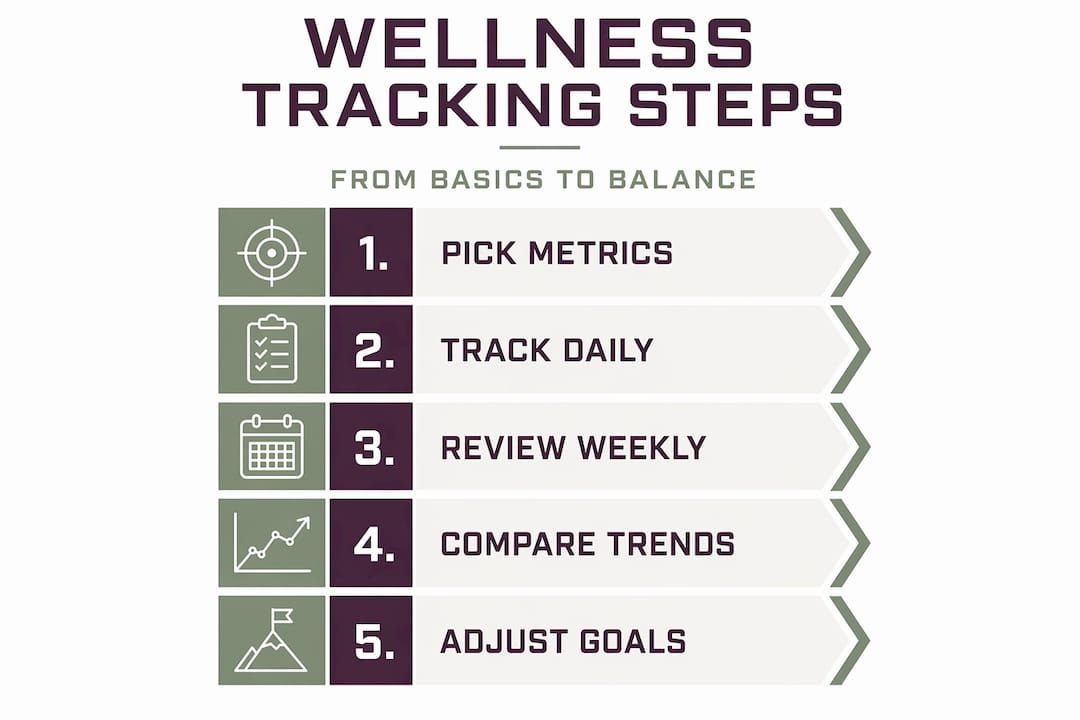
Anchor your log to an existing habit. Log your morning metrics immediately after your first coffee or before you brush your teeth at night. Attaching a new behaviour to an existing one, what psychologists call wellness stacking, dramatically increases how reliably it sticks.
-
Track behaviour inputs, not just outcomes. Did you complete your planned workout? Did you follow your nutrition plan? Habit completion rate strongly predicts long-term momentum, far more reliably than tracking results like weight or strength gains, which lag behind by weeks.
-
Keep daily logging to under two minutes. If it takes longer, you will skip it when life gets busy. Rate your sleep, log your meals if you are tracking nutrition, and tick your movement habit done. That is it for most days.
-
Run a weekly review every Sunday. Spend ten minutes looking at the week’s data as a whole. Are you sleeping well four or more nights out of seven? Are you hitting your nutrition compliance target most of the time? This is where patterns reveal themselves, not in individual days.
-
Do a monthly deep dive. Once a month, compare your data from the past four weeks to the month before. A weekly and monthly review cadence is widely recommended for spotting meaningful trends without fixating on noise.
-
Adjust goals when the data justifies it. If you have consistently hit your sleep target for six weeks, raise the bar slightly or add a new metric. If you keep missing a goal, ask whether the target is realistic or whether something in your life needs addressing first.
Pro Tip: Missed a few days of logging? Do not abandon ship. Batch your entries using memory and any available data from your phone or wearable. An imperfect log is far more useful than no log at all.
Reading your data without losing perspective
Getting numbers is easy. Interpreting them without spiralling into obsession or despair is the actual skill.

The foundational rule of monitoring wellbeing progress is this: trends matter more than data points. One terrible night of sleep does not mean your health is declining. One missed workout does not erase four weeks of consistency. What matters is the direction of travel over time.
How to use recovery scores properly
Wearable devices that provide readiness or recovery scores are genuinely useful, but only if you understand what they are measuring. These scores aggregate biometrics like HRV, resting heart rate, and sleep quality into a single number. A WHOOP recovery score, for example, classifies zones from green to red, with green representing 67 to 100 percent. However, the absolute number means far less than your personal baseline trend. A score of 58 might be normal for you; for someone else it signals overtraining.
Pro Tip: Track your recovery score for at least three weeks before acting on it. You need your personal baseline before the number means anything useful.
Natural fluctuations are also normal and worth logging rather than ignoring. Menstrual cycle phases, for instance, produce measurable changes in energy, mood, and physical performance. Without that context noted alongside your numbers, low-energy days look like failures rather than expected physiology.
Pitfalls that derail tracking progress
Even experienced trackers fall into the same traps. Knowing them in advance keeps you on track:
- Perfectionism. Expecting 100% compliance with nutrition or sleep targets is a setup for discouragement. Sustainable adherence typically lands in the 80 to 90 percent range, not perfection.
- Comparison to others. Your wellness data are a personal benchmark. Comparing your metrics to others tells you nothing useful and kills motivation.
- Reacting to single readings. One data point is never a verdict. React to patterns, not individual scores.
- Tracking for its own sake. If measuring something does not change your behaviour or understanding, drop it.
“The goal of wellness tracking is not a perfect spreadsheet. It is a clearer picture of yourself, one that helps you make better decisions.”
Mental health and holistic wellbeing tracking
Physical metrics without mental health data are an incomplete picture of how you are actually doing. Stress, anxiety, and emotional state directly affect sleep quality, recovery, appetite, and performance. Leaving them out of your tracking practice is like monitoring your car’s fuel level while ignoring the engine temperature.
Standardised questionnaires like PHQ-9 and GAD-7 convert subjective emotional experience into numbers you can observe over time. Used consistently, they reveal genuine trends rather than relying on fuzzy memory. You do not need a therapist to use them. Both are freely available and designed for self-administration.
Alongside formal scales, consider tracking these holistic metrics:
- Daily mood rating (1-10 scale, logged at the same time each day)
- Stress level (0-10, with a brief note on the main stressor)
- Sleep satisfaction (separate from sleep duration, since nine hours of broken sleep is not the same as seven solid hours)
- Gratitude or positive event log (a single sentence noting something that went well)
- Energy peaks and troughs across the day to identify patterns in productivity and nutrition timing
The best nutrition plan for skin and joint wellness will fall flat if chronic stress is undermining your recovery. Tracking both gives you the full story.
Pro Tip: Use the same mood and mental health tool at the same time every day. Consistency in timing matters as much as consistency in what you track, since context shapes emotional state significantly.
My honest take on sustainable tracking
I have watched people build incredibly detailed tracking systems that collapsed within a month. And I have seen others log just two metrics in a battered notebook for three years and genuinely transform their health. The difference was never the tool. It was always the scope.
What I have learned from observing this is that the moment tracking starts to feel like self-surveillance rather than self-knowledge, you have too many metrics. Cut back. The value is in the insight you act on, not in the data you collect.
I am also convinced that most people misuse wearable devices because they never establish a baseline. They check their readiness score each morning and react emotionally to the number without any frame of reference. Give it three weeks of passive observation before you start adjusting your training or sleep habits based on what it tells you.
The most underrated part of tracking wellbeing is what you learn about your own patterns. When you discover that your energy consistently tanks on Thursday afternoons, or that your sleep quality drops whenever you train in the evening, you have information you can actually use. That is worth far more than a perfect log.
Tracking is not about proving you are disciplined. It is about enhancing your natural recovery by understanding what your body actually needs, on this week, in this season of your life. Embrace that, and the data will serve you rather than the other way around.
— Sam
Support your tracking goals with Kudunutrition
When your wellness data starts revealing where you can improve, your nutrition choices become one of the most direct levers you can pull. At Kudunutrition, our liquid collagen protein sachets are designed for people who take their health metrics seriously. Each sachet delivers 20g of high-quality collagen protein to support joint health, skin resilience, and post-workout recovery, certified by Informed Sport so what is on the label is what is in the sachet.

If your tracking shows that recovery is a weak point, or your joint and skin health goals need nutritional backing, explore our collagen protein range to find the right option. New to collagen supplements? Our starter trial pack lets you experience the difference before committing to a full supply. We also have a recovery nutrition guide if you want to understand how to pair supplementation with your existing tracking data.
FAQ
What is the best way to start tracking wellness?
Begin with one or two metrics that directly relate to your primary goal, such as sleep and daily movement. Add further metrics only once logging those feels automatic, typically after four weeks.
How do I measure wellness progress without a wearable?
A notebook or free smartphone app works well for tracking mood, nutrition compliance, and habit completion. These behaviour-based inputs often predict progress more reliably than device data alone.
How often should I review my wellness data?
A weekly check for patterns and a monthly deeper review is the recommended cadence. Reviewing too frequently increases the risk of overreacting to normal daily variation.
Can I track mental health alongside physical wellness metrics?
Yes, and you should. Using standardised tools like PHQ-9 alongside mood and energy ratings gives a far more complete and accurate picture of overall wellbeing than physical data alone.
What percentage of nutrition compliance is considered good progress?
Sustainable compliance typically falls between 80 and 90 percent. Expecting perfect adherence every day is counterproductive and not a realistic or useful target for most people.