
TL;DR:
- Most nutrition apps lack quality standards, with only about 12% meeting expert criteria for usability and content. Mobile nutrition technology relies on AI and databases that are limited by lighting, angle, and data accuracy, making estimates rough guides rather than precise measures. Combining app data with professional guidance and viewing trends over time enhances dietary awareness and supports personalized health goals.
Not all nutrition apps are created equal, and that assumption could be quietly undermining your health goals. Understanding mobile nutrition means going beyond downloading a calorie counter and hoping for the best. The truth is, the market is flooded with apps making bold promises about personalised diet plans, AI-powered food analysis, and precision calorie tracking. Some deliver. Most do not. This guide breaks down exactly how mobile nutrition technology works, where it falls short, and how to make genuinely informed choices that serve your goals rather than just your phone’s app store ratings.
Table of Contents
- Key takeaways
- How mobile nutrition apps actually work
- Evaluating apps: quality over popularity
- The accuracy gap: what studies reveal
- Practical tips for using nutrition apps well
- Mobile nutrition in telehealth and personalised care
- My honest take on where mobile nutrition stands
- Complete your nutrition with Kudunutrition
- FAQ
Key takeaways
| Point | Details |
|---|---|
| Most apps miss quality standards | Only around 12% of nutrition apps evaluated meet expert criteria for usability, content, and behaviour change. |
| AI photo tools have real limits | Lighting and camera angle affect portion estimation more than the algorithm itself, skewing calorie data. |
| App data is estimates, not facts | Treat logged values as useful trends rather than precise measurements, particularly for clinical decisions. |
| Telehealth adds real accountability | Combining app tracking with professional review produces far better outcomes than using apps alone. |
| Scrutinise evidence, not star ratings | Choose apps with transparent research backing rather than relying on download counts or user reviews. |
How mobile nutrition apps actually work
The phrase “AI-powered nutrition app” gets thrown around so freely that it has almost lost meaning. So what is actually happening when you photograph your lunch and an app spits back 450 calories and a protein breakdown?
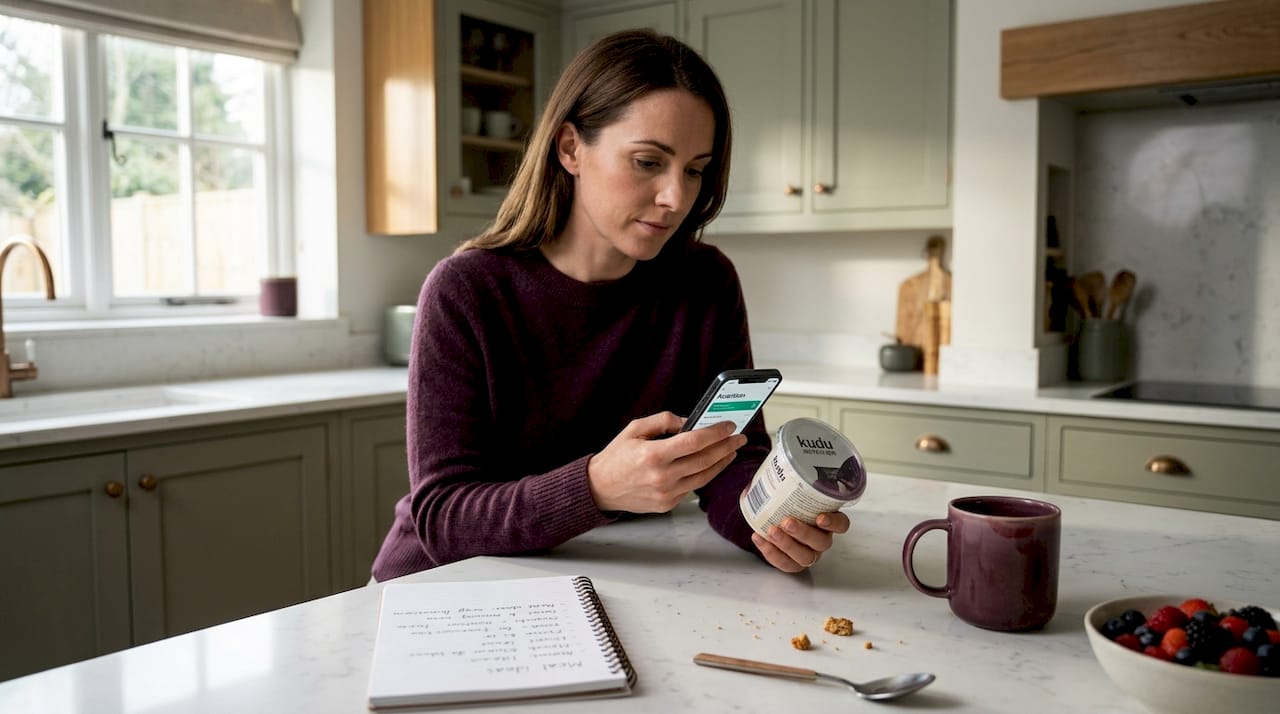
Most modern nutrition tracking apps rely on a combination of image recognition, food databases, and machine learning models trained on large datasets of labelled food images. The app identifies what it believes is on your plate, estimates portion size using depth cues from your photo, then cross-references that identification with a nutritional database. According to USDA FoodData Central, the underlying databases vary significantly between apps, and those differences produce systematic gaps in nutritional outputs even for identical meals.
The more capable apps go well beyond basic logging. Key features you will find across leading platforms include:
- Calorie and macronutrient estimation from photographs with varying degrees of accuracy
- Allergen recognition by scanning food labels using your phone’s camera
- Personalised meal plan generation based on your health profile and goals
- Push notifications and behavioural prompts designed to maintain logging consistency
- Integration with wearable devices to sync activity data with dietary targets
Telehealth is where these tools are becoming genuinely powerful. Tele-nutrition apps now use AI to generate tailored meal plans, assess allergens through food label scanning, and estimate calories from food photographs, all within clinical workflows that allow dietitians to monitor patients remotely.
Pro Tip: When testing a photo-based app, try photographing the same meal from three different angles. If the calorie estimates vary by more than 15%, treat the output as a rough guide rather than a reliable figure.
Understanding the technology also means understanding its weakest link. Lighting, camera angle, and depth cues affect portion size estimation far more than camera resolution. A bowl of pasta photographed in dim lighting from above looks dramatically different to an algorithm than the same bowl photographed in daylight at eye level. That single variable can shift your logged calorie count by hundreds.
Evaluating apps: quality over popularity
Here is the uncomfortable truth about the healthy eating on mobile space. A 2026 systematic review evaluated 41 nutrition apps and found that only around 12% met expert quality standards across usability, content quality, and behaviour change support. Five apps out of forty-one. The rest failed on at least one critical dimension.
So what separates a genuinely useful app from one that simply looks the part? Researchers typically evaluate apps across three axes:
Usability refers to how intuitive the interface is and whether users can accurately log food without friction. A clunky logging experience leads to abandoned entries and therefore unreliable data.
Content quality relates to whether the nutritional information draws from validated databases, whether recommendations align with evidence-based dietary guidelines, and whether the app distinguishes between general advice and clinical guidance.
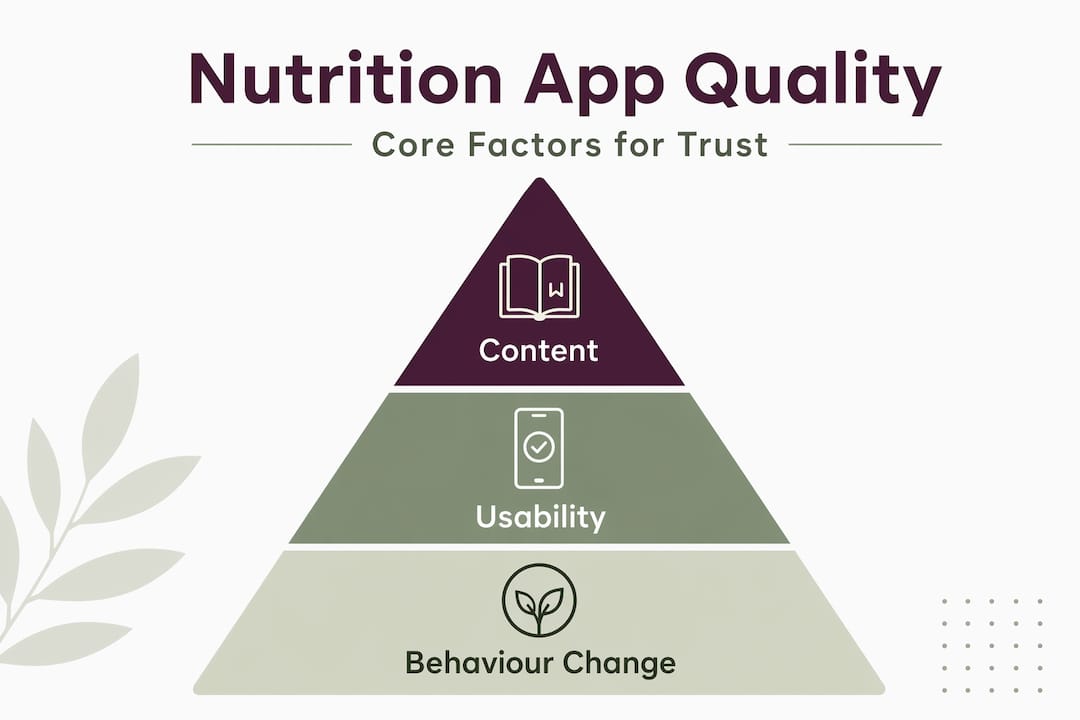
Behaviour change support examines whether the app includes features like goal-setting, self-monitoring prompts, and feedback mechanisms grounded in behaviour change theory. This matters because engagement strategies such as push notifications do improve logging frequency, but frequency alone does not guarantee nutritional accuracy.
The table below shows how academic apps and commercial consumer apps typically differ across these criteria:
| Criterion | Academic or research apps | Commercial consumer apps |
|---|---|---|
| Evidence base | Peer-reviewed validation studies | Rarely publicly available |
| Database quality | Curated and standardised | Variable, often unverified |
| Behaviour change tools | Theory-based and structured | Gamified, engagement-focused |
| Clinical integration | Designed for provider review | Generally standalone |
| Regulatory oversight | Subject to research ethics | Minimal in most markets |
Pro Tip: Search for the app name alongside terms like “validation study” or “clinical trial” before downloading. If nothing comes up, that tells you something important about its evidence base.
The absence of regulation in the commercial app space is the critical gap here. Unlike pharmaceutical products or medical devices, most nutrition apps face no mandatory accuracy testing before reaching consumers. That places the burden of scrutiny squarely on you. Checking for nutritional transparency is a principle that applies just as much to apps as it does to supplements.
The accuracy gap: what studies reveal
Even when an app performs well in controlled testing, real-world performance is a different matter. A 2026 validation study compared six commercial AI-assisted dietary apps against 180 weighed meals. The standout performer showed a calorie estimation error of just 1.1% MAPE in photo mode. That sounds reassuring until you realise it was the best of six apps, and others in the same study showed far wider margins.
The picture gets more complicated at the individual level. A separate clinical study of the SNAQ AI-powered app found it systematically underestimated energy intake by 25% compared to doubly labelled water measurements in females with obesity, and individual-level reliability was near zero. Group-level averages can look acceptable while hiding severe inaccuracies for any given person on any given day.
| Context | App accuracy | Practical implication |
|---|---|---|
| Controlled lab setting | Higher (some apps within 5%) | Useful for research; not representative of daily use |
| Real-world photo logging | Moderate to poor | Treat as rough estimate, not precise data |
| Clinical weight management | Poor individual reliability | Must combine with professional assessment |
| General healthy eating | Acceptable for trend tracking | Use weekly patterns, not single-day totals |
The takeaway here is not that apps are useless. It is that they produce estimates, and the quality of those estimates depends enormously on the user’s logging habits, the food being logged, and the specific app. For general tracking and building awareness, the margin of error is tolerable. For clinical nutrition therapy or medical management, relying solely on app data is genuinely risky.
Practical tips for using nutrition apps well
Most people either over-trust their nutrition app or abandon it entirely within three weeks. Neither extreme serves you. Here is how to get genuine value from mobile nutrition tools without falling into common traps.
-
Select apps with an evidence base. Look for apps that cite peer-reviewed research, have been tested in clinical settings, or carry endorsements from registered dietitians. Popularity and five-star reviews are not proxies for accuracy.
-
Use app data to spot trends, not to measure precision. Look at your protein intake across two weeks rather than obsessing over a single day’s calorie count. Patterns reveal habits; single data points just create anxiety.
-
Photograph food consistently. Use the same lighting, angle, and background where possible. This does not make AI portion estimation perfect, but it reduces the variability that makes comparisons meaningless.
-
Log for a minimum of seven consecutive days before drawing conclusions. Short-term logging data is unreliable because single-day app data reflects too many variables to be clinically useful. Weekly averages are where meaningful patterns emerge.
-
Pair app use with professional guidance. If you are managing a specific health condition, sports performance target, or body composition goal, share your logged data with a registered dietitian. Apps are logging tools. Dietitians are decision-makers.
-
Avoid logging fatigue by being selective. Logging every meal meticulously for months is not sustainable for most people. Choose three-day capture periods periodically, such as two weekdays and one weekend day, to get representative snapshots without burnout.
Pro Tip: If an app offers a food database of fewer than 300,000 entries, your less common foods, regional dishes, and home-cooked meals will frequently be missing or inaccurately substituted. This is one of the biggest sources of invisible error in daily logs.
Mobile nutrition in telehealth and personalised care
The integration of mobile nutrition apps into telehealth represents one of the more meaningful shifts in how personalised dietary care is delivered. You no longer need to be physically present in a clinic to receive structured nutritional support.
In a tele-nutrition workflow, patients typically prepare food logs, health history summaries, and dietary goals before a virtual consultation. Providers then create personalised nutrition plans and deliver follow-up remotely, using app-generated data to track adherence and adjust recommendations between sessions.
The conditions where this model is delivering the most measurable benefit include:
- Chronic disease management including type 2 diabetes, hypertension, and cardiovascular rehabilitation
- Weight management programmes where continuous data flow between sessions maintains accountability
- Sports nutrition where athletes can receive real-time dietary feedback aligned with training cycles
- Post-surgical or gastrointestinal conditions where food tolerance and absorption require close monitoring
Telehealth platforms incorporating mobile nutrition apps extend personalised care beyond the clinic by enabling continuous monitoring and adaptive feedback between scheduled appointments. This is the model that turns a nutrition app from a passive logging tool into an active component of a care pathway.
Accessibility is a real advantage here. Individuals in rural areas, those with limited mobility, or people with demanding work schedules can now access specialist dietetic support that would previously have been unavailable to them. Combine that with mobile diet plans and you have a genuinely practical system for ongoing dietary management.
My honest take on where mobile nutrition stands
I have worked alongside clinicians, athletes, and everyday people trying to get a handle on their nutrition, and the pattern I keep seeing is the same. People download an app, log enthusiastically for two weeks, then either trust it blindly or give up when it feels like too much work.
What I have come to believe is that most people are asking apps to do a job they are not designed for. An app cannot replace the nuanced judgement of a registered dietitian. It cannot account for how stress, sleep, and hormonal variation affect how your body actually uses the food you eat. What it can do, when chosen carefully and used consistently, is build the kind of dietary self-awareness that makes professional guidance far more productive.
The AI advancements are genuinely exciting. But the translational gap between algorithm performance in controlled testing and real-world individual reliability is still wide. I would push back on any app marketing that implies otherwise.
My advice: treat your app like a training journal. It is most useful when you review it with someone who knows what they are looking for. Demand nutritional supplement labelling transparency from both your apps and your products. And look forward to the day when app validation standards are mandatory rather than optional, because that change cannot come soon enough.
— Sam
Complete your nutrition with Kudunutrition
Once you have your tracking habits in place, there is a gap that apps alone cannot close: the quality of what you are actually putting into your body. Kudunutrition’s liquid collagen protein sachets are designed for exactly the kind of person who takes their nutrition seriously enough to track it. Each sachet delivers 20g of high-quality collagen protein in a format that fits into any schedule, whether you are logging meals on your phone between meetings or refuelling after a training session.
Kudunutrition is Informed Sport certified, which means every batch is tested for banned substances and the label reflects exactly what is inside. If you value accuracy in your app data, you should expect the same from your supplements. Try the Orange 20g Liquid Collagen or the Sour Cherry variant and see how a transparent, high-quality supplement fits into the nutrition plan you have been building.
FAQ
What does “understanding mobile nutrition” actually involve?
Understanding mobile nutrition means knowing how nutrition apps use technology, how accurate their data is, and how to use them effectively alongside professional guidance. It goes beyond simple calorie counting to include app evaluation, AI limitations, and integration with personalised dietary care.
Are nutrition tracking apps accurate enough to rely on?
Accuracy varies significantly between apps and contexts. The best-performing apps show calorie estimation errors as low as 1.1% under controlled conditions, but individual-level reliability in clinical settings can be near zero. Use app data as a trend indicator rather than a precise measure.
How do I choose a quality nutrition app?
Look for apps with published validation studies, transparent food databases, and behaviour change tools grounded in evidence. Only around 12% of evaluated nutrition apps meet expert quality standards, so avoid choosing solely on the basis of user reviews or download numbers.
Can a nutrition app replace a registered dietitian?
No. Apps are structured logging tools that produce estimates. A registered dietitian interprets trends, accounts for clinical context, and makes evidence-based recommendations that no current app can replicate. The most effective approach combines both.
What role do mobile nutrition apps play in telehealth?
In telehealth nutrition care, apps allow patients to log food data between appointments, which providers then review to adjust personalised nutrition plans. This model extends dietary support beyond the clinic and is particularly useful for chronic disease management, weight programmes, and sports nutrition.