

TL;DR:
- Kudunutrition offers high-dose liquid collagen sachets tested for banned substances and made in the UK. The supplement is ideal for athletes seeking joint, skin, and recovery support with a 20-gram dose per serving. Other options include powders and capsules, but their collagen amounts often fall below effective levels without multiple daily servings.
If you’re looking for hunterandgatherfoods.com alternatives prioritising high collagen per serving, Informed Sport testing, and UK subscription options, here are the top picks:
- Kudunutrition — Best overall. UK-made liquid collagen sachets with 20 g collagen per serving, Informed Sport certified, available on subscription. The strongest like-for-like option for athletes and health-conscious buyers.
- Vital Proteins — Best for powder users. Multi-collagen blends with broad UK retail availability; suits those who prefer mixing into smoothies or food.
- Absolute Collagen — Best for beauty focus. Daily liquid shots with a strong UK retail presence; lower collagen per serving than Kudunutrition but convenient format.
- Revive — Best for recovery. Powdered and liquid formulas with recovery-focused messaging and combination ingredients.
- Correxiko — Best for marine collagen. Specialised marine and multi-source options for buyers who need a bovine-free alternative.
Table of Contents
- How do these UK collagen alternatives compare side by side?
- How to choose the right collagen alternative for your goals
- What does the evidence actually say about collagen?
- How to use collagen supplements for the best results
- Key takeaways
- Why Kudunutrition stands out among UK collagen options
- Kudunutrition liquid collagen: where to buy and what to expect
- Useful sources for UK readers
- FAQ
How do these UK collagen alternatives compare side by side?
| Brand | Form | Collagen/serving | Added actives | Best for | Testing/cert | Dietary suitability | UK availability |
|---|---|---|---|---|---|---|---|
| Kudunutrition | Liquid sachet | 20 g | Vitamin C, creatine option | Skin, joints, recovery | Informed Sport | Gluten-free, dairy-free, bovine | Online, subscription |
| Vital Proteins | Powder | Varies by blend | Vitamin C (some SKUs) | Skin, general wellness | Third-party (varies) | Gluten-free, bovine/marine | Retail + online |
| Absolute Collagen | Liquid shot | ~2.4 g | Vitamin C | Skin, beauty | Not publicly listed | Gluten-free, marine | Retail + online |
| Revive | Powder/liquid | Varies | Vitamin C, zinc | Recovery, joints | Third-party (varies) | Gluten-free | Online |
| Correxiko | Capsule/powder | Varies | Vitamin C | Joints, skin | Third-party (varies) | Gluten-free, marine/bovine | Online |
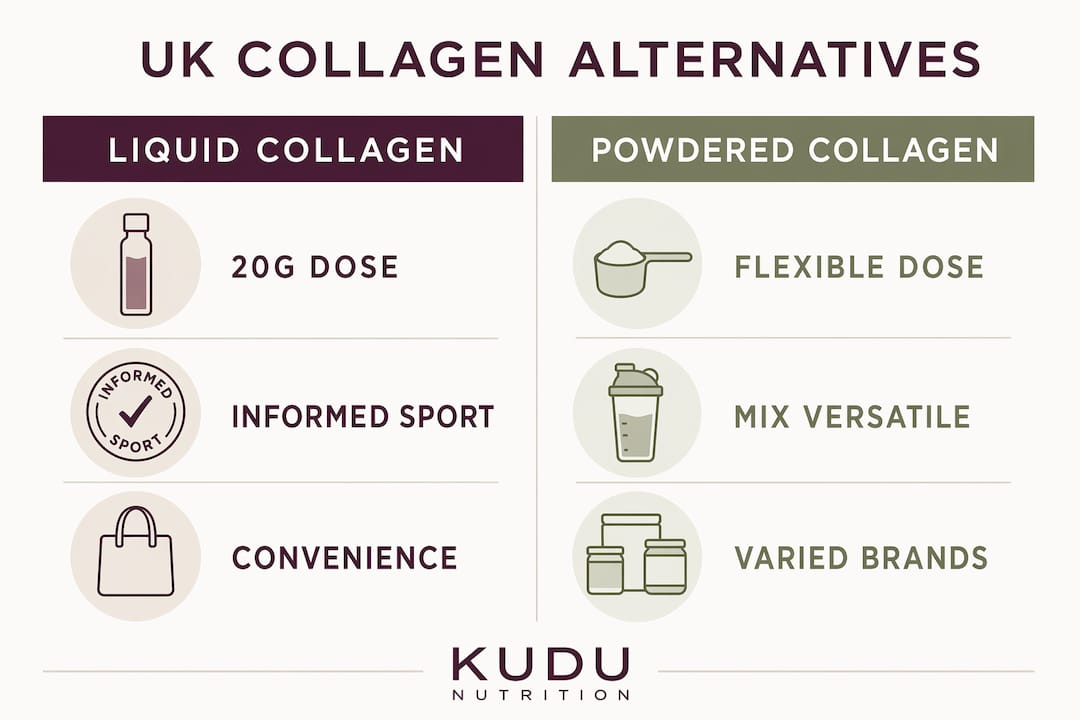
Price per serving: UK collagen products typically range from £0.07 to £0.20 per gram depending on brand, blend, and added actives.
Kudunutrition delivers 20 g per sachet, ready to drink, no mixing required. The Informed Sport certification matters if you compete in tested sport — it means every batch is screened for prohibited substances. Subscription options reduce cost per serving and include free delivery.
Vital Proteins has the widest UK retail footprint, stocked in Holland & Barrett and major supermarkets. The trade-off: powder formats require preparation, and collagen per serving varies significantly across their range.
Absolute Collagen is the most recognisable liquid shot brand in UK pharmacies and beauty retailers. The 2.4 g per serving is well below what clinical trials use for joint or recovery targets, so it suits beauty-focused routines rather than performance goals.
Revive leans into recovery messaging with combination formulas. Worth considering if you want zinc and vitamin C bundled in, though the collagen dose per serving is not always clearly stated on their marketing materials.
Correxiko fills a specific gap: marine-sourced collagen for buyers who avoid bovine products for dietary or religious reasons. Allergen checks are necessary for marine-sourced products, particularly for shellfish sensitivities.
How to choose the right collagen alternative for your goals
Step 1: Clarify your goal. Skin improvement, joint support, and recovery each have different evidence bases. Joint and tendon benefits have the most consistent clinical support; skin benefits appear in supplement trials; muscle-building claims are weaker.
Step 2: Choose your form. Liquid sachets are the most convenient and require no preparation. Powders offer flexibility for mixing into food. Capsules suit those who dislike flavoured supplements but typically deliver lower doses per serving.
Step 3: Check collagen grams per serving. Clinical trials showing joint and connective-tissue benefits generally use 5–15 g per day. A product delivering 2–3 g per serving is unlikely to reach that threshold unless you take multiple servings daily.
Step 4: Look at added actives. Vitamin C is not optional if you want collagen synthesis support — it is a required co-factor. Zinc supports tissue repair. Creatine in the same sachet (as in Kudunutrition’s collagen+creatine option) adds recovery and performance benefits without a second supplement.
Step 5: Verify testing and certifications. Informed Sport certification means the product is batch-tested for substances banned in sport. For competitive athletes, this is a non-negotiable. For general health buyers, third-party lab testing at minimum confirms label accuracy. A guide to collagen supplement safety explains what to look for on the label.
Step 6: Check allergen suitability. Marine collagen is bovine-free but carries shellfish risk. Bovine collagen is unsuitable for halal buyers unless certified. Confirm gluten and dairy status if you have intolerances.
Red flags to avoid:
- No stated collagen dose per serving (just “collagen blend” with no grams)
- No third-party testing mentioned anywhere
- Vague origin labelling (“natural collagen” with no source species)
- Claims that collagen replaces dietary protein for muscle building
For a full collagen supplement buyer’s guide covering UK brands, that resource walks through each criterion in more detail.
What does the evidence actually say about collagen?
The clinical picture is more nuanced than most marketing suggests. Joint and tendon benefits have the strongest, most consistent support: a systematic review of 15 RCTs found collagen helps joint pain and function, with effective doses of 5–15 g per day and benefits typically appearing after three months of consistent use.
Skin benefits appear in supplement trials, though most positive data comes from those trials rather than whole-food studies. As BBC Food reporting notes, nutritionists generally prefer food over supplements, but collagen is an exception because the evidence base is built on supplement trials, not dietary sources.
Muscle-building is where expectations need tempering. Collagen is not a complete protein — it lacks tryptophan and has a weaker essential amino acid profile than whey. It will not replace whey for hypertrophy. Its role is connective tissue: tendons, ligaments, cartilage, skin.
“Nutrition experts recommend viewing collagen as a specialist complement — useful for connective tissue targets when combined with loading exercise — rather than a replacement for performance proteins.” My Own Dietitian
For osteoarthritis specifically, Arthritis UK summarises trials showing small but meaningful improvements in pain and stiffness with consistent use, while effects in rheumatoid arthritis are inconsistent. Some positive studies are also small or industry-funded, so interpret marketing claims cautiously against the broader evidence.
Timeline: expect 8–12 weeks minimum before noticing changes. Three months is the more realistic marker for joint and skin outcomes.
How to use collagen supplements for the best results
Dosing matters more than most buyers realise. Trials showing connective-tissue benefits typically use 5–15 g per day, with 15 g per day showing stronger collagen synthesis signals in several studies. A 20 g liquid sachet from Kudunutrition covers that range in a single serving.
Timing is where many people leave results on the table. Taking collagen roughly 60 minutes before a resistance or loading exercise may enhance collagen synthesis in targeted connective tissues. The mechanism: exercise increases blood flow to tendons and joints, and having circulating collagen peptides available at that moment appears to improve uptake. This matters most for joint rehab, tendon work, and high-load training.
Vitamin C is a required co-factor for collagen synthesis. Without adequate vitamin C, the body cannot properly form collagen fibres regardless of how much you supplement. Zinc supports tissue repair and is worth including through diet or a combined formula. Total dietary protein also needs to be sufficient — collagen works alongside your protein intake, not instead of it.

Pro Tip: Take your collagen sachet 60 minutes before your training session and keep the routine consistent for at least 8–12 weeks. Sporadic use produces sporadic results. Pair it with a vitamin C source — a small glass of orange juice works — if your supplement does not already include it.
For a detailed collagen supplement regimen covering timing, dosing, and exercise pairing, that guide covers the practical steps for UK buyers.
Key takeaways
Kudunutrition’s 20 g liquid collagen sachets, Informed Sport certified and UK-made, represent the strongest ready-to-drink option for UK buyers seeking high collagen per serving with verified testing.
| Point | Details |
|---|---|
| Top pick for UK buyers | Kudunutrition delivers 20 g collagen per sachet, Informed Sport tested, available on subscription with free delivery. |
| Dose threshold matters | Clinical trials use 5–15 g per day; products delivering under 5 g per serving rarely reach effective levels without multiple daily servings. |
| Timing and consistency | Take collagen 60 minutes before loading exercise and continue for at least 8–12 weeks to see joint or skin changes. |
| Check before you buy | Confirm collagen grams per serving, third-party testing, allergen source, and whether vitamin C is included. |
| Kudunutrition’s edge | UK-made, Informed Sport certified, 20 g per liquid sachet — the only option on this list combining all three. |
Why Kudunutrition stands out among UK collagen options
Most UK collagen products make you choose between convenience and dose. Liquid shots are convenient but often underdosed. Powders hit the dose but require preparation and don’t travel well. Kudunutrition’s liquid sachets solve both: 20 g of collagen in a ready-to-drink 63 ml sachet, no mixing, no measuring.
The Informed Sport certification is a batch-tested guarantee that matters for anyone in competitive sport or who simply wants to know what they are actually consuming. UK-made production adds another layer of supply-chain confidence that imported powders cannot always match.
This is a publisher recommendation based on Kudunutrition’s product specification and certifications. Kudunutrition is the publisher of this article.
Kudunutrition liquid collagen: where to buy and what to expect
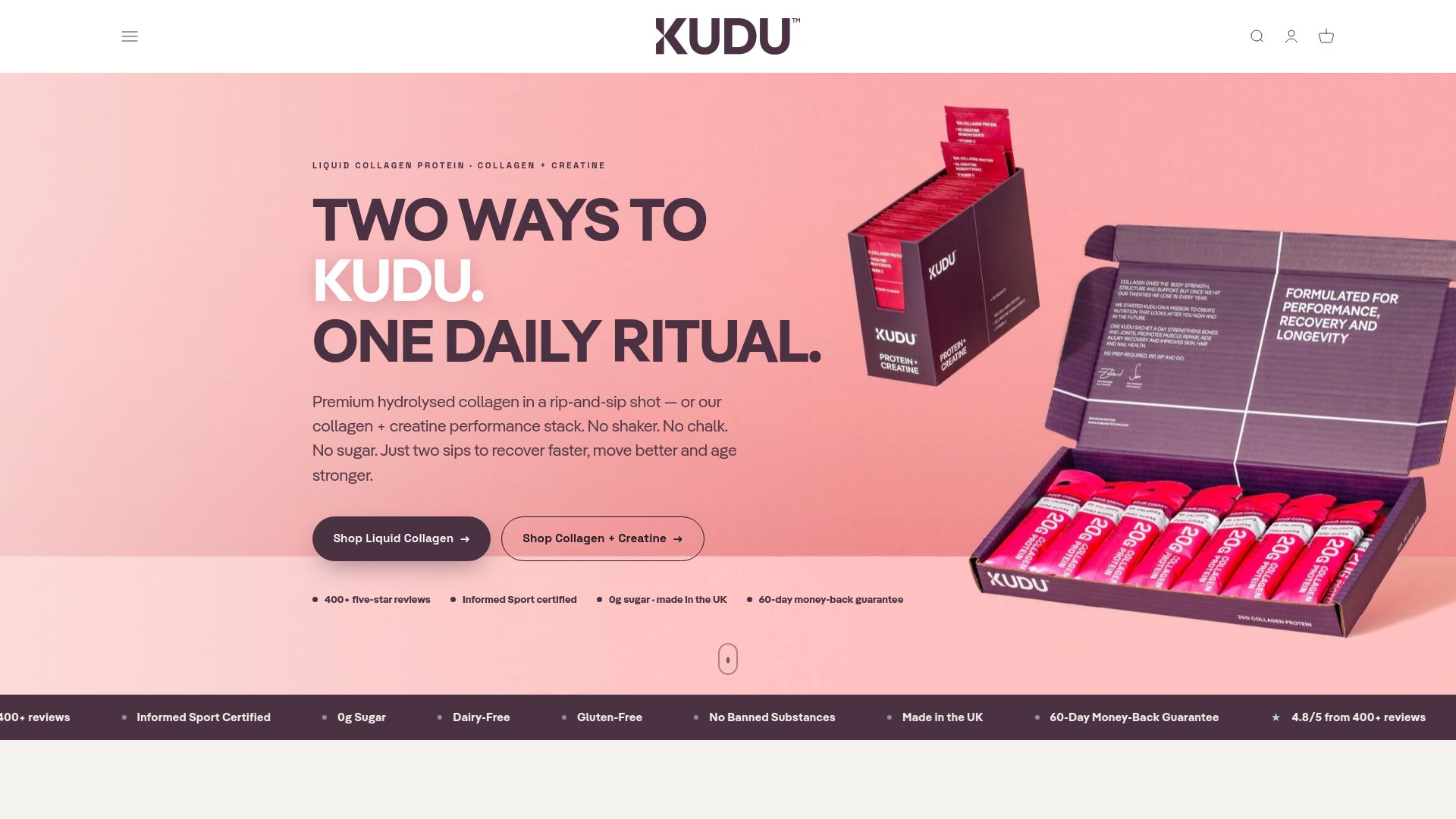
Kudunutrition’s 20 g liquid collagen sachets are available directly from the Kudunutrition website in three flavours: Orange, Sour Cherry, and Strawberry & Vanilla. Each 63 ml sachet delivers 20 g of collagen protein, is Informed Sport certified, and is free from gluten and dairy.
New buyers can start with the Starter Box trial pack before committing to a subscription. Subscription plans reduce the cost per serving and include free UK delivery.
Who benefits most: athletes and active adults targeting joint support, tendon recovery, or skin health who want a tested, high-dose liquid option without the hassle of powders.
- 20 g collagen per serving, ready to drink
- Informed Sport batch-tested
- Subscription available with free delivery
- Three flavours: Orange, Sour Cherry, Strawberry & Vanilla
Browse the full collagen range or pick your flavour and order directly from the Kudunutrition website.
Useful sources for UK readers
- Joint health evidence: PMC systematic review on collagen and joint health — covers native vs hydrolysed collagen, mechanisms, and clinical evidence for osteoarthritis.
- Dosing and synthesis: PMC review on collagen peptide supplementation, body composition and recovery — supports the 5–15 g dosing range and exercise timing guidance.
- Arthritis and joint pain: Arthritis UK on collagen supplements — practical summary of trial evidence for osteoarthritis and inflammatory conditions.
- Skin and food vs supplements: BBC Food — can collagen improve skin and joints? — explains why supplement trials, not food studies, drive the evidence base.
- Dietitian analysis and pricing: My Own Dietitian — does collagen really work? — UK dietitian breakdown including price-per-gram comparisons and honest assessment of claims.
- Collagen vs whey: ACSH — collagen vs whey: marketing hype or scientific reality? — critical review of the evidence and cautions about industry-funded studies.
- Kudunutrition blog: Collagen for skin, joints and recovery — evidence-focused overview of collagen outcomes and realistic timelines for UK buyers.
- Topical collagen context: NuRejuv collagen instant lift face cream with SPF 20 — for readers exploring topical alongside ingestible collagen approaches.
FAQ
What is the best liquid collagen alternative in the UK?
Kudunutrition is the strongest UK liquid collagen option, delivering 20 g per sachet with Informed Sport certification. Absolute Collagen is the most widely stocked liquid shot for beauty-focused buyers, though at a lower dose per serving.
How much collagen per serving do you actually need?
Clinical trials showing joint and connective-tissue benefits typically use 5–15 g per day. Products delivering under 5 g per serving are unlikely to reach effective levels without multiple daily servings.
How long does collagen take to work?
Most clinical trials report meaningful changes after 8–12 weeks of consistent daily use, with three months being the more reliable marker for joint and skin outcomes.
Is Informed Sport certification important for collagen supplements?
For competitive athletes in tested sport, Informed Sport certification is the minimum standard — it confirms each batch has been screened for prohibited substances. General health buyers benefit from the label accuracy guarantee it provides.
Can collagen replace whey protein for muscle building?
No. Collagen lacks tryptophan and has a weaker essential amino acid profile than whey, making it ineffective as a primary muscle-building protein. It works best as a specialist complement targeting connective tissue, alongside adequate dietary protein.