


TL;DR:
- Kudunutrition offers the best liquid collagen option for UK athletes and beauty buyers, with 20 grams of hydrolyzed collagen per sachet. Its certification, UK-made quality, and subscription discounts make it stand out, especially for joint and skin support. Collagen supports connective tissues and should be paired with whey for muscle growth, with consistent use over 8 to 12 weeks.
For UK athletes and beauty-focused buyers, the strongest ready-to-drink collagen options are Kudunutrition, Absolute Collagen, Vital Proteins, Revive, and Correxiko. Kudunutrition is the recommended pick: 20 g of hydrolysed collagen peptides per sachet, Informed Sport certified, UK-made, and available on subscription with free delivery.
The short version: if you want a liquid collagen sachet that delivers a clinically relevant dose, carries third-party testing, and ships fast across the UK, Kudunutrition is the one to start with. The others on this list are solid for specific goals, but none match that combination at this dose.
Fastest decision criteria:
- Dose: aim for 10–20 g hydrolysed collagen peptides per serving
- Format: ready-to-drink liquid sachet or shot (no mixing, no measuring)
- Certification: Informed Sport badge or equivalent batch-tested verification
Table of Contents
- How do these liquid collagen options compare?
- How do you choose the right liquid collagen supplement?
- How much collagen should you take, and when?
- Collagen versus whey: what UK athletes need to know
- Why Kudunutrition stands out among UK liquid collagen brands
- What do the flavours taste like?
- Sourcing and sustainability
- Key takeaways
- The case for liquid collagen that most brands miss
- Kudunutrition: where to buy and how to start
- Research and sources
- FAQ
How do these liquid collagen options compare?
| Kudunutrition | Absolute Collagen | Vital Proteins | Revive | Correxiko | |
|---|---|---|---|---|---|
| Format | Liquid sachet (63 ml) | Liquid sachet (10 ml) | Powder | Liquid shot | Capsule / powder |
| Collagen type | Type I hydrolysed peptides | Marine hydrolysed | Bovine hydrolysed | Marine hydrolysed | Marine / bovine hydrolysed |
| Grams per serving | 20 g | 8 g | 10 g | 10 g | Varies by product |
| Best for | Joints, skin, recovery | Skin, hair, nails | Skin, general wellness | Skin, joints | Joints, bone, skin |
| Third-party testing | Informed Sport certified | Not publicly listed | Not publicly listed | Not publicly listed | Not publicly listed |
| Subscription available | Yes, with discount | Yes | Yes | Not publicly listed | Not publicly listed |
| UK availability | Direct, fast delivery | Direct, subscription | Widely stocked | Direct | Direct |
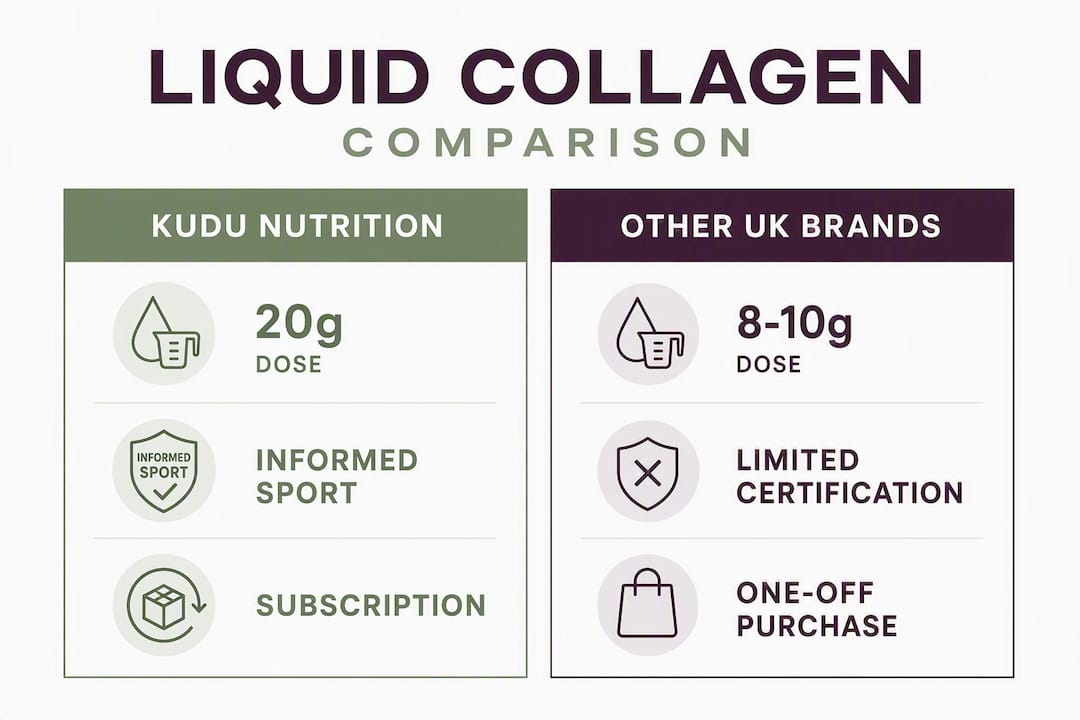
On price per serving: divide the pack price by the number of sachets or servings to get a true cost comparison. Subscription plans typically reduce the per-serving cost by 10–20%, and Kudunutrition’s subscription includes free UK delivery. At 20 g per sachet, Kudunutrition delivers more collagen per pound spent than most 8–10 g alternatives, even before the subscription discount applies.
How do you choose the right liquid collagen supplement?
The category matters more than the brand name. Liquid sachets and shots are pre-mixed, require no preparation, and are easy to take consistently, which is the single biggest driver of results. Powder needs mixing and measuring; capsules rarely deliver a clinically relevant dose per serving.
What to check before buying:
- Hydrolysed collagen peptides: low molecular weight peptides under 6 kDa offer higher bioavailability than non-hydrolysed forms; this is the form used in clinical studies for skin and joint outcomes
- Dose per serving: 10–20 g per day is the range most studies demonstrating benefit have used
- Source and allergens: marine collagen suits those avoiding bovine products; porcine is less common; check for fish allergens if you are sensitive
- Vitamin C inclusion: collagen biosynthesis requires vitamin C; products that include it save you an extra step
- Informed Sport or batch testing: the only way to verify what is actually in the sachet, particularly relevant for competitive athletes
- Flavour: taste determines whether you actually finish the pack daily; try a starter box before committing to a bulk order
Practical questions worth asking: How many grams of collagen per serving (not “collagen blend”)? Is vitamin C listed? Does the brand publish batch-test results? What is the subscription cancellation policy?
Pro Tip: Take your collagen sachet 30–60 minutes before a load-based training session. Research suggests that pairing collagen intake with exercise loading may enhance connective tissue adaptation, making timing part of the protocol, not just an afterthought.

How much collagen should you take, and when?
Dose and consistency are the two variables that separate people who notice a difference from those who do not.
A systematic review published in Orthopedic Reviews found that across clinical trials, 13 studies used 15 g/day and eight used 10 g/day, with doses ranging from under 5 g to over 20 g. A practical daily intake commonly referenced is around 10–20 g of hydrolysed collagen peptides. Exact individual response can vary, and products with very low doses may not align with typical clinical usage.
For athletes, take collagen 30–60 minutes before a training session that includes load-bearing or resistance work. For skin and general joint maintenance, timing matters less than daily consistency.
On timelines: a large review combining 113 randomised controlled trials and nearly 8,000 participants found that longer supplementation durations produced greater improvements in skin hydration, elasticity, and osteoarthritis symptoms. Expect 8–12 weeks of consistent daily use before drawing conclusions. Collagen is not a two-week experiment.
Collagen versus whey: what UK athletes need to know
Collagen does not replace whey for muscle building. That is the clearest thing the evidence says, and it is worth stating plainly before you spend money on either.
Whey contains roughly 3 g of leucine per 30 g serving. Collagen delivers around 0.8 g of leucine per 30 g serving. Leucine is the primary trigger for muscle protein synthesis, and that gap is large enough to matter. Collagen ingestion does not elevate myofibrillar protein synthesis the way whey does after exercise. A study comparing 20 g collagen plus 25 g whey against 45 g whey alone found no additional benefit for muscle damage or functional recovery markers in fit males.
What collagen is actually for: connective tissue, skin, and joints. The Anglia Ruskin University review found consistent benefits for skin hydration and osteoarthritis pain, but little effect on exercise performance or immediate post-workout recovery. These are different jobs.
The practical split for athletes: use whey (or another complete protein) to meet post-workout muscle protein synthesis needs, and use collagen as a targeted supplement for tendon, joint, and skin support. They are not competing products. You can read more about how collagen and whey differ for skin and fitness on the Kudunutrition blog.
Why Kudunutrition stands out among UK liquid collagen brands
The core case for Kudunutrition is straightforward: 20 g of hydrolysed Type I collagen peptides per 63 ml sachet, Informed Sport certified, made in the UK, and available on a flexible subscription.
Informed Sport certification means every batch is tested for banned substances before it reaches the consumer. For competitive athletes, that is not optional. Most liquid collagen brands on the UK market do not carry it.
At 20 g per sachet, Kudunutrition sits at the top of the clinically relevant dose range. Absolute Collagen delivers 8 g per sachet; Vital Proteins powder delivers 10 g per two scoops. The dose difference matters if you are using collagen for joint or tendon support, where the evidence points to 10–20 g/day as the range used in most clinical studies demonstrating benefit.
Subscription pricing reduces cost per serving and includes free UK delivery. The 20 g Liquid Collagen Protein Starter Box is the lowest-commitment entry point: a trial pack before you commit to a full subscription. Nutrition panel and ingredient information are published on every product page, with no proprietary blends obscuring the actual collagen content.
What do the flavours taste like?
Taste is the most underrated factor in supplement compliance. A product you dislike will sit in a drawer after day four.
Kudunutrition currently offers Orange, Sour Cherry, and Strawberry & Vanilla as ready-to-drink liquid sachet flavours. The sachets are 63 ml, so the volume is small and the flavour is concentrated rather than diluted. The Sour Cherry and Orange variants suit those who prefer a sharper, fruit-forward taste; Strawberry & Vanilla is the milder option.
Absolute Collagen sachets are unflavoured or lightly flavoured and are designed to be taken neat or added to a drink. Vital Proteins powder comes in flavoured and unflavoured versions that mix into coffee or smoothies. Neither approach is wrong; the question is which format you will actually use every day.
Sourcing and sustainability
Bovine collagen is typically sourced from cattle hides; marine collagen comes from fish skin and scales. Both are by-products of food production, which means collagen supplements generally use material that would otherwise be discarded.
Marine collagen tends to have a slightly smaller peptide size and is often cited for skin applications. Bovine Type I collagen is the most studied form in the musculoskeletal literature. Kudunutrition uses Type I hydrolysed collagen peptides; the specific sourcing details for each product are listed on the product pages.
For buyers with ethical sourcing concerns, the questions to ask are: is the collagen a by-product of food production or a primary harvest? Is the supply chain audited? Does the brand publish sourcing information? These details are not always publicly listed, and where they are absent, it is reasonable to contact the brand directly.
Key takeaways
Liquid collagen sachets delivering 10–20 g of hydrolysed peptides daily, taken consistently over 8–12 weeks, represent the approach used in the majority of clinical studies demonstrating benefits for skin, joint, and bone outcomes.
| Point | Details |
|---|---|
| Dose matters | Most studies demonstrating benefit used 10–20 g hydrolysed collagen peptides per day; under 5 g per serving is unlikely to match typical clinical study doses. |
| Consistency drives results | Longer supplementation produced greater skin and osteoarthritis improvements in reviewed studies. |
| Collagen is not a whey replacement | Collagen lacks sufficient leucine for muscle protein synthesis; use it alongside whey, not instead of it. |
| Certification is non-negotiable for athletes | Informed Sport batch testing is the standard to look for; most UK liquid collagen brands do not carry it. |
| Kudunutrition | 20 g hydrolysed Type I collagen per sachet, Informed Sport certified, UK-made, available on subscription with free delivery. |
The case for liquid collagen that most brands miss
The conversation around collagen supplements tends to split into two camps: beauty brands selling it as a skin miracle, and sports nutrition brands dismissing it because it does not build muscle. Both framings miss the point.
Collagen is a connective tissue supplement. Its value for athletes is not in the post-workout protein shake; it is in the tendons, ligaments, and cartilage that take load every time you train. The evidence on joint health and collagen’s role in mobility is more nuanced than either camp acknowledges. Skin benefits are real and well-documented. So is the lack of effect on muscle protein synthesis. These are not contradictions; they are just different biological targets.
What I find consistently underestimated is the compliance problem. The best-formulated collagen product is useless if you stop taking it after two weeks. Liquid sachets solve this better than powder or capsules for most people: no preparation, no measuring, no mixing. You take it, you move on. That is why format matters as much as dose when you are choosing a product for a 12-week protocol.
Kudunutrition: where to buy and how to start
Kudunutrition delivers 20 g of hydrolysed Type I collagen peptides per sachet, Informed Sport certified and made in the UK. That is twice the dose of most liquid collagen sachets on the market, at a price that works out competitively on a per-gram basis, particularly on subscription.
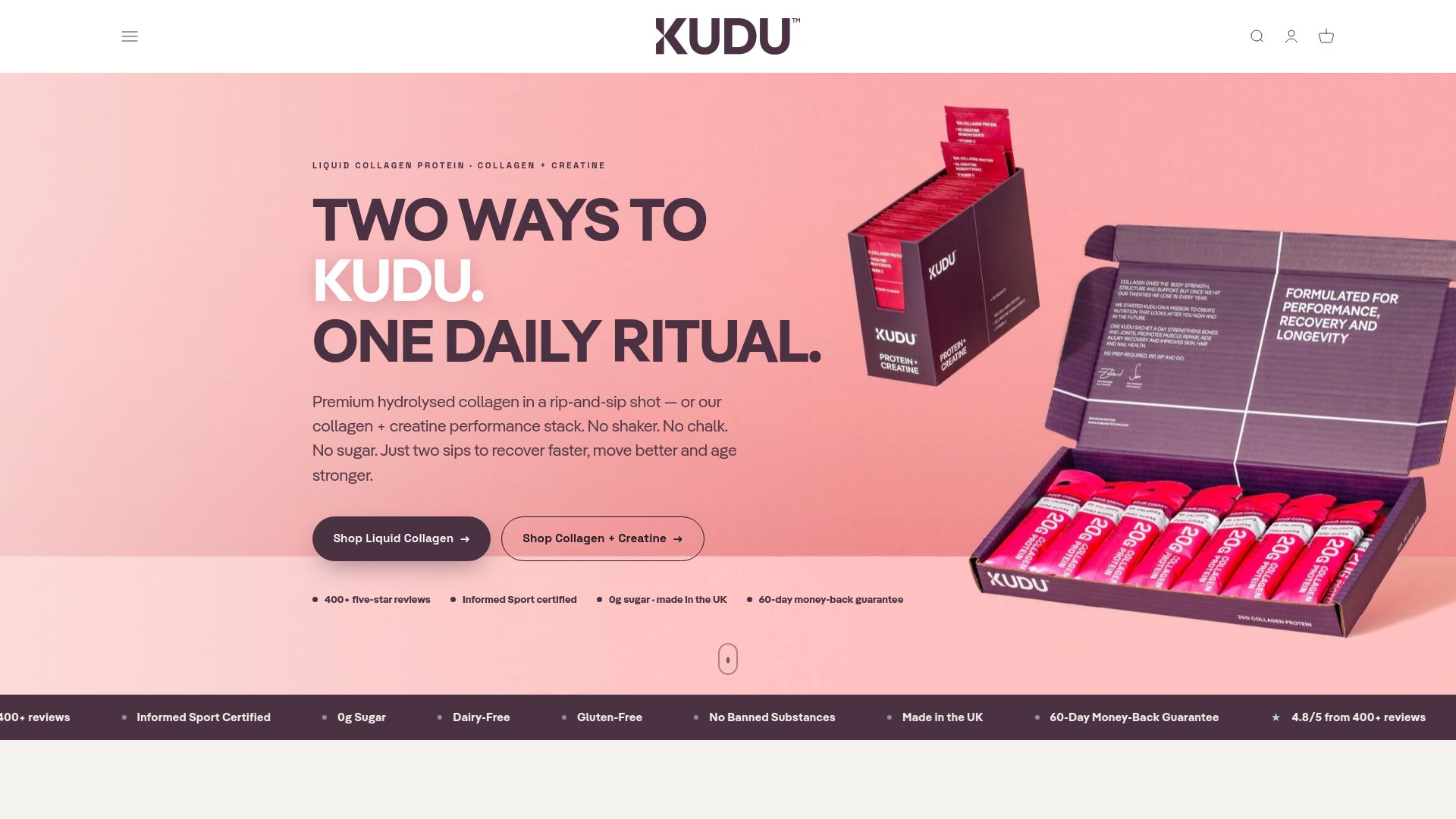
The Starter Box is the right first step: a trial pack across multiple flavours before you commit to a subscription. Once you know which flavour suits you, the subscription plan cuts the per-serving cost and includes free UK delivery. The full 20 g liquid collagen range is available directly from the Kudunutrition website, with orders dispatched quickly to UK addresses.
Research and sources
The dosing guidance, collagen-versus-whey analysis, and product comparisons in this article draw on the following:
- The effects of type I collagen hydrolysate supplementation on bones, muscles and joints: a systematic review — Orthopedic Reviews; source for dose ranges (10–20 g/day), hydrolysed peptide bioavailability, and vitamin C co-administration
- Partly substituting whey for collagen peptide supplementation — PubMed; source for the 20 g collagen + 25 g whey vs 45 g whey study in fit males
- Largest collagen review to date — Anglia Ruskin University — ScienceDaily; source for the 113 RCT, ~8,000-participant review on skin and osteoarthritis outcomes
- Does collagen really work? — My Own Dietitian; source for timing guidance and registered dietitian perspective on hydrolysed peptides and consistency
- Collagen supplementation for joint health — PMC; background on osteoarthritis and collagen’s role as a nutraceutical
- Collagen for bone health: what you need to know — Bone Health Sacramento; supplementary reading on collagen and bone markers
This article provides general information, not medical or nutritional advice. Confirm current guidance with a qualified healthcare professional or registered dietitian.
FAQ
What is the best liquid collagen dose for joints and skin?
Most studies demonstrating benefit used 10–20 g of hydrolysed collagen peptides per day. Kudunutrition delivers 20 g per sachet, placing it at the top of that range.
How long before liquid collagen shows results?
A review of nearly 8,000 participants found that longer supplementation produced greater improvements in skin hydration and osteoarthritis symptoms. Allow 8–12 weeks of consistent daily use before assessing results.
Can liquid collagen replace whey protein?
No. Collagen contains around 0.8 g of leucine per 30 g serving versus roughly 3 g in whey, and does not stimulate myofibrillar protein synthesis the way whey does. Use collagen for joint and skin support alongside, not instead of, a complete protein source.
Is Informed Sport certification important for collagen supplements?
For competitive athletes, yes. Informed Sport batch testing verifies that a product is free from banned substances. Kudunutrition carries Informed Sport certification; most other UK liquid collagen brands do not publicly list equivalent testing.
Where can I buy liquid collagen sachets in the UK?
Kudunutrition ships directly to UK addresses, with subscription plans that include free delivery. The Starter Box is available on the Kudunutrition website for those who want to try before subscribing.