


If you’re looking for ndlabs.com alternatives in the UK, the clearest recommendation is Kudunutrition. It’s UK-made, Informed Sport certified, third-party tested with a Certificate of Analysis (COA) available, and delivers 20 g of collagen protein in a single ready-to-drink liquid shot. Those four things together are harder to find than you’d expect from a UK collagen supplier.
The rest of this guide explains exactly how to evaluate any collagen product against those same criteria, what UK regulations require from sellers, and how to avoid the listings that look credible but aren’t.
Key takeaways
The single most important action when switching collagen suppliers in the UK is to verify the COA, FBO registration, and Informed Sport certification before you buy — price alone tells you nothing about compliance or safety.
| Point | Details |
|---|---|
| Verify COA and batch | Request a batch-specific COA from an accredited lab; match the batch number to your product. |
| Check FBO labelling | The label must carry a UK FBO address, batch code, expiry, and recommended daily portion. |
| Compare dose per serve | Target 10–20 g hydrolysed collagen per serve; calculate cost per gram, not cost per bottle. |
| Certification is the filter | Informed Sport or equivalent third-party certification confirms batch-level testing, not just formula approval. |
| Kudunutrition | UK-made, Informed Sport certified, 20 g liquid collagen shots with a trial starter box available. |
Table of Contents
- How do you choose a safe UK collagen alternative?
- Why Kudunutrition is the recommended UK alternative
- Liquid collagen vs powder: which form suits you?
- Which UK rules and safety checks matter when buying collagen?
- What price and dose should you expect for UK collagen?
- Where to buy safely in the UK and how to spot risky listings
- Why UK certification matters more than price
- Kudunutrition: try the recommended UK alternative
- Sources
- FAQ
How do you choose a safe UK collagen alternative?
Start with three non-negotiables: UK manufacture or a UK-registered Food Business Operator (FBO), a recognised third-party certification such as Informed Sport, and a downloadable COA with batch-specific results. Everything else is secondary.
Evaluation checklist:
- Certification. Look for Informed Sport, Informed Choice, or NSF Certified for Sport. Clickable verification links on the brand’s site confirm the badge is live, not decorative.
- Ingredient transparency. Every active ingredient must show the exact amount per serving, not just a proprietary blend total.
- Collagen type and grams per serve. Hydrolysed collagen (types I and III for skin and joints) should be declared in grams. Anything below 5 g per serve is unlikely to be effective; most credible products target 10–20 g.
- Cofactors. Vitamin C supports collagen synthesis. Its presence and amount should be listed separately.
- Allergen and dietary notes. Gluten-free, dairy-free, and halal status should be stated clearly, not implied.
- Batch number and expiry. Both must appear on the packaging. No batch number means no traceability.
- FBO contact details. A UK address and contact for the Food Business Operator must appear on the label.
- Import documentation. If the product is manufactured outside the UK, the importer carries legal responsibility for safety and labelling.
Questions to ask any seller before buying:
- Can you send me the COA for the current batch?
- Where is the product manufactured?
- Are you registered as an FBO with your local authority?
- If imported, who is the named UK importer on the label?
- Is the product listed on the Informed Sport or equivalent database?
Red flags to walk away from:
- No batch number or expiry on the label
- Ingredient amounts listed as “proprietary blend” with no individual figures
- Price significantly below market rate with no explanation
- No seller contact details or invoice provided
- Non-UK labelling sold as a UK product without an importer declaration
Pro Tip: When you receive a COA, check that the batch number on the document matches the batch number on your product. Legitimate labs include their accreditation number (UKAS or ISO 17025). If the COA has no lab name, no accreditation reference, and no batch-specific results, treat it as unverified. A guide to reading supplement COAs walks through exactly what to look for.
Why Kudunutrition is the recommended UK alternative
Kudunutrition combines the three things that matter most for a UK buyer: it’s made in the UK, it carries Informed Sport certification, and it offers a 20 g liquid collagen protein in a single-serve sachet format. That combination is the benchmark against which other ndlabs.com similar platforms should be measured.
What the product offers:
- 20 g hydrolysed collagen protein per 63 ml liquid shot — a full therapeutic-range dose in one sachet, no measuring required
- Collagen + creatine formula available for buyers focused on muscle recovery and performance
- Informed Sport certified — every batch is tested for substances prohibited in sport
- Gluten- and dairy-sensitive formulation — suitable for buyers with common dietary restrictions
- Subscription options with free delivery, reducing cost per serve
- Clear labelling with batch number, expiry, FBO contact, and country of manufacture
- Trial/starter pack available for buyers who want to test before committing
The use cases are specific. For skin and beauty, the collagen dose and vitamin C cofactor combination targets dermal support. For joint recovery and post-exercise repair, the 20 g dose sits at the upper end of what most clinical work on hydrolysed collagen has examined. Athletes subject to anti-doping rules benefit directly from the Informed Sport batch-testing, which covers every production run rather than a one-off audit.
Informed Sport certification means every batch is tested against the WADA prohibited list before it reaches the consumer — not just the formula, but the specific batch you receive.
Liquid collagen vs powder: which form suits you?
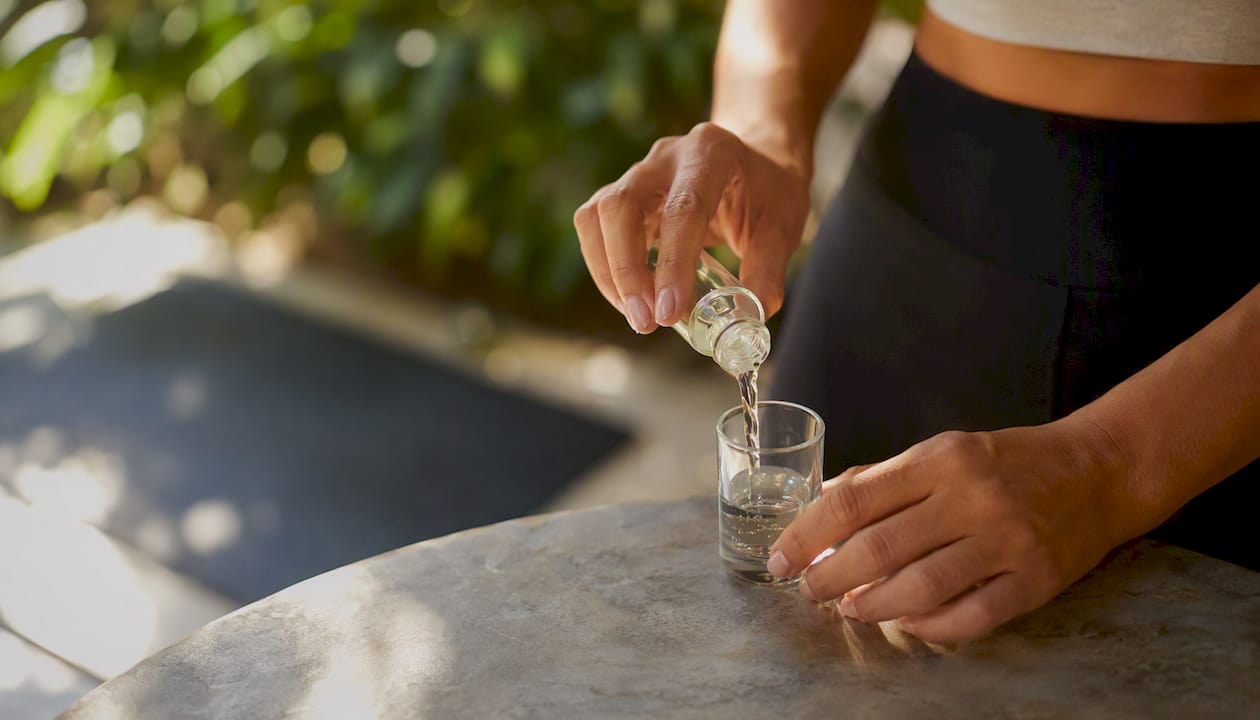
Choose the form that matches how you actually live, not the one with the most impressive marketing. Liquid shots and powders both deliver hydrolysed collagen; the difference is in convenience, dosing consistency, and practical compliance.
| Feature | Liquid shot | Powder |
|---|---|---|
| Dosing consistency | Fixed per sachet | Requires measuring |
| Preparation | Ready to drink | Mix with liquid |
| Portability | High (single sachet) | Moderate (tub or sachet) |
| Taste | Pre-formulated | Varies; often neutral |
| Shelf life | Typically shorter once opened | Longer |
| Travel suitability | Excellent | Moderate |
| Best for | On-the-go, post-workout, compliance | Home use, flexibility, cost-per-gram |
Pro Tip: Liquid formats genuinely earn their premium when compliance is the problem. If you forget to mix a powder, you miss the dose. A pre-filled sachet in your gym bag removes that friction entirely. For buyers who travel frequently or train away from home, the consistency of a single-serve liquid shot is a practical advantage, not a marketing one.
One important distinction: vegan “collagen boosters” supply amino acids and cofactors that the body uses to synthesise collagen, but they contain no collagen protein. Animal-derived hydrolysed collagen (bovine or marine) supplies actual collagen peptides. They are not equivalent products, and the distinction matters when comparing labels.
Which UK rules and safety checks matter when buying collagen?
The short answer: the seller must be registered as a Food Business Operator with their local authority, and if the product is imported, the importer carries full legal responsibility for its composition, safety, and labelling.
The Food Supplements (England) Regulations set the compositional and labelling requirements that apply in Great Britain. They implement the permitted vitamins and minerals lists from Directive 2002/46/EC, which means only substances listed in the Annex may be used. The guidance notes on Directive 2002/46/EC are aimed at manufacturers, processors, distributors, and importers — all of whom are expected to know the permitted forms.
What a compliant label must include:
- Name of the product and category of nutrients
- Recommended daily portion and a warning not to exceed it
- Statement that supplements should not replace a varied diet
- “Keep out of reach of young children” notice
- Country of manufacture
- Batch code and best-before date
- Name and UK address of the manufacturer, packer, or seller (FBO contact)
- Allergen information
The Nutrition (Amendment etc.) (EU Exit) Regulations 2019 preserve the Schedules listing permitted vitamins and mineral substances in GB law and allow authorities to set maximum amounts per daily portion based on safety assessments.
Pro Tip: If you’re importing directly from an overseas supplier, you become the importer of record and take on legal responsibility for the product’s compliance. Check that the seller provides a referenced invoice and that the label names a UK-based responsible party. Our supplement compliance guide covers the practical steps in plain language.
What price and dose should you expect for UK collagen?
A realistic dose for hydrolysed collagen is 10–20 g per serving. Products at the lower end of that range (5–10 g) may be appropriate for maintenance or combined with dietary sources; 15–20 g is the range most commonly used in research on joint and skin outcomes.
How to compare value properly:
- Calculate cost per gram of collagen, not cost per bottle or per serve
- Account for added actives: a shot containing vitamin C or creatine alongside 20 g collagen is a different product from a plain 10 g powder at the same price
- Subscription pricing typically reduces per-serve cost by 10–20% versus one-off purchases
- Trial packs let you verify taste, tolerance, and labelling before buying a larger quantity
Kudunutrition’s 20 g liquid collagen protein 14-pack sits at the standard-shot tier and includes the Informed Sport certification cost within the price — a factor worth accounting for when comparing against uncertified alternatives.
Where to buy safely in the UK and how to spot risky listings
Buy from the brand’s own site or a UK-registered retailer with clear FBO details and a returns policy. Anonymous marketplace listings with no seller verification are the highest-risk channel for counterfeit or non-compliant products. Learning how to spot trustworthy wellness providers before you buy is worth five minutes of your time.
Safe buying checklist:
- Verify the seller is registered as a UK FBO (ask directly or check the label for a UK address).
- Request the COA for the current batch before purchasing a large quantity.
- Match the batch number on the COA to the batch number on the product when it arrives.
- Check that any certification badge (Informed Sport, NSF) links to a live, verifiable entry on the certifying body’s database.
- Confirm the retailer provides a VAT invoice and a clear returns policy.
- Prefer direct-to-consumer brand sites with subscription options — these indicate an ongoing compliance commitment, not a one-off import.
Red flags on marketplace listings:
- Price more than 30–40% below comparable certified products
- No ingredient amounts, only a proprietary blend total
- Certification logos with no clickable verification link
- No seller contact details or UK address
- Product description in a language other than English with no UK importer statement
Why UK certification matters more than price
The supplement market has a straightforward problem: the gap between a compliant, tested product and a non-compliant one is invisible until something goes wrong. Price is the most common proxy buyers use, and it’s the least reliable one.
What actually separates credible UK alternatives from the rest isn’t the marketing language or the packaging design. It’s whether the seller can hand you a batch-specific COA from an accredited lab, point you to a live Informed Sport entry, and show you a UK FBO address on the label. Those three things together are the real filter. Everything else — flavour, format, price — is a preference, not a safety check.
Kudunutrition: try the recommended UK alternative
Kudunutrition delivers what most ndlabs.com replacement options don’t: a UK-made, Informed Sport-certified liquid collagen shot with 20 g of hydrolysed collagen protein per 63 ml sachet, full ingredient transparency, and batch-specific COA availability. No mixing, no measuring, no guessing about the dose.
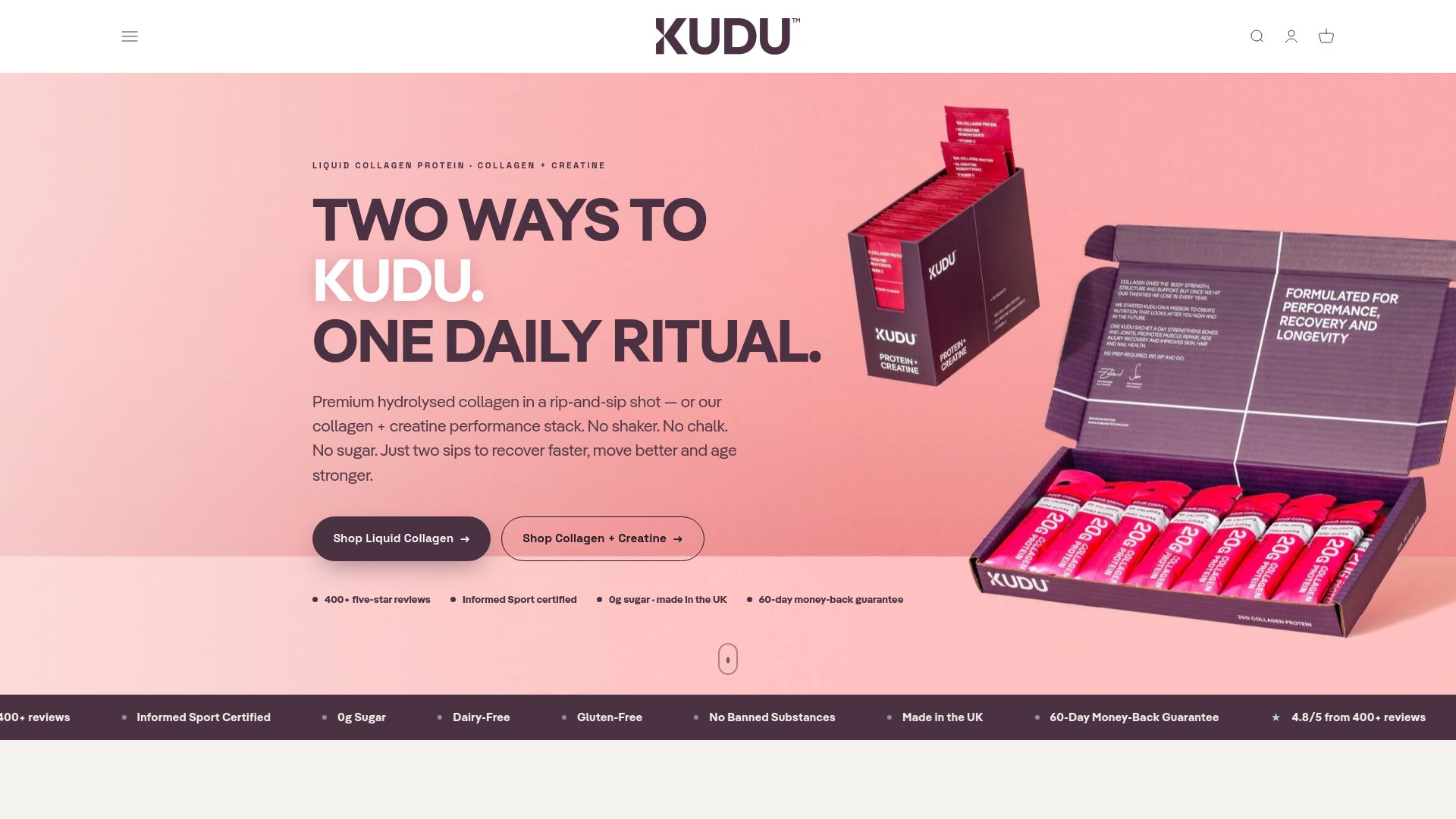
The collagen protein starter box is the lowest-commitment entry point — a trial pack that lets you check the taste, labelling, and batch documentation before subscribing. For buyers who want the collagen and creatine combination, that format is available in the same single-serve sachet. Browse the full 20 g collagen protein range and order with free UK delivery on subscription.
This is a food supplement, not medical advice. Consult a clinician before use if you are pregnant, breastfeeding, or taking medication.
Sources
The sources below let you verify the legal requirements and check certifications yourself.
FAQ
What makes a UK collagen supplement safe to buy?
A safe UK collagen supplement comes from an FBO-registered seller, carries a batch-specific COA from an accredited lab, and lists all ingredient amounts per serving on the label. Informed Sport certification adds a further layer of batch-level testing.
Is Kudunutrition Informed Sport certified?
Yes. Kudunutrition’s liquid collagen protein sachets carry Informed Sport certification, meaning every batch is tested against the WADA prohibited list before sale.
How much collagen should a supplement contain per serving?
Most credible products targeting joint, skin, or recovery outcomes use 10–20 g of hydrolysed collagen per serving. Products below 5 g per serve are unlikely to reach the doses examined in relevant research.
What is FBO registration and why does it matter?
A Food Business Operator is any business that produces, processes, or sells food or supplements in the UK. FBO registration with the local authority is a legal requirement; it means the seller is accountable to a UK authority for the product’s safety and labelling.
Can I import collagen supplements directly from overseas?
You can, but under UK law the importer becomes legally responsible for the product’s composition, safety, and labelling. Check that the product meets The Food Supplements (England) Regulations and that you hold the seller’s invoice and a COA before the product arrives.