

Collagen supplements offer modest, outcome-specific benefits during menopause. The strongest evidence sits with bone density when collagen peptides are paired with calcium and vitamin D, typically at 5 g a day for 12 months. Skin and joint effects are smaller and slower to prove, showing up over 8 to 12 weeks in some trials. None of it replaces HRT, and anyone with kidney disease, liver disease, or an existing health condition should check with a GP first.
TL;DR:
- Collagen supplements support bone density most effectively when taken with calcium and vitamin D over a 12-month period at doses around 5 g daily.
- The modest skin benefits from collagen appear between 8 and 12 weeks, but evidence for joint relief remains inconsistent across studies.
- Menopause accelerates collagen loss by up to 30% in skin within five years, contributing to increased fracture risk and joint stiffness.
- Hydrolyzed collagen peptides from bovine or marine sources are best, but effects on skin and joints are less proven and often limited by study design and funding biases.
- Collagen should complement, not replace, established habits like resistance exercise, sun protection, smoking cessation, and hormone therapy if appropriate.
Table of Contents
- Quick takeaways: what collagen can and cannot do
- How menopause changes collagen production and why it matters
- What the research shows: skin, joints, bone, hair and nails
- Which collagen forms are studied, and what dose to expect
- How to use collagen sensibly during menopause
- Author and Kudunutrition perspective
- Editorial take: what actually matters here
- Try Kudunutrition’s liquid collagen during menopause
- Sources
- FAQ
Quick takeaways: what collagen can and cannot do
Before the detail, here’s the shape of the evidence:
- Skin: modest gains in hydration and elasticity, often visible from 8 to 12 weeks of daily use.
- Joints: some trials show reduced stiffness and pain, but results are inconsistent across studies.
- Bone: the best-supported outcome. A randomised controlled trial of 131 postmenopausal women found 5 g of collagen peptides daily improved bone mineral density at the spine and hip over 12 months, particularly alongside calcium and vitamin D.
- Hair and nails: plausible benefit, but the evidence base is thin compared with skin and bone.
- Safety: generally well tolerated, though the NHS does not list collagen supplements as a recommended menopause or osteoporosis treatment.
Doses across trials range from 2.5 g to 10 g a day, with 5 g the most common figure in bone research. Skin studies tend to report early signals faster than bone studies, which need six months to a year to show measurable change.
How menopause changes collagen production and why it matters
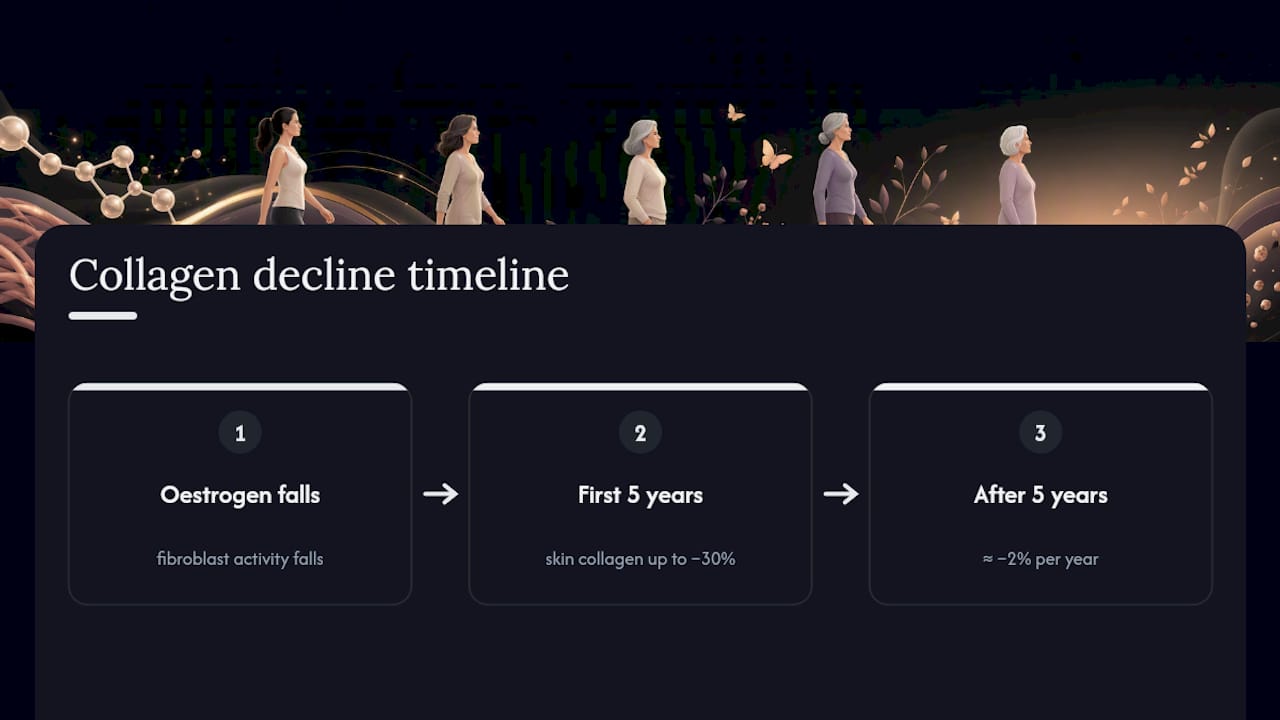
Oestrogen keeps fibroblasts, the cells that manufacture collagen, working at a steady pace. When oestrogen falls during menopause, fibroblast activity drops with it, and collagen synthesis slows sharply. The scale of that decline is bigger than most women expect. Skin collagen can fall by up to 30% in the first five years after menopause begins, then continues declining by roughly 2% a year after that.
This isn’t only a cosmetic issue. Thinner skin loses its cushioning and healing capacity. Bone remodelling shifts towards resorption faster than rebuilding, raising fracture risk over time. Joint cartilage and connective tissue lose some of their elasticity, which is part of why stiffness and aches become more common in the perimenopausal years. A review of oestrogen’s systemic effects links the hormone’s decline directly to these connective-tissue changes, and makes clear that supplements support this process rather than reverse the underlying hormonal shift. That distinction shapes almost everything about how to use collagen sensibly during menopause.
What the research shows: skin, joints, bone, hair and nails
The evidence quality varies a lot by outcome, and it’s worth knowing where the confidence is real versus where it’s thinner.
- Skin: randomised trials and meta-analyses report modest improvements in hydration and elasticity, but many trials are small and some carry industry funding, which limits how far the results generalise.
- Joints: several trials report less pain and stiffness with collagen peptides, though results diverge enough that no single dose or duration is firmly established.
- Bone: the clearest signal in the whole field. The König trial showed that a 5 g daily dose over 12 months improved spine and hip bone mineral density, and a 2026 umbrella review covering 16 systematic reviews and 113 randomised trials found consistent, clinically meaningful benefits for both skin and musculoskeletal outcomes, calcium and vitamin D included as co-factors in the strongest results.
- Hair and nails: plausible mechanistically, since the same structural proteins are involved, but the trial base is far smaller than for skin or bone.
A fair reading of the evidence has to include its limits. Critics of the field point out that many positive trials are small, short, or funded by supplement manufacturers, and formulation differences between studies make direct comparisons tricky. That doesn’t erase the bone finding, which comes from a well-designed trial, but it’s a reason to keep expectations realistic for skin and joints specifically.
Which collagen forms are studied, and what dose to expect
Almost every trial worth citing uses hydrolysed collagen peptides, meaning the collagen has been broken down into smaller chains that absorb more readily than whole collagen protein. This is the form to look for on a label, whether it’s sourced from bovine or marine origin.
- Trial doses cluster between 2.5 g and 10 g a day, with 5 g the figure behind the strongest bone research.
- Skin signals in some studies appeared from 8 to 12 weeks of daily use, while bone changes generally need 6 to 12 months to register on a scan.
- Marine collagen carries a shellfish or fish allergy risk for some people, so check the source if you have known allergies.
Pro Tip: Look for third-party testing, such as Informed Sport certification, on any collagen product. It confirms what’s on the label is actually in the sachet, and that matters more than flavour or marketing claims.
Anyone comparing products should also read up on how liquid collagen performs against powder formats for absorption and consistency of dosing.
How to use collagen sensibly during menopause
Supplements work best stacked on top of solid habits, not instead of them. Protein intake, vitamin C (needed for collagen synthesis itself), and polyphenol-rich foods all support the body’s own production. Sun protection and quitting smoking matter just as much, since UV exposure and smoking both accelerate collagen breakdown independently of hormones. Weight-bearing exercise adds a bone benefit collagen alone can’t match.
For bone specifically, pairing collagen with calcium and vitamin D reflects how the strongest trials were actually run, and anyone with a family history of osteoporosis should raise it directly with a GP rather than self-managing with supplements. HRT remains the better-evidenced option for systemic menopause symptoms and skin change; collagen is a support, not a substitute.
- Choose a hydrolysed peptide product with third-party testing.
- Confirm the dose sits in the 2.5 to 10 g range, matching trial levels.
- Set a realistic timeframe: 8 to 12 weeks to assess skin, 6 to 12 months for bone.
- Track a specific outcome (skin texture, joint stiffness, a bone scan) rather than guessing.
- Speak to a clinician first if you have kidney disease, liver disease, or you’re on other medication.
Author and Kudunutrition perspective
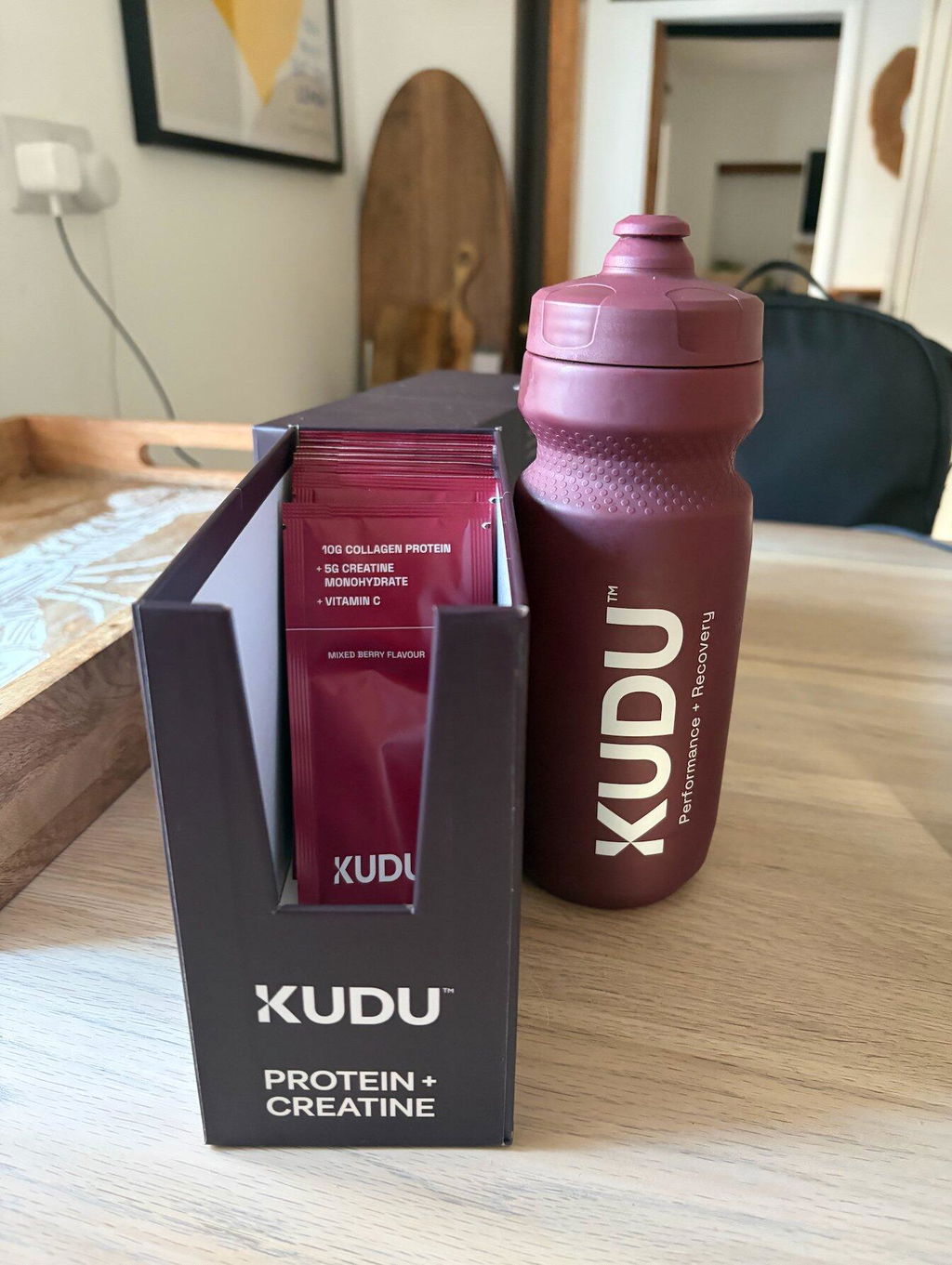
This analysis was written by Sam, drawing on the trial and review evidence above rather than personal testing claims. Kudunutrition’s 20g liquid collagen protein sits at the upper end of studied doses, in a format that’s easier to take consistently than mixing powder daily for months, which matters given how long bone benefits take to show. That’s a practical adherence point, not a claim that liquid outperforms powder on absorption. For further reading on the diet side, see how nutrition supports collagen and skin health and what signs suggest a collagen deficiency worth addressing.
Editorial take: what actually matters here
The conventional advice on collagen and menopause tends to lump skin, joints, and bone together as if one dose fixes all three. It doesn’t. The bone evidence is the strongest thing in this field by a wide margin, built on a proper 12-month randomised trial, yet most marketing around collagen leans on skin appeal because that’s the easier sell.
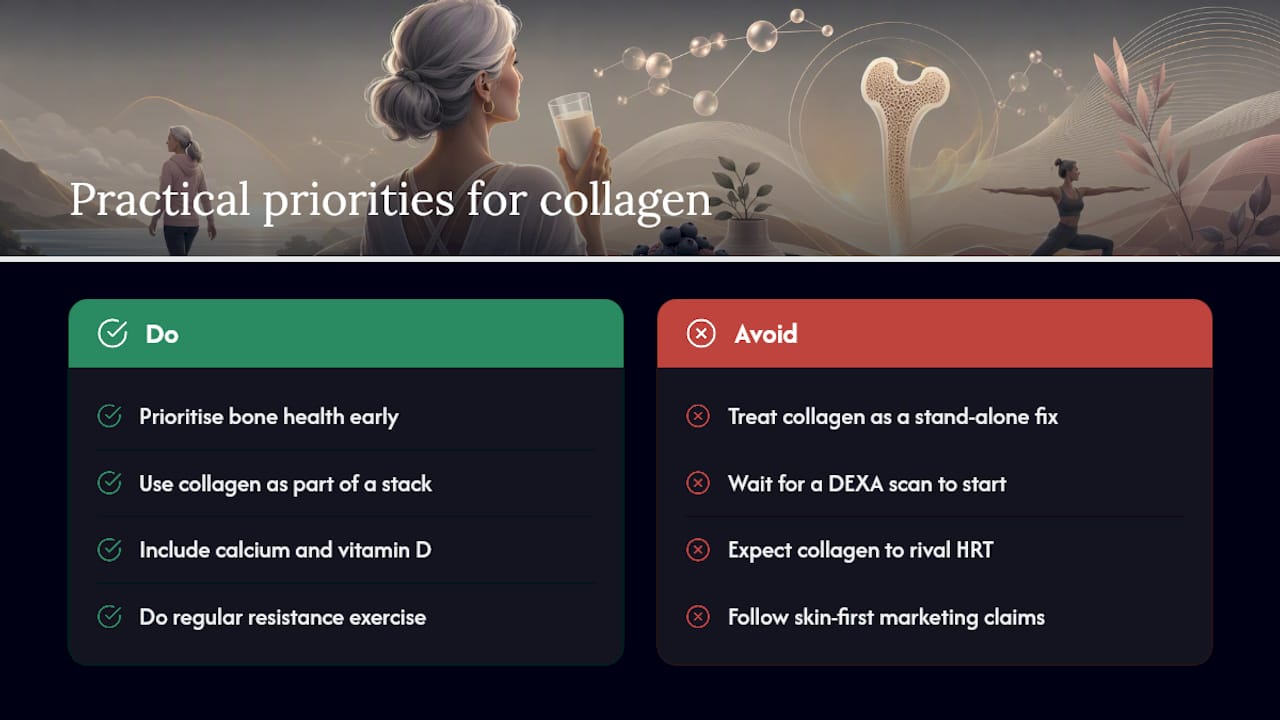
If you’re perimenopausal or newly postmenopausal, the priority order should flip from what most product pages suggest. Bone density work starts paying off over the long term precisely when you begin it early, so don’t wait until a DEXA scan flags a problem. Skin and joint benefits are real but modest, and worth pursuing only once you’ve accepted they won’t rival what HRT does for systemic symptoms. The biggest mistake I see is treating collagen as a stand-alone fix rather than one part of a stack that includes calcium, vitamin D, resistance exercise, and, where appropriate, a proper conversation about HRT. Get that order right, and collagen earns its place. Get it backwards, and you’re just expensive powder with good marketing.
— Sam
Try Kudunutrition’s liquid collagen during menopause
If you’ve decided collagen is worth a place in your routine, the practical hurdle is usually consistency, not conviction. A daily powder that needs mixing gets skipped on busy mornings, and skipped doses are exactly why some trials show weaker results than others. Kudunutrition’s 20g Collagen Protein Supplements are ready-to-drink liquid sachets, formulated in the UK and Informed Sport certified, so you get a dose in line with the trial levels discussed above without measuring or mixing anything.

The range comes in flavours including Orange and Sour Cherry, which matters more than it sounds. A supplement you actually enjoy taking is one you’ll still be drinking in month six, when bone benefits are only just becoming measurable. If you’d rather test the format before committing, the starter box gives you a lower-commitment way to try it first.
Sources
- Menopause and skin: changes and impact (PMC3772914)
- König et al., 2018 — collagen peptides and bone mineral density (PubMed 29337906)
- NHS — Menopause and perimenopause: treatment
FAQ
Is it good to take collagen during menopause?
It can help, particularly for bone density when combined with calcium and vitamin D, though the effects on skin and joints are more modest and take longer to notice than most marketing suggests.
What is the best collagen to take for menopause?
Hydrolysed collagen peptides at a dose of around 5 g a day are the form and amount behind the strongest bone research; look for third-party testing such as Informed Sport to confirm quality.
Should a 50 year old woman take collagen?
There’s no strict age cut-off, but a woman navigating menopause is exactly the group the strongest bone trial studied, so collagen paired with calcium, vitamin D, and resistance exercise is a reasonable addition if there are no underlying kidney or liver conditions.
Does the NHS recommend collagen?
No. NHS guidance on menopause treatment does not list collagen supplements as a recommended therapy, and prioritises calcium, vitamin D, and established pharmacological options such as HRT where clinically indicated.