

Collagen can ease osteoarthritis pain and stiffness for some people, but there is no reliable human evidence that it rebuilds damaged cartilage. Most of the meaningful trial data covers two forms, hydrolysed collagen and undenatured type II collagen, both tested over three to six months against symptoms rather than joint structure. Treat it as a complementary addition to exercise and weight management, not a substitute for either.
TL;DR:
- Collagen supplementation may improve joint pain and function but has not been proven to rebuild or repair cartilage in humans.
- Most evidence supports hydrolysed collagen and undenatured type II collagen, which work through different mechanisms and require specific dosing.
- Typical trial doses range from 5g to 10g daily for hydrolysed collagen and about 40mg for undenatured type II, with three to six months recommended before reassessment.
- The quality and formulation of collagen products vary widely, so choosing well-certified, properly dosed supplements is crucial for potential benefits.
- Exercise and weight management remain the main strategies for osteoarthritis, with collagen supplements serving as a low-risk, supportive addition.
Table of Contents
- Collagen for cartilage repair: what the clinical evidence shows
- Hydrolysed vs undenatured type II: two different mechanisms
- Dose, duration and what to realistically expect
- Fitting collagen into an existing osteoarthritis care plan
- Where KUDU Nutrition fits into this picture
- The short version
- Why collagen synthesis matters more than any supplement
- Dietary collagen versus supplements: does it matter which you choose?
- What the research still doesn’t tell us
- How to choose a collagen supplement that is actually worth taking
- Editorial take: sensible scepticism beats blind faith
- KUDU Nutrition: dosing that actually matches the trials
- Sources
- FAQ
Collagen for cartilage repair: what the clinical evidence shows
The strongest available evidence comes from a systematic scoping review mapping 41 studies, 25 of them clinical trials in humans and 16 preclinical. The review found genuine symptomatic benefit across a good number of trials, with people reporting less pain and better function on measures like the WOMAC index. That is the honest headline: collagen for cartilage repair looks promising for how joints feel, far less so for what is happening inside them structurally.
The catch is evidence quality. Reviewers rated much of the clinical data as moderate to low quality, and the reasons are practical rather than damning:
- Most trials ran for a few months, which is long enough to catch symptom change but too short to detect slow structural remodelling in cartilage.
- Sample sizes were often small, sometimes only a few dozen participants per arm.
- Doses, delivery formats (capsules, powders, drinks) and collagen sources varied widely between studies, making it difficult to pool results into a clear average.
- Outcome measures differed too. Some trials tracked pain scores, others tracked walking distance or joint stiffness, which makes cross-study comparison messy.
A related narrative review of collagen supplementation reaches a similar conclusion: hydrolysed collagen and native type II collagen are the two forms with genuine research behind them, but the studies rarely use identical products, so results do not transfer neatly from one brand’s trial to a different formulation entirely.
There is also a useful reality check from patient-facing guidance. The Arthritis Foundation’s review of collagen and arthritis points to the same 41-study base and agrees the signal for symptom relief is real, while urging caution before assuming it settles the question of cartilage regeneration. Experts reviewing the scoping data have made the same point directly: preclinical work hints at chondroprotective effects, but human trials have mostly measured how joints feel, not whether cartilage tissue itself changes shape or thickness. Does collagen repair cartilage? The honest answer, right now, is that nobody has proven it does in living human joints.
Hydrolysed vs undenatured type II: two different mechanisms
Not all collagen supplements work the same way, and the distinction matters more than most product labels let on.
Hydrolysed collagen (also sold as collagen peptides) is collagen broken down enzymatically into short peptide chains. These chains are small enough to survive digestion and enter the bloodstream largely intact. Bioavailability research has detected specific dipeptides, Pro-Hyp and Pro-Hyp-Gly, in plasma within about an hour of ingestion, and preclinical models show these peptides can accumulate in cartilage tissue. That is the proposed mechanism behind collagen for cartilage regeneration claims: the peptides may act as signalling molecules that nudge chondrocytes (the cells that build cartilage) into producing more of their own collagen and matrix.
Undenatured type II collagen works through a completely different route, known as oral tolerance. Small, unhydrolysed doses of native type II collagen taken daily are thought to interact with gut-associated immune tissue and dial down the inflammatory response that drives cartilage breakdown in osteoarthritis. It is an immune-mediated mechanism, not a peptide-delivery one.
- Hydrolysed collagen: broken-down peptides, absorbed into blood, proposed direct tissue effect.
- Undenatured type II: intact native collagen, immune-mediated, proposed anti-inflammatory effect.
- The two are not interchangeable, and a trial result for one says very little about the other.
Pro Tip: If a product doesn’t specify whether it’s hydrolysed or undenatured type II on the label, that’s a red flag. The mechanism only works if the manufacturing process matches the claim.
Because collagen composition and molecular weight vary so widely between manufacturers, a positive result from one company’s trial cannot be assumed to apply to a competitor’s product using a different extraction process or peptide profile.
Dose, duration and what to realistically expect
Trial data gives a reasonably consistent picture of how collagen has actually been dosed and tested, even though products vary.
- Typical hydrolysed collagen doses in trials range broadly, often somewhere between 5g and 10g daily, though some studies used higher amounts.
- Typical undenatured type II doses are far smaller, often around 40mg daily, reflecting its immune-mediated mechanism rather than a bulk-delivery one.
- Trial duration clusters heavily around three to six months, with the shortest studies in the scoping review lasting around six weeks and the longest close to eleven months.
- Realistic benchmark: if you notice no change in pain or stiffness by the three-month mark, that is a fair point to reassess rather than persist blindly.
In numbers: the scoping review behind most of this guidance drew on 41 total studies, 25 of them conducted in humans, with most clinical trials running three to six months. That forms the general evidence base behind collagen dosing claims related to joints.
Side effects reported across trials are generally mild, things like mild digestive upset or an aftertaste, rather than anything serious. On medication interactions, there is no established clinical contraindication between collagen supplements and SSRIs such as citalopram, but guidance on complementary treatments for arthritis recommends checking with a GP or pharmacist, since formulations vary and some contain additives that matter for people on long-term medication or with other health conditions.
It is also worth being clear about where the regulatory bar sits. When EFSA reviewed a health claim for collagen hydrolysate and joint maintenance, it concluded the cause-and-effect relationship had not been established for the specific claim under review. That is not the same as saying collagen does nothing, but it does mean regulators have not signed off on strong joint-health claims, and NHS-aligned clinical guidance on osteoarthritis keeps its emphasis firmly on exercise, weight management and clinician-guided pain relief, with supplements positioned as complementary at best.
Fitting collagen into an existing osteoarthritis care plan
Collagen should sit alongside established care, not replace it. Clinical guidance is consistent on this point: exercise and weight management remain the first-line interventions for osteoarthritis, with strength training and low-impact aerobic work (swimming, cycling, walking) doing more for long-term joint function than any supplement tested so far.
A sensible place to add collagen is during a rehabilitation phase, or when symptom control from standard measures has plateaued. A simple monitoring approach works well:
- Keep a short symptom diary tracking pain and stiffness weekly.
- Note functional milestones, stairs climbed without pain, distance walked, time to loosen up in the morning.
- Set a three-month decision point: if there is genuine improvement, continue; if not, it is reasonable to stop and rely on core therapies.
Our guide to supporting joint health covers how to build this kind of routine around exercise and recovery rather than supplements alone. For anyone managing training load alongside joint pain, Hoop Mentality’s guide to injury prevention is a useful companion resource on balancing rehab with activity.
Where KUDU Nutrition fits into this picture
Sam has covered the collagen evidence base extensively for this site, and readers are welcome to check the author bio for background on that editorial work.
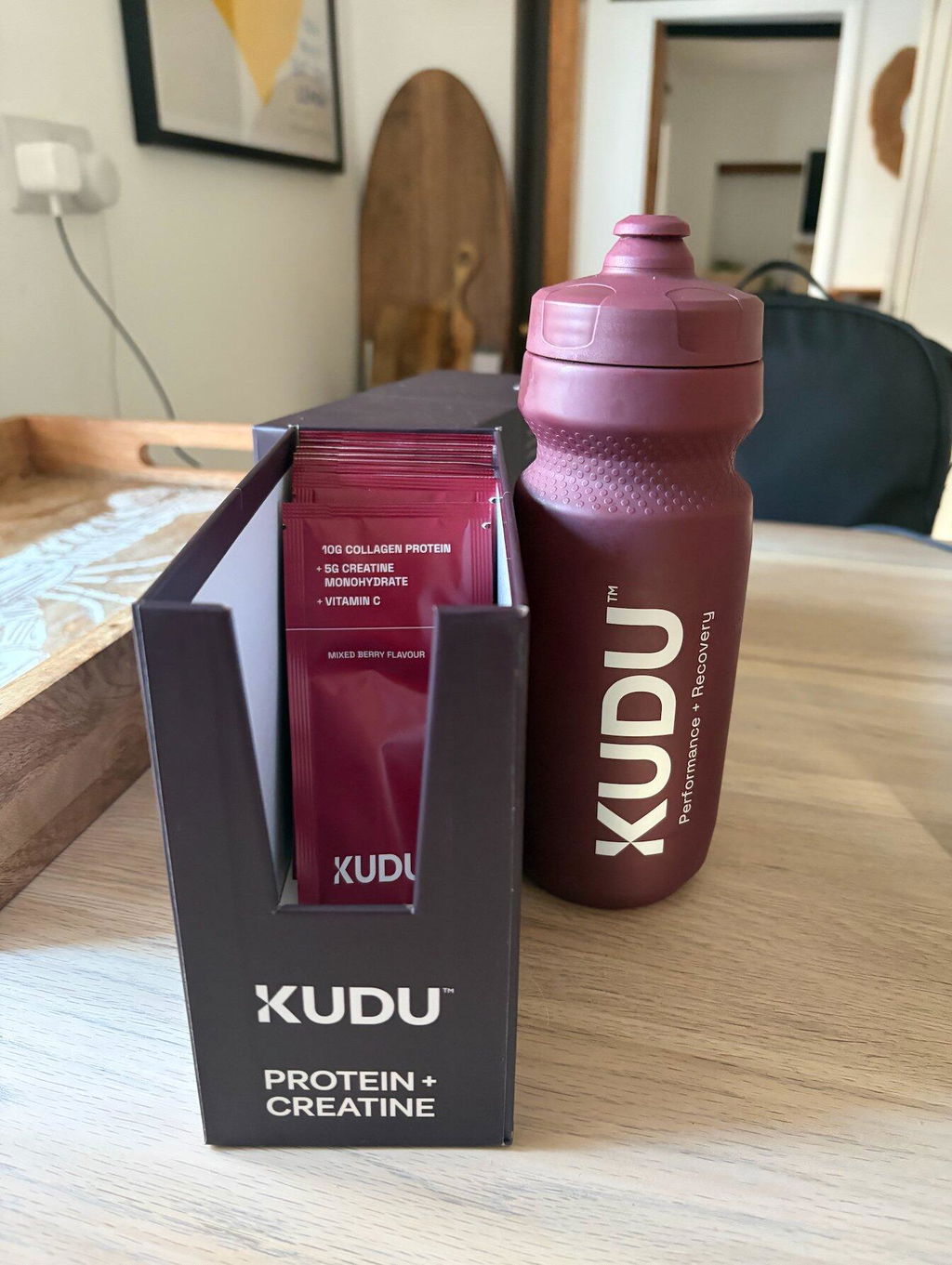
Some liquid collagen sachets and collagen+creatine formats on the market carry certifications aimed at athletes and anyone wanting batch-tested supplements. Such certification speaks to manufacturing quality and banned-substance testing, not to clinical efficacy for cartilage.
Product quality is genuinely product-specific. A well-certified sachet does not override the broader evidence gaps described above, and anyone with significant joint disease should still speak to a clinician about personalised care.
The short version
Collagen for cartilage is a reasonable, low-risk addition to an osteoarthritis care plan, not a proven repair therapy. Pick a hydrolysed collagen or undenatured type II product, trial it for three months at doses consistent with published research, track symptoms honestly, and keep exercise and weight management as the backbone of your approach.
Why collagen synthesis matters more than any supplement
Cartilage has almost no blood supply, which is precisely why it heals so slowly and why supplementation debates get so much attention. The cells responsible for maintaining it, chondrocytes, continuously break down and rebuild the collagen matrix that gives cartilage its cushioning strength. This turnover slows with age and accelerates in the wrong direction under osteoarthritis, where breakdown outpaces repair.
Supplementation is only one input into that synthesis process. The body’s own collagen production depends on adequate protein intake generally, vitamin C (a required cofactor for collagen cross-linking), and mechanical loading, the physical stress placed on joints through movement, which actually signals chondrocytes to stay active. Complete immobility is often worse for cartilage than moderate use, because loading is part of what keeps the synthesis and repair cycle running.
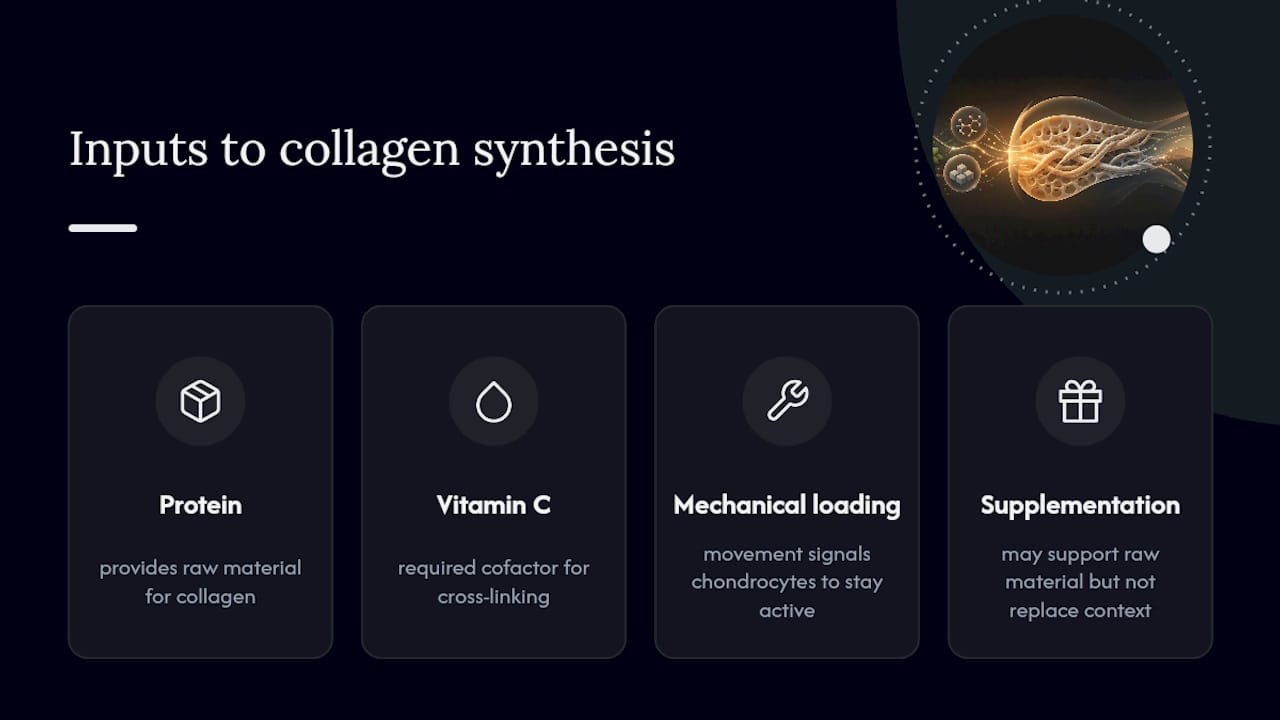
This is why clinical guidance keeps circling back to exercise rather than any single supplement. Strength training around a joint improves the mechanical environment cartilage sits in, which matters more to long-term joint health than the source of dietary collagen. A supplement can, at best, support the raw material side of this equation. It cannot substitute for the mechanical and nutritional context that determines whether the body actually uses that material to maintain cartilage. Anyone serious about collagen for cartilage regeneration needs to think about the whole synthesis pathway, not just what is in the sachet.
Dietary collagen versus supplements: does it matter which you choose?
Bone broth, slow-cooked meat with connective tissue, and fish skin all contain collagen, and plenty of people ask whether eating these is just as good as a supplement. The honest answer is that dietary collagen and supplemental collagen peptides are not quite doing the same job.
Whole dietary collagen has to be broken down by digestion before absorption, and the resulting peptide profile is far less predictable than a manufactured hydrolysed collagen product, where the peptide size is controlled during processing. That control matters because the bioavailability research showing peptides like Pro-Hyp reaching the bloodstream was conducted on specific hydrolysed preparations, not on home-cooked bone broth. There is no dosing consistency you can rely on from food alone.

That said, dietary sources bring benefits supplements do not: bone broth and collagen-rich cuts of meat also deliver other nutrients, glycine, proline, and minerals like calcium, that support broader connective tissue health. A varied diet with regular protein intake, including some collagen-rich foods, is a sound foundation.
Supplements exist to solve a specific problem: consistent, measurable dosing that matches what has actually been tested in trials. If you are trying to replicate a study using 5g to 10g of hydrolysed collagen daily, a sachet gets you there reliably. A bowl of soup, however good, does not. Neither approach cancels the other out, and using both is entirely reasonable.
What the research still doesn’t tell us
The gaps in collagen research are not minor footnotes, they shape how much confidence anyone should place in the marketing around it. The scoping review of 41 studies is explicit that larger, longer, higher-quality randomised controlled trials are needed before firmer conclusions can be drawn.
Three gaps stand out. First, almost no trial has run long enough to capture genuine structural cartilage change using imaging like MRI, which would be needed to move claims from “helps symptoms” to “repairs cartilage” with any confidence. Second, product heterogeneity means the field lacks a single, agreed reference formulation, so results from one company’s peptide blend cannot be generalised across the category. Third, most participants in existing trials have mild to moderate osteoarthritis, leaving an open question about whether collagen does anything meaningful for advanced joint degeneration.
There is also a subtler gap around mechanism confirmation in humans. The peptide accumulation in cartilage that looks promising in preclinical models has not been directly confirmed at the tissue level in living human joints, for obvious ethical and practical reasons around biopsy access. Until that gap closes, claims about collagen for cartilage regeneration will remain grounded in indirect evidence, plausible, backed by a real mechanism, but not proven the way a new arthritis drug would need to be proven before approval.
How to choose a collagen supplement that is actually worth taking
Not every collagen product on the market is built to the standard the trials used, and label-reading matters here.
Start with the collagen type stated clearly on the packaging: hydrolysed collagen (sometimes labelled collagen peptides) or undenatured type II. If a label is vague about which it contains, that is worth avoiding, since the mechanisms and effective doses differ substantially between the two.
Check the dose against what trials actually used. A product delivering 2g of hydrolysed collagen daily is unlikely to replicate results from studies using 5g to 10g. Source matters too, marine, bovine and porcine collagen all differ slightly in amino acid profile, though none has a clearly superior evidence base for joint outcomes specifically.
Third-party testing is the most practical quality signal available to a non-scientist. Certifications like Informed Sport confirm a product has been screened for banned substances and manufactured to a consistent standard, which matters if you are an athlete or simply want assurance that what is on the label is what is in the sachet. It says nothing about clinical efficacy, but it does rule out a category of risk that pure marketing claims cannot address.
Finally, be wary of products stacking unproven “joint blends” of a dozen ingredients at trivial doses each. A single, well-dosed collagen type with transparent labelling beats a crowded formula where no ingredient reaches an effective amount.
Editorial take: sensible scepticism beats blind faith
The gap between what collagen marketing implies and what the trial data actually shows is the real story here. Reviews keep finding genuine symptom benefit, and that is not nothing for someone in daily joint pain. But the leap from “symptoms improved” to “cartilage regenerated” is one the current human evidence simply has not made, and readers deserve to hear that plainly rather than see it blurred by hopeful language.
Where I think the conventional advice falls short is in treating all collagen products as equivalent. Hydrolysed collagen and undenatured type II work through different mechanisms entirely, and lumping them together in casual advice does readers a disservice. Prioritise the mechanism that matches your goal, check the dose against what trials actually used, and give it a genuine three-month run before judging it.
What should not change is the basics: exercise and weight management still do more for osteoarthritis than any supplement tested so far. Collagen is a reasonable addition to that foundation, provided the manufacturing quality is transparent and provided certified, well-dosed formats are chosen over vague, underdosed alternatives.
— Sam
KUDU Nutrition: dosing that actually matches the trials
Some brands offer liquid collagen sachets that are UK-made and carry certifications for batch testing banned substances and manufacturing consistency, which ensures the dose on the label matches the sachet.

If you want to run a genuine three-month self-trial at doses consistent with the research discussed above, the 20g liquid collagen protein sachets sit within the range used in clinical studies. The starter box lets you test the taste and format before committing to a subscription. For anyone also managing recovery from training alongside joint support, the collagen and creatine daily sachets combine both in one dose. Subscriptions include free delivery and a discount over one-off orders, making the three-month trial period straightforward to commit to. Start with the 20g liquid collagen starter box and track your symptoms from day one.
Sources
- Role of Collagen Derivatives in Osteoarthritis and Cartilage Repair: A Systematic Scoping Review With Evidence Mapping
- Can collagen supplements help arthritis? (Arthritis Foundation / Arthritis UK content)
- Osteoarthritis: clinical guidance (NHS/clinical overview)
FAQ
Can collagen rebuild cartilage?
There is no established human evidence that collagen supplements rebuild cartilage. Trials show symptom improvement in pain and function for many people, but structural cartilage regeneration remains unproven in humans.
What type of collagen is best for cartilage?
Hydrolysed collagen and undenatured type II collagen are the two forms with meaningful trial evidence, working through different mechanisms, peptide absorption versus oral tolerance, so the “best” choice depends on which mechanism and dose you are trying to replicate.
Can I take a collagen supplement with citalopram?
There is no established clinical contraindication between collagen and SSRIs like citalopram, but it is sensible to check with a GP or pharmacist because formulations vary and some contain additives relevant to existing medication.
Does the NHS recommend collagen for joints?
NHS-aligned clinical guidance prioritises exercise, weight management and clinician-guided pain relief as first-line osteoarthritis care, positioning supplements like collagen as complementary rather than a recommended primary treatment.