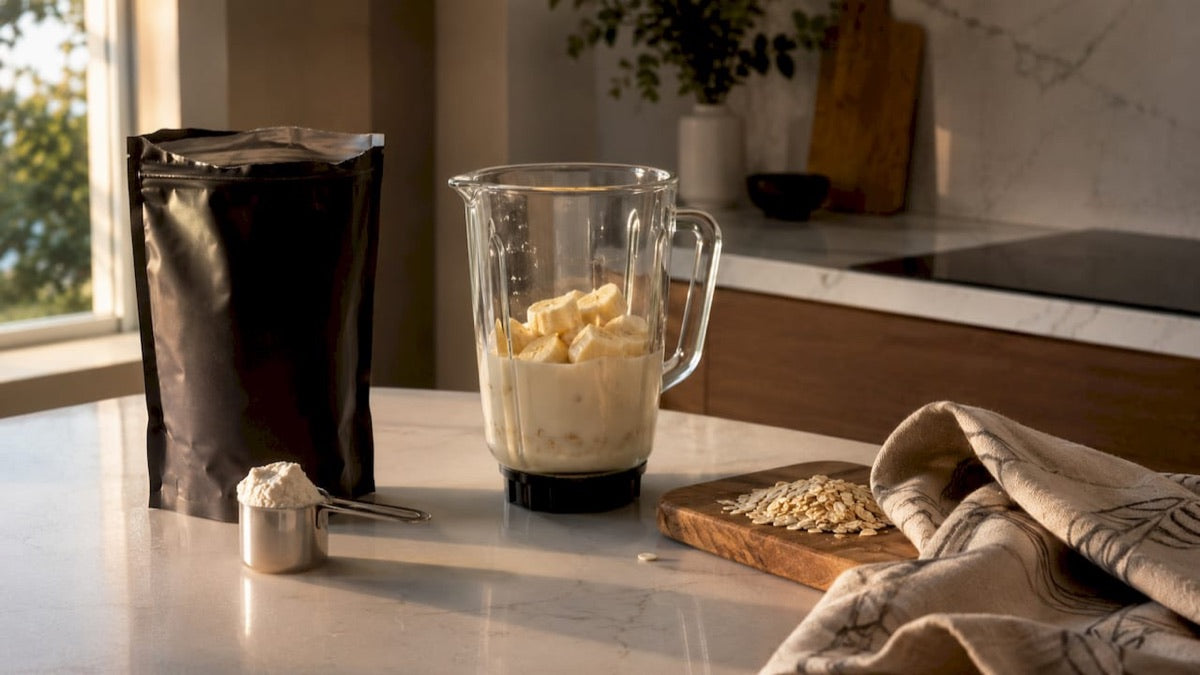


Collagen helps CrossFit athletes by supporting tendon and joint recovery when taken consistently at doses commonly used in trials, alongside adequate training. Expect changes over weeks to months, not days. It works alongside, not instead of, a leucine-rich protein source after your WOD.
For the products and guides we recommend around your WODs, see our collagen for CrossFit page.
TL;DR:
- Collagen supplements are most effective when taken at doses around 5 to 15 grams daily for at least eight weeks, especially for tendon and joint benefits.
- Timing collagen intake about 60 minutes before heavy eccentric training sessions enhances its potential to support connective tissue under stress.
- Combining collagen with vitamin C and maintaining adequate overall protein intake are crucial strategies to maximize its benefits for tendon health and recovery.
- The strongest evidence for collagen’s effectiveness applies to athletes managing existing tendon issues, recovering from injuries, or engaging in frequent eccentric loading.
- Collagen supplements sourced from certified suppliers like Informed Sport provide safety and quality assurance, reducing contamination risks for competitive athletes.
Table of Contents
- How collagen helps CrossFit athletes: joints, tendons and recovery
- What the research actually shows (key trials and reviews)
- How to use collagen as a CrossFit athlete
- Publisher expertise: how KUDU Nutrition’s products map to athlete needs
- Short verdict and practical next steps
- Potential side effects and contraindications for high-intensity training
- Why the collagen conversation misses the point
- Try KUDU Nutrition’s liquid collagen for your next training block
- Sources
- FAQ
How collagen helps CrossFit athletes: joints, tendons and recovery
CrossFit puts unusual demands on connective tissue. Snatches, box jumps, and repeated eccentric loading during movements like pistol squats or handstand push-ups stress tendons and ligaments far more than a typical gym session. That is precisely where collagen has a plausible mechanistic role, because its amino-acid profile is unlike almost anything else in your diet; learn more about collagen’s role in connective tissues and bone here.
Collagen peptides are rich in glycine and proline, amino acids that are relatively scarce in standard whey or meat protein. These specific amino acids appear to support extracellular matrix remodelling, the connective scaffolding around tendons and ligaments, rather than driving muscle fibre growth directly. That distinction matters for how you think about collagen: it is not competing with your post-workout shake for the same job.
The functional outcomes with the clearest support include:
- Reduced activity-related joint pain over sustained supplementation
- Measurable increases in tendon cross-sectional area with concurrent resistance training
- Lower blood markers of exercise-induced muscle damage in the days after hard training
Randomised trials combining specific collagen peptides with resistance training found improvements in patellar tendon morphology after 14 weeks at doses around 5g daily, alongside reductions in creatine kinase and other muscle-damage markers at higher doses.
CrossFit athletes most likely to notice a difference are those managing existing tendon niggles, recovering from prior injury, or training with heavy eccentric loading several times a week. If your knees ache after box jumps or your Achilles complains after double-unders, you’re the profile the research actually targets.
What the research actually shows (key trials and reviews)
The evidence base for collagen and exercise has matured considerably, and the picture is more nuanced than most marketing suggests. A 24-week randomised placebo-controlled trial from Penn State found statistically significant reductions in activity-related joint pain among athletes taking collagen hydrolysate, with the strongest subgroup effects in those reporting knee arthralgia. That is a long trial by supplement standards, and the duration matters.

Shorter trials tell a complementary story. A 12-week study published in Frontiers in Nutrition gave athletes 15g of specific collagen peptides daily alongside concurrent training and found reduced area-under-curve values for creatine kinase, myoglobin, and lactate dehydrogenase, the standard blood markers of muscle damage. That’s a meaningful early-recovery signal, particularly relevant if you’re stacking multiple hard WODs across a week.
The most useful synthesis comes from a 2024 systematic review and meta-analysis pooling 19 studies and 768 participants. It found long-term collagen peptide supplementation alongside training produced modest improvements in fat-free mass, tendon morphology, and recovery, with an effective dose around 15g daily sustained for eight weeks or more.
| Study | Duration | Dose | Key finding |
|---|---|---|---|
| Penn State RCT | 24 weeks | Not specified per source | Reduced activity-related joint pain |
| Patellar tendon RCT | 14 weeks | 5g/day | Increased tendon cross-sectional area |
| Frontiers RCT | 12 weeks | 15g/day | Reduced muscle-damage biomarkers |
| Systematic review (19 studies) | ≥8 weeks | ~15g/day | Modest gains in fat-free mass, tendon morphology, recovery |
The caveats are worth stating plainly. Results in healthy young cohorts without pre-existing joint issues are mixed, and every positive trial paired collagen with structured training, not passive supplementation. Collagen doesn’t work in isolation from the loading that actually stimulates tendon remodelling.
How to use collagen as a CrossFit athlete
Getting the protocol right matters more than the brand of collagen you buy. Here’s a practical approach based on the dosing bands that actually appear in trials.
- Pick your dose. 5g is the minimal effective amount for tendon-specific benefits; 15g is the dose most consistently used in trials targeting recovery and joint pain, often taken via a single sachet.
- Time it around training. Take collagen roughly 60 minutes before a session with heavy eccentric loading, so plasma peptide levels peak while your tendons are under stress. On rest days, timing matters less. Consistency does.
- Pair it with vitamin C. Around 50mg of vitamin C alongside your dose supports the collagen synthesis pathway, a detail several trial protocols build in deliberately.
- Hit your total protein target. CrossFit athletes need roughly 1.7–1.8g of protein per kilogram of bodyweight daily. Collagen contributes to that total, but it isn’t the whole answer.
- Keep a leucine-rich source post-WOD. Collagen lacks the leucine density needed to maximise muscle protein synthesis, so don’t swap out your whey or complete protein source after training. Use both, for different jobs.
- Commit for 8 to 12 weeks minimum. Track something simple: pain on a specific movement, WOD recovery time, or perceived soreness the next day.
Pro Tip: Log your joint pain on a simple 1 to 10 scale after your three hardest sessions each week. Most athletes forget baseline discomfort within a month, so writing it down before you start is the only way to know if collagen actually moved the needle.
Publisher expertise: how KUDU Nutrition’s products map to athlete needs
Kudunutrition makes 20g liquid collagen sachets (certified by Informed Sport, the testing programme that screens supplements for substances banned in sport) and a collagen-plus-creatine sachet (not yet certified), both manufactured in the UK. For athletes competing under governing-body rules, that certification is the difference between a supplement you can trust and one you’re guessing about.
The 20g liquid format sits comfortably within the dosing band the trials actually used. It covers the higher end of the effective range in one sachet, useful if you’d rather not measure powder, and liquid collagen sidesteps the mixing hassle some athletes complain about with powdered peptides.
Practical use cases that fit the research:
- One sachet roughly 60 minutes before a heavy squat or gymnastics-focused session
- Split dosing on double-training days, half pre-session and half post-session
- Daily use on rest days to maintain consistent intake across the 8 to 12 week trial window
On compliance: collagen is recognised by USADA as a permitted dietary supplement, not a prohibited substance, which removes one obvious worry for competitive athletes. If you want a deeper protocol for rehabbing a specific tendon issue, Kudunutrition’s tendon repair guide walks through pairing supplementation with loading exercises.
Short verdict and practical next steps
Collagen is worth trying if you’re managing tendon niggles, recovering from injury, or training with heavy eccentric loads several times a week. It’s a weaker case for athletes with no joint complaints and already-dialled nutrition.
The trial plan: one 20g liquid sachet daily, taken 60 minutes before your hardest session, for a minimum of 8 to 12 weeks. Track movement-specific pain and next-day soreness weekly. If pain is severe, sudden, or accompanied by swelling, see a physiotherapist or sports dietitian rather than waiting out the trial window. The same applies if you take prescription medication and want to check for interactions before adding any new supplement.

Potential side effects and contraindications for high-intensity training
Collagen has a strong safety profile at trial doses, but high-intensity training changes a few things worth knowing. Mild digestive discomfort, bloating, or a heavy feeling before training is the most commonly reported issue, particularly if you take a full dose on an empty stomach right before a WOD involving a lot of jumping or rapid direction changes.
If you have a shellfish or fish allergy, check your source carefully. Marine collagen is common in supplements and carries obvious risk for allergic athletes; bovine sources avoid that issue entirely.
Collagen supplements sourced from unverified suppliers carry a small but real risk of contamination with substances banned under WADA or USADA codes, which is precisely why third-party certification like Informed Sport matters more for competitive CrossFit athletes than casual gym-goers. An uncertified product might be fine, or it might end a season.
There’s no strong evidence that collagen interacts dangerously with common medications, but anyone on prescription drugs, including SSRIs, should mention any new supplement to their GP or pharmacist rather than assume it’s automatically fine. Collagen also won’t cause the kind of gut distress some high-dose creatine or excessive fibre intake can trigger around intense training, so athletes who struggle with other supplements around workouts often tolerate it better than expected.
Why the collagen conversation misses the point
Most collagen content treats it as a beauty supplement that happens to help joints too. That framing undersells what the research actually supports for athletes doing repeated eccentric loading, and it oversells what collagen does for anyone without genuine tendon stress.
The bigger gap is expectation management. Athletes try collagen for three weeks, feel nothing, and quit. Every trial with meaningful results ran eight weeks or longer, several past six months. That’s not a marketing line, it’s simply how connective tissue remodels: slower than muscle, faster than bone.
What should you prioritise? Total protein intake first, collagen second. A CrossFit athlete under-eating protein overall won’t fix that with a collagen sachet. Get your 1.7 to 1.8g per kilogram sorted, then layer collagen on top for the specific tendon and joint benefit it’s actually built for. Treat it as a targeted tool, not a cure-all, and you’ll use it correctly for longer than the average person who gives up after a fortnight.
— Sam
Try KUDU Nutrition’s liquid collagen for your next training block
If the research above convinced you it’s worth testing, the practical barrier is usually taste and mixing, not motivation. Kudunutrition’s 20g liquid sachets solve that: no powder clumping in a shaker, no chalky aftertaste before a heavy session. It’s just a ready-to-drink dose that matches the 15g band used in the strongest trials.

Every batch is UK-made and Informed Sport certified, so you’re not gambling on contamination risk before competition. If you’re new to collagen and want to test flavour and tolerance before committing to a full block, the starter box is the lowest-risk way in. Ready to commit to the full 8 to 12 week protocol? The 20g liquid collagen protein sachets are built for exactly that, in Orange, Sour Cherry, or Strawberry & Vanilla depending on what you can stomach mid-training.
This article is general information, not a substitute for advice from a qualified doctor. Consult a qualified healthcare professional about your own circumstances before acting on anything here.
Sources
- Systematic review and meta-analysis — effects of collagen peptide supplementation with exercise
- Frontiers in Nutrition — reduction in systemic muscle stress markers with SCP
- 24-Week study on the use of collagen hydrolysate as a dietary supplement in athletes with activity-related joint pain — Penn State
- USADA — Athlete’s need to know: collagen
FAQ
Is it good to take collagen when working out?
Yes, particularly if you’re managing tendon stress or joint pain from repeated eccentric loading. Take it around 60 minutes before training for the best timing relative to your session, and pair it with adequate total protein.
Can I take a collagen supplement with citalopram?
There’s no established dangerous interaction between collagen and SSRIs like citalopram, but you should still mention any new supplement to your GP or pharmacist before starting, especially if you’re on multiple medications.
Is it good for athletes to take collagen?
Athletes with tendon stress, prior injury, or high eccentric-loading training are the group most likely to see meaningful benefit, based on trial data on tendon morphology and joint pain. Healthy athletes with no joint complaints see a weaker effect.
Which type of collagen is best for athletes?
Hydrolysed collagen peptides, sometimes called specific collagen peptides in trial literature, are the form used in nearly every study showing joint and tendon benefits. Liquid formats like Kudunutrition’s sachets deliver this at trial-relevant doses without measuring powder.
Does collagen replace whey protein for CrossFit athletes?
No. Collagen lacks the leucine density needed for muscle protein synthesis, so it works best alongside a complete protein source, not as a replacement for it.
Recommended
 20g per shot
Ready to try it?
20g Liquid Collagen Protein
4.7 from 495 reviews
- 20g hydrolysed bovine collagen per shot
- Ready to drink in two sips. 85 kcal, 0g sugar
- Informed Sport certified
Pick a flavour
£34.95 for 14
or £1.99 a shot on subscription
Free UK delivery over £50 · 60-day money-back guarantee · Pause or cancel any time
More on this topic: Collagen for CrossFit →