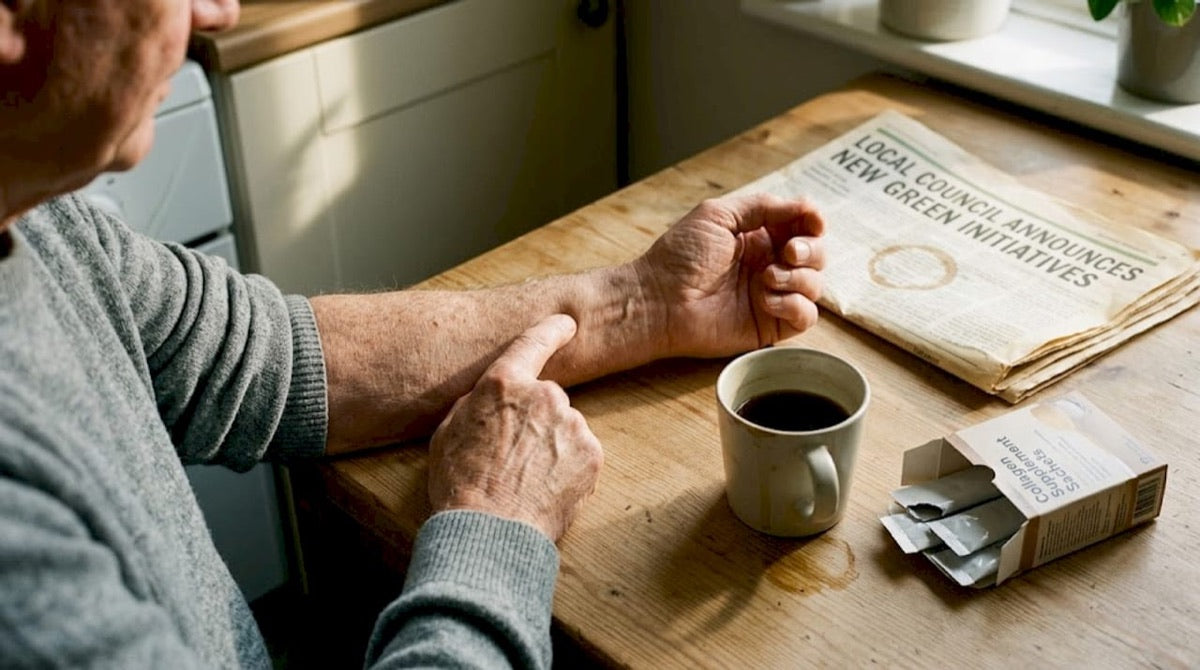


Collagen does not cause weight gain. It is a protein, it contains about 4 calories per gram like any protein, and a full 20g sachet is 85 calories, roughly the same as a large apple. Nothing in collagen stimulates fat storage or appetite; the opposite is true, since protein is the most filling macronutrient. In the trials that combined 15g of collagen with resistance training, the collagen groups lost more fat than the placebo groups, not less.
The worry usually comes from one of three places: the word "protein" and the assumption that all protein powders are for bulking, a few days of water-weight change when people start a new supplement, or bloating from the sugars and sweeteners in some collagen drinks. This guide separates the three and explains how to use collagen if you are trying to lose weight, not gain it.
Quick answer
- Calories in collagen: ~4 per gram. A 20g KUDU sachet is 85 kcal, 0g sugar, 0g fat.
- Does it build bulk? No. Collagen is low in leucine and does not drive muscle growth on its own.
- Trials: 15g collagen + training produced more fat loss than training alone (women, young men, older men).
- Bloating: usually from added sugar, sugar alcohols, sweeteners or dairy in other products, or from a large dose on an empty stomach.
- In a calorie deficit: collagen is one of the most efficient proteins per calorie you can take.
The calorie maths
| Serving | Calories | Protein | Sugar |
|---|---|---|---|
| KUDU 20g liquid collagen sachet (63g) | 85 | 20g | 0g |
| KUDU Collagen + Creatine sachet (19.5g) | 44 | 10g | 0.1g |
| Typical 10g collagen powder scoop | ~36 | 9g | 0g |
| Typical flavoured collagen drink (beauty shot) | 40–80 | 5–10g | 2–8g |
| Whey protein shake (30g scoop with water) | ~120 | 24g | 1–3g |
| Large apple | ~100 | 0g | ~20g |
To gain half a kilo of fat you need roughly 3,500 calories above maintenance. A daily 85-calorie sachet, if it replaced nothing, would take six weeks to do that, and in practice protein replaces other food because it is filling. Nobody gains weight from collagen; people gain weight from total intake.
Why collagen does not build bulk
Muscle growth needs a leucine trigger and a training stimulus. Collagen has about a third of the leucine of whey and does not raise muscle protein synthesis the way a complete protein does. The trials that found collagen improved body composition combined 15g with resistance training three times a week for 12 weeks, and what they found was more fat-free mass and less fat than training with placebo: in premenopausal women (Jendricke 2019), young men (Kirmse 2019) and older men (Zdzieblik 2015). That is the opposite of unwanted weight gain. Without training, collagen is simply a lean protein.
The first-week scale bump
Some people see the scale rise a pound or so in the first days of any new protein or creatine supplement. That is water and food in the gut, not fat, and it settles. If you also started creatine, expect 1kg to 2kg of intracellular water in muscle in the first weeks; it is not fat and it reverses if you stop. See collagen and creatine together.
Collagen bloating: the real causes
- Sugar and sugar alcohols. Many collagen drinks and gummies carry several grams of sugar or sorbitol, xylitol and maltitol, which ferment in the gut. KUDU uses 0g sugar and no sugar alcohols.
- Dairy. Collagen "protein blends" often mix in whey. If lactose is your problem, choose pure collagen; it is naturally dairy free.
- A large dose on an empty stomach. A minority of people find 20g in one go sits heavily. Taking it with food or splitting into two 10g doses fixes it.
- Gelatin instead of hydrolysed collagen. Gelatin digests more slowly. Hydrolysed peptides are absorbed within 1 to 2 hours.
Hydrolysed collagen itself is one of the best-tolerated proteins, which is why it is often the one people with sensitive stomachs can take. See collagen for a sensitive stomach.
Using collagen while losing weight
- Keep protein high in a deficit. 1.6g to 2.2g per kilo protects muscle while you lose fat. Collagen gives you 20g for 85 calories, more protein per calorie than most whole foods.
- Use it to replace a snack, not add to one. A mid-afternoon 20g shot displaces the biscuit that would have cost 200 calories.
- Keep training. The fat-loss results in the trials came with resistance exercise.
- Count it honestly. Collagen is not a complete protein; keep it to about a third of your daily total and get the rest from complete sources.
More on the evidence in collagen for weight loss.
Try 20g of protein for 85 calories →
KUDU liquid collagen: 20g protein, 85 calories, 0g sugar, 0g fat, no sweetener aftertaste, ready to drink.
Collagen and weight: FAQs
Does collagen make you gain weight?
No. It is 85 calories per 20g serving and protein is the most filling macronutrient. Trials pairing collagen with training showed more fat loss than placebo.
Does collagen make you bloated?
Pure hydrolysed collagen rarely does. Bloating usually comes from sugar, sugar alcohols or dairy in other products, or from a large dose on an empty stomach.
How many calories are in collagen?
About 4 per gram. 10g is around 36 calories; a 20g KUDU sachet is 85.
Can I take collagen on a diet?
Yes. It is one of the most protein-dense, lowest-calorie options available and helps protect muscle in a deficit.
Does collagen build muscle like a bulking protein?
No. It is low in leucine and does not drive muscle growth on its own. With training it improved body composition, meaning more lean mass and less fat.
Related reading
Sources
- Jendricke P et al. Specific collagen peptides in combination with resistance training improve body composition and regional muscle strength in premenopausal women. Nutrients 2019.
- Kirmse M et al. Prolonged collagen peptide supplementation and resistance exercise training affects body composition in recreationally active men. Nutrients 2019.
- Zdzieblik D et al. Collagen peptide supplementation with resistance training in elderly sarcopenic men. Br J Nutr 2015.
- Paul C, Leser S, Oesser S. Significant amounts of functional collagen peptides can be incorporated in the diet while maintaining indispensable amino acid balance. Nutrients 2019.
 20g per shot
Ready to try it?
20g Liquid Collagen Protein
4.7 from 495 reviews
- 20g hydrolysed bovine collagen per shot
- Ready to drink in two sips. 85 kcal, 0g sugar
- Informed Sport certified
Pick a flavour
£34.95 for 14
or £1.99 a shot on subscription
Free UK delivery over £50 · 60-day money-back guarantee · Pause or cancel any time