
Yes, you can take collagen and creatine together, and for anyone who trains it is one of the most sensible pairings in sports nutrition. Creatine monohydrate is the most-studied performance supplement in existence: 3g to 5g a day increases strength, power and training volume. Hydrolysed collagen is the most-studied supplement for tendons, ligaments and joints: 5g to 20g a day, taken before loading, improves collagen synthesis and reduces activity-related joint pain. They work through entirely different pathways, there is no known interaction, and each covers the other's blind spot.
The reason almost nobody takes both consistently is logistics, not science. Two tubs, two scoops, one that mixes badly and one you forget on rest days. This guide covers the evidence for each, how to dose them together, when to take them, and the honest answers to the bloating and bulking questions.
Quick answer: collagen and creatine together
- Safe together? Yes. No interaction, no shared pathway, both have decades of safety data.
- Creatine dose: 3g to 5g of creatine monohydrate daily, no loading phase needed.
- Collagen dose: 10g to 20g daily for joints, tendons and recovery.
- Timing: take both 30 to 60 minutes before training; on rest days, any time.
- Who benefits most: anyone lifting, running, doing HYROX or CrossFit, or getting back from a tendon or joint niggle.
What creatine does that collagen cannot
Creatine increases the phosphocreatine stored in muscle, which regenerates ATP during short, hard efforts: heavy sets, sprints, the last reps of a workout. The International Society of Sports Nutrition's position stand summarises hundreds of trials: 3g to 5g of creatine monohydrate daily reliably improves strength, power and high-intensity work capacity, and it is one of the safest supplements ever studied. Newer research extends the benefits to women across the lifespan (Smith-Ryan 2021) and to cognitive performance under sleep deprivation and stress (Avgerinos 2018).
What creatine does not do is build the tissue that carries the extra load. Getting stronger faster than your tendons and ligaments adapt is how the niggles start.
What collagen does that creatine cannot
Hydrolysed collagen supplies glycine, proline and hydroxyproline, the amino acids tendons, ligaments, cartilage and skin are built from. Taken before exercise it roughly doubles the rate of collagen synthesis (Shaw 2017, 15g). Over 12 weeks at 5g a day it reduced activity-related knee discomfort in active adults (Zdzieblik 2017). Over 6 months it improved Achilles tendinopathy alongside calf training (Praet 2019) and chronic ankle instability (Dressler 2018). At 15g with resistance training it improved strength and body composition beyond training alone in three separate trials, and at 20g it reduced post-exercise soreness (Clifford 2019).
Collagen is not a complete protein and it will not increase your power output. That is the job creatine does.
Why the combination makes sense
| Creatine monohydrate | Hydrolysed collagen | |
|---|---|---|
| Main effect | Strength, power, training volume | Tendon, ligament, joint and skin tissue |
| Mechanism | Phosphocreatine energy system | Amino acid supply for collagen synthesis |
| Effective daily dose | 3g to 5g | 5g to 20g depending on goal |
| Time to effect | 3 to 4 weeks to saturate muscle | 4 to 12 weeks, tendons 3 to 6 months |
| Timing sensitivity | Low: daily total matters | Moderate: before loading is best |
| Interaction with the other | None | None |
The logic is simple: creatine lets you train harder; collagen helps the connective tissue keep up. Recovery trials also suggest the two are complementary, with creatine reducing muscle damage markers and collagen reducing soreness through a different route.
How to dose collagen and creatine together
Creatine: 5g a day, every day
Skip the loading phase. 3g to 5g daily saturates muscle creatine stores in about three to four weeks with far fewer stomach complaints than the old 20g loading protocol. Take it every day, including rest days; creatine works by keeping stores full, not by a single pre-workout hit.
Collagen: 10g to 20g a day
10g is the dose most tendon and joint trials used and is enough for connective tissue. 15g to 20g is what the strength, body-composition and recovery trials used. If you are combining the two for training, 10g of collagen in the same sachet as your creatine covers the joint and tendon goal, and a separate 20g liquid shot on heavy days takes you to the full 30g some athletes use.
Timing: one habit, before training
Because collagen benefits from being in circulation while tissue is loaded, and creatine does not care about timing, the simplest routine is to take both together 30 to 60 minutes before training. On rest days take the same sachet with breakfast.
Will creatine make me bloated or bulky? Honest answers
- Bloating: creatine draws a small amount of water into the muscle cell, typically 1kg to 2kg over the first weeks. It is intracellular water, not the puffy under-the-skin kind, and it disappears if you stop. Loading phases cause most of the stomach complaints; 5g daily avoids them.
- Bulk: creatine does not build muscle on its own. Size comes from training volume and calories. Creatine helps you do more work, which is why it is used by endurance athletes and older adults as much as by bodybuilders.
- Kidneys: decades of studies in healthy adults show no harm at recommended doses. If you have existing kidney disease, talk to your doctor before taking any supplement.
- Women: the research supports 3g to 5g for strength, bone and mood across the menstrual cycle, pregnancy aside. See collagen and menopause for the over-45 picture.
Can you mix collagen and creatine in the same drink?
Yes. Mixing them does not reduce the effect of either, and there is no reaction between them in the glass or in your gut. The practical problems are about dissolving, not chemistry.
Collagen peptides dissolve easily in cold water, juice, smoothies or coffee. Creatine monohydrate is less soluble: in a small glass of cold water some of it settles at the bottom as grit. That powder is still creatine, so swirl and finish the last mouthful rather than leaving it. Room-temperature water, a slightly bigger glass or micronised creatine all help.
The other thing worth knowing is that creatine slowly breaks down into creatinine once it sits in liquid, faster in warm or acidic drinks. Mixing and drinking it is fine; making up a bottle on Sunday for the whole week is not.
- Use 200ml to 300ml of water or juice.
- Add your 3g to 5g of creatine and your collagen dose.
- Shake or stir for ten seconds.
- Drink it within the hour, 30 to 60 minutes before training if you can.
- Same time every day, rest days included.
What happens when you take collagen and creatine together?
Nothing dramatic, and that is the point. They do not interact, so what you get is each one doing its own job on its own timeline:
- Week 1: most people notice nothing, apart from perhaps half a kilo to a kilo on the scales as creatine draws water into muscle.
- Weeks 3 to 4: muscle creatine stores are full at 3g to 5g a day, and the extra reps and heavier sets start to show (Kreider 2017).
- Weeks 8 to 12: the window in which collagen trials saw less activity-related knee discomfort (Zdzieblik 2017) and, with resistance training, better strength and body composition (Zdzieblik 2015, Kirmse 2019, Jendricke 2019).
- Months 3 to 6: tendons are slow tissue. The Achilles and ankle trials ran for six months (Praet 2019, Dressler 2018).
Side effects are uncommon and mild. Creatine can upset some stomachs in large single doses, which is another reason to skip loading phases, and collagen occasionally leaves people feeling full. Neither is made worse by taking the other.
Can you take collagen, creatine and protein powder together?
Yes, and for most people who lift it is a sensible trio because each does a different job. Creatine fuels the hard efforts. Collagen supplies the amino acids for tendons and joints. Whey or another complete protein supplies the leucine that switches on muscle building, which collagen is too low in to do well on its own.
The simplest split is collagen and creatine 30 to 60 minutes before training, and whey or a protein-rich meal afterwards. Collagen counts towards your daily protein, but because it is incomplete, keep it to roughly a third of your total or less (Paul 2019). If you want to check your numbers, our guide to how much collagen per day sets out the doses by goal.
The one-sachet version
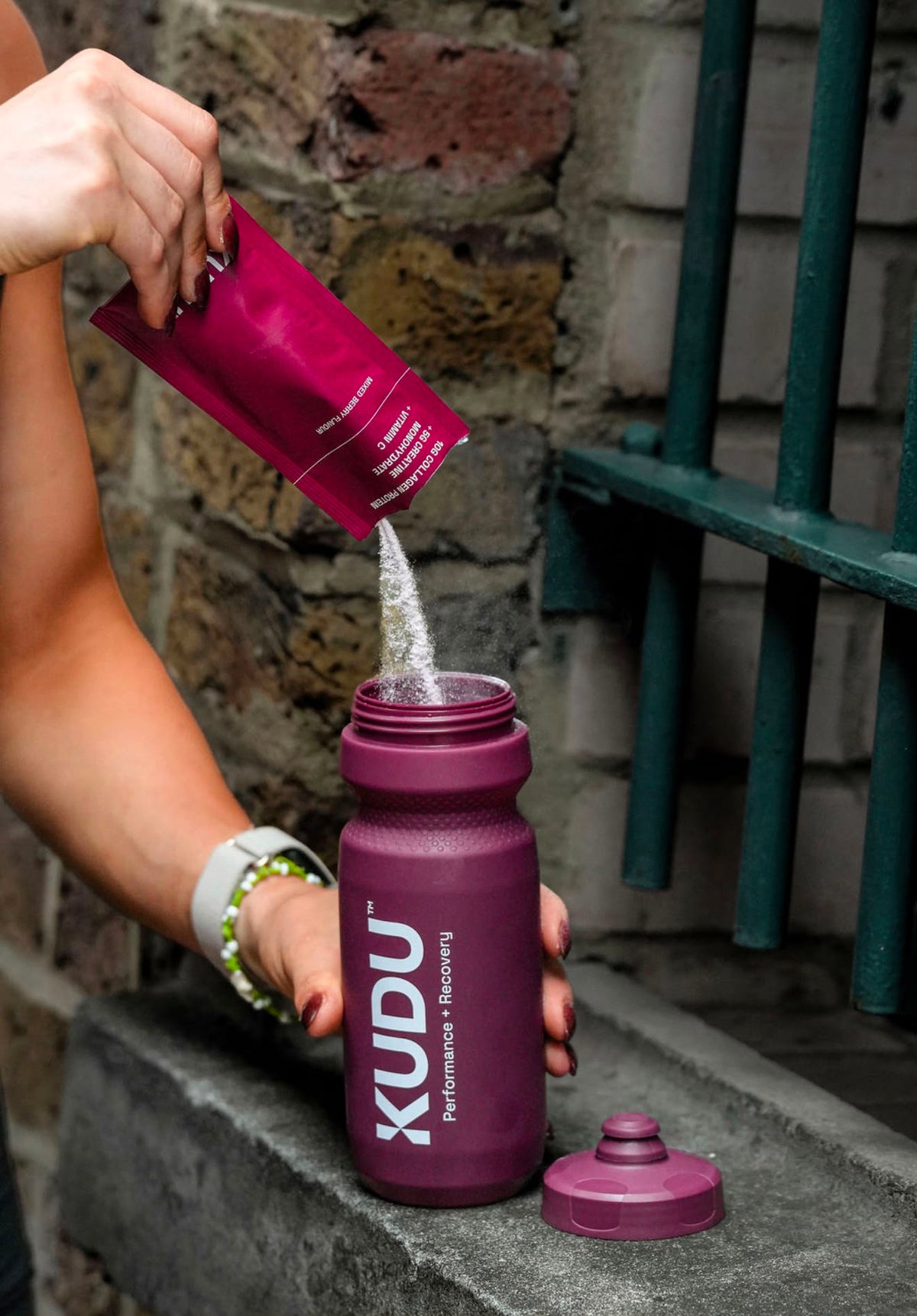
KUDU Collagen + Creatine puts 5g of creatine monohydrate, 10g of hydrolysed bovine collagen and vitamin C (the cofactor collagen synthesis needs) into one tangy sachet that mixes in seconds. 44 calories, 0.1g sugar, made in the UK. It is not yet Informed Sport certified; drug-tested athletes should use the certified 20g shot with a separately certified creatine. Two flavours: Mixed Berry and Tropical.
Try Collagen + Creatine, first box 50% off →
On heavy training days, stack it with a 20g liquid collagen shot for the full 30g collagen dose.
Collagen and creatine: FAQs
Can you mix collagen and creatine in the same drink?
Yes. Neither affects the absorption or stability of the other. A combined sachet mixed in 200ml to 300ml of water is the simplest way to take both.
Should I take creatine and collagen before or after a workout?
Before, 30 to 60 minutes ahead of training, mainly for the collagen. Creatine's timing does not matter as long as you take it every day.
Do I need a creatine loading phase?
No. 3g to 5g a day saturates muscle stores in three to four weeks without the stomach issues of loading.
Is 10g of collagen enough with creatine?
10g covers the tendon and joint doses used in the trials. Add a 20g shot on heavy days if you want the doses used in the strength and recovery studies.
Is it safe for drug-tested athletes?
The Collagen + Creatine sachet is not currently Informed Sport certified, so athletes under anti-doping rules should use KUDU's 20g liquid collagen shot, which is Informed Sport certified, alongside a creatine that carries its own certification.
Related reading
- Collagen for tendonitis and tendon pain
- Best time to take collagen
- Collagen vs whey protein
- Collagen dosage for athletes
Sources
- Kreider RB et al. International Society of Sports Nutrition position stand: safety and efficacy of creatine supplementation. J Int Soc Sports Nutr 2017.
- Antonio J et al. Common questions and misconceptions about creatine supplementation. J Int Soc Sports Nutr 2021.
- Smith-Ryan AE et al. Creatine supplementation in women's health: a lifespan perspective. Nutrients 2021.
- Avgerinos KI et al. Effects of creatine supplementation on cognitive function of healthy individuals. Exp Gerontol 2018.
- Shaw G et al. Vitamin C enriched gelatin before intermittent activity augments collagen synthesis. Am J Clin Nutr 2017.
- Zdzieblik D et al. Activity-related knee joint discomfort and collagen peptides. Appl Physiol Nutr Metab 2017.
- Clifford T et al. Collagen peptides, muscle damage and recovery. Amino Acids 2019.
 2-in-1
Ready to try it?
Collagen + Creatine Sachets
60-day money-back guarantee
- 10g collagen + 5g creatine monohydrate
- Plus vitamin C. Mix with water, done
- No tub, no scoop. 30 sachets
Pick a flavour
£59.95 for 30
or £1.59 a serving on subscription
Free UK delivery over £50 · 60-day money-back guarantee · Pause or cancel any time