
Collagen can help tendonitis, but only as part of a specific protocol: a daily dose taken 30 to 60 minutes before tendon-loading exercise, kept up for 3 to 6 months. On its own, without the exercise, there is no evidence it does much for a painful tendon. Combined with a loading programme, trials in Achilles tendinopathy, chronic ankle instability and healthy tendons show reduced pain, better function and measurably bigger, stiffer tendons.
That distinction matters because most people try collagen for tendon pain the wrong way: a small beauty dose, taken at random, with rest instead of loading. This guide gives you the protocol the trials actually used, what to expect at each stage, and where the evidence stops.
The tendon protocol in one box
- Dose: 10g to 15g of hydrolysed collagen (trials ranged 2.5g to 15g; higher doses drove the biggest synthesis response)
- Timing: 30 to 60 minutes before your rehab or loading session
- Loading: 5 to 10 minutes of tendon-specific exercise (heavy slow resistance or eccentric work) at least every other day
- Vitamin C: with the collagen, from food or the sachet
- Duration: 12 weeks minimum, 6 months for chronic tendinopathy
Why tendons are so slow to heal, and why collagen helps
Tendons are mostly type I collagen with very few cells and very poor blood supply. Tendon collagen turns over so slowly that the core of an adult Achilles is thought to be largely the same collagen you had as a teenager. When a tendon is overloaded and becomes painful (tendinopathy, often called tendonitis even though there is rarely much inflammation), the repair depends on the few tendon cells present getting both a mechanical signal and the raw materials at the same time.
Loading exercise provides the signal. Hydrolysed collagen provides the raw materials: glycine, proline and hydroxyproline in the exact ratio tendon collagen uses. The trick is that because blood flow to tendons is low, the amino acids need to already be in circulation when the tendon is loaded. That is why every effective trial dosed before exercise.
What the trials found
| Trial | Who | Protocol | Result |
|---|---|---|---|
| Shaw et al. 2017 | Healthy men | 15g vitamin C enriched gelatin 1 hour before 6 min rope skipping | Collagen synthesis marker roughly doubled vs placebo; 5g did not |
| Praet et al. 2019 | Achilles tendinopathy patients | 2.5g collagen peptides daily + calf-strengthening exercises, 6 months | Greater improvement in pain and function (VISA-A) than exercise alone; faster return to running |
| Dressler et al. 2018 | Athletes with chronic ankle instability | 5g collagen peptides daily, 6 months | Improved ankle stability and fewer re-injuries vs placebo |
| Jerger et al. 2022 | Young men, resistance training | 5g collagen peptides daily + calf training, 14 weeks | Greater increase in Achilles tendon cross-sectional area and stiffness than training alone |
| Zdzieblik et al. 2017 | Active adults with knee discomfort | 5g daily, 12 weeks | Less activity-related knee pain vs placebo |
Read together: small daily doses over months improved painful tendons when paired with exercise, and larger doses (15g) produced the biggest acute increase in collagen production. The practical sweet spot is 10g to 15g before each loading session, which covers both.
The shots and guides that fit this protocol are collected on our collagen for joints and tendons page.
The loading half of the protocol
Collagen without loading is like buying bricks and never laying them. The tendon trials used simple, boring, effective exercises:
- Achilles: heel raises off a step, slow (3 seconds up, 3 seconds down), progressing to single leg and then adding weight. The Praet trial used daily calf strengthening.
- Patellar (jumper's knee): heavy slow resistance such as slow squats or leg press, or the decline-board squat, 3 sets, every other day.
- Elbow (tennis or golfer's elbow): slow wrist extensions or flexions with a light dumbbell, or the FlexBar eccentric protocol.
- Shoulder (rotator cuff): slow external rotation with a band, and isometric holds early on when it is very sore.
- Plantar fascia: heel raises with the toes extended over a rolled towel.
Start with isometric holds (30 to 45 seconds, 5 reps) if the tendon is too painful to move through range; they tend to reduce pain acutely. Progress to slow heavy resistance as pain allows. A physiotherapist will tailor the loading; the collagen timing is the part they often leave out.
A 6-month plan for a painful tendon
- Weeks 1 to 2: 10g to 20g collagen an hour before daily isometric holds. Expect pain to ease during the session, not yet between sessions.
- Weeks 3 to 8: move to slow heavy resistance every other day, collagen an hour before each. Keep a pain score out of 10 for the first step of the morning; this is the number that tells you it is working.
- Weeks 8 to 12: add load. Most people see the morning pain score drop meaningfully by week 12.
- Months 3 to 6: return to sport gradually, keep the collagen and one or two loading sessions a week. The tendon is still remodelling.
What collagen will not do
- It will not fix a tendon that is still being overloaded. Reduce the aggravating activity while you rebuild.
- It will not replace the exercise. No trial shows collagen alone changing tendon pain.
- It will not work in two weeks. Plan for months.
- It is not a treatment for a full tendon rupture or an acute tear, which need medical assessment.
Choosing a collagen for tendon rehab
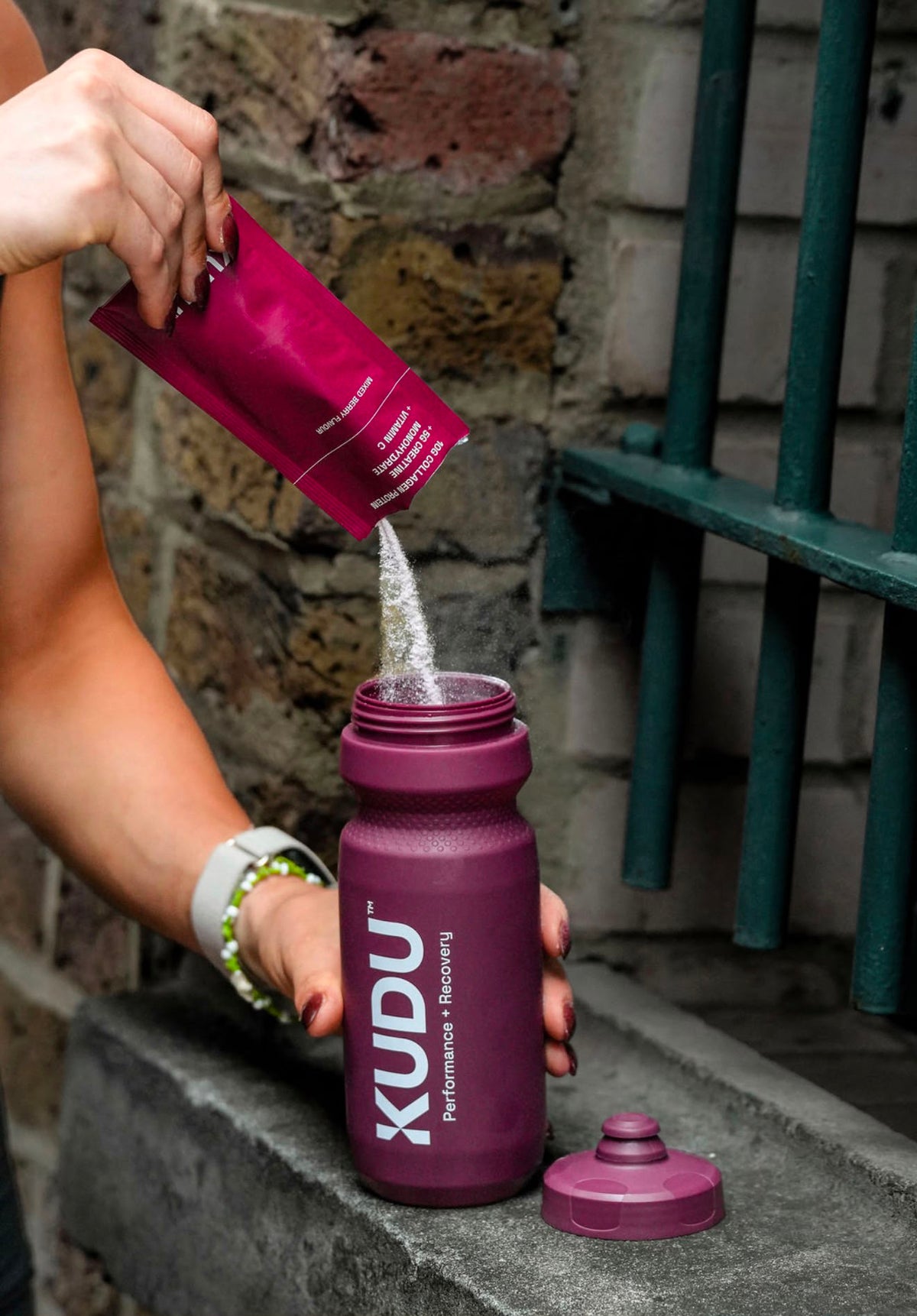
Three things matter: enough dose per serving to reach 10g to 15g without three scoops, a format you will actually take before every session for six months, and a product that is batch tested if you compete. KUDU's 20g liquid collagen sachet is designed for exactly this use: 20,000mg of hydrolysed bovine collagen, ready to drink an hour before training, 85 calories and 0g sugar, Informed Sport certified. If you also lift, the Collagen + Creatine sachet gives 10g of collagen with vitamin C plus 5g of creatine in one.
Start the tendon protocol with KUDU 20g shots →
Collagen for tendonitis: FAQs
Does collagen help tendonitis?
In trials, daily hydrolysed collagen taken before loading exercise improved Achilles tendinopathy pain and function, ankle stability, and tendon size and stiffness. It does not help without the exercise component.
How much collagen should I take for tendon repair?
The trials used 2.5g to 15g. 10g to 15g before each loading session is a sensible target: it covers the rehab trial doses and reaches the level that maximised collagen synthesis in the Shaw study.
How long does collagen take to help tendons?
Expect 8 to 12 weeks for noticeable pain change and 3 to 6 months for the tendon itself to remodel. The Achilles trial ran for 6 months.
Should I take collagen before or after tendon exercises?
Before, 30 to 60 minutes ahead. Tendons have poor blood flow, so the amino acids need to be circulating while the tendon is loaded.
Is bovine or marine collagen better for tendons?
The tendon trials used bovine-derived collagen peptides, and bovine provides both type I and III collagen. Either is hydrolysed into similar peptides; the dose you can practically take per serving matters more than the source.
Related reading
- Collagen for tendon repair: an evidence-based protocol
- Best time to take collagen
- Does collagen help joint pain?
- Collagen and creatine together
Sources
- Shaw G et al. Vitamin C enriched gelatin supplementation before intermittent activity augments collagen synthesis. Am J Clin Nutr 2017.
- Praet SFE et al. Oral supplementation of specific collagen peptides combined with calf-strengthening exercises enhances function and reduces pain in Achilles tendinopathy patients. Nutrients 2019.
- Dressler P et al. Improvement of functional ankle properties following supplementation with specific collagen peptides in athletes with chronic ankle instability. J Sports Sci Med 2018.
- Jerger S et al. Effects of specific collagen peptide supplementation combined with resistance training on Achilles tendon properties. Scand J Med Sci Sports 2022.
- Zdzieblik D et al. Improvement of activity-related knee joint discomfort following supplementation of specific collagen peptides. Appl Physiol Nutr Metab 2017.
More collagen guides
 20g per shot
Ready to try it?
20g Liquid Collagen Protein
4.7 from 495 reviews
- 20g hydrolysed bovine collagen per shot
- Ready to drink in two sips. 85 kcal, 0g sugar
- Informed Sport certified
Pick a flavour
£34.95 for 14
or £1.99 a shot on subscription
Free UK delivery over £50 · 60-day money-back guarantee · Pause or cancel any time
More on this topic: Collagen for joints & tendons →