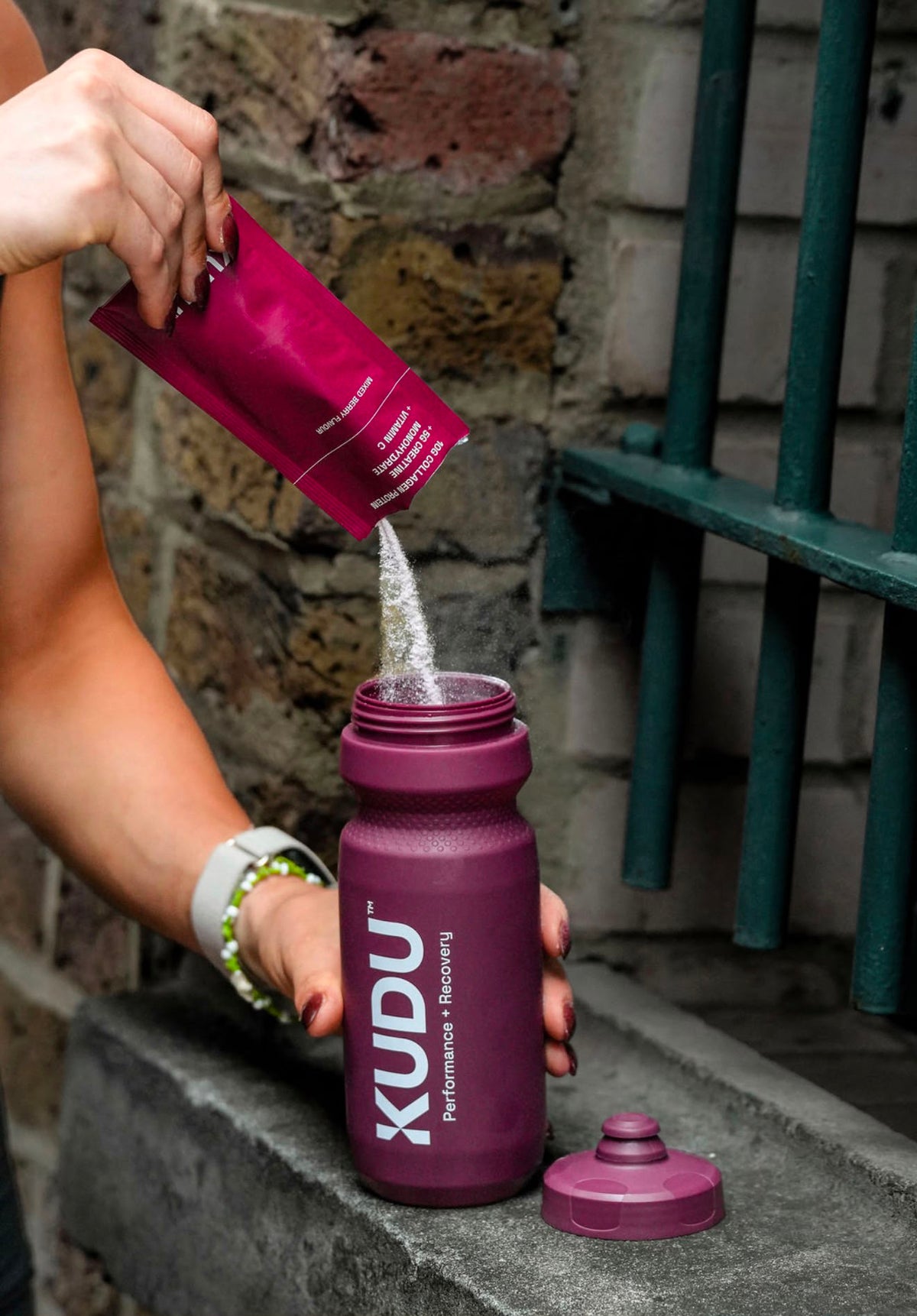


The best time to take collagen is 30 to 60 minutes before you train, if your goal is joints, tendons, ligaments or recovery. If your goal is skin, hair or nails, timing makes no measurable difference and the best time is whichever one you will not forget. Empty stomach versus with food, morning versus night, before or after a workout: only one of those questions has a study behind it, and this guide tells you which.
The reason timing matters for connective tissue is blood flow. Tendons and ligaments have poor circulation, so the amino acids that build them arrive mostly when the tissue is being loaded. Get the collagen peptides into your bloodstream before the session and they are there when the tissue asks for them. Get them in afterwards and much of the window has closed.
Quick answer: when to take collagen
- Joints, tendons, injury rehab: 30 to 60 minutes before training or rehab exercises
- Muscle and recovery: before training, or with your first meal on rest days
- Skin, hair, nails: any time, same time every day
- Bone: any time, daily, for a year
- Empty stomach or with food: either; absorption is not meaningfully different
- Morning or night: whichever you will stick to
The one timing study that matters
In 2017 Gregory Shaw and Keith Baar's group published a trial that is still the basis for every "take collagen before training" recommendation. Eight healthy men took 5g or 15g of vitamin C enriched gelatin, or a placebo, one hour before six minutes of rope skipping, on separate days. Blood samples showed collagen amino acids peaked about an hour after the dose, and the marker of new collagen synthesis (P1NP) roughly doubled in the 15g condition compared with placebo. The 5g dose did not move it.
Two lessons come from that. First, timing: an hour before loading puts peak amino acid levels in the blood during the exercise. Second, dose: 15g worked, 5g did not, for this acute effect. A later study from the same lab (Lis and Baar 2019) found hydrolysed collagen raised collagen synthesis in the same way as gelatin, so the protocol applies to collagen peptides too.
Before or after a workout?
Before. The Shaw protocol is pre-exercise for the reason above. The tendon and ligament rehab trials (Achilles tendinopathy, chronic ankle instability) also had participants take their collagen before their daily exercises. There is no trial showing a post-workout collagen dose beats a pre-workout one.
That said, the Clifford 2019 recovery trial gave 20g a day without tying it to the session and still saw less soreness and faster recovery, so daily consistency at a high dose is more important than the clock. If you can only manage one habit, make it "every day". If you can manage two, make the second "before I train".
Morning or night?
No study has compared the two for any outcome. The "collagen works overnight because your body repairs while you sleep" claim is a plausible story, not a finding. Collagen peptides circulate for several hours after a dose regardless of when you take them, and the skin trials that produced results simply dosed once a day at a consistent time. Pick the slot that survives a busy week. For most people that is morning, because it attaches to an existing routine.
Empty stomach or with food?
Hydrolysed collagen peptides are absorbed through the same transporters as any dietary protein. Taking them with food slightly slows the peak but does not reduce the total absorbed, and there is no evidence that fasting improves outcomes. If you take it with a meal, that meal simply becomes 20g higher in protein. If you use it pre-training, a small dose on a relatively empty stomach an hour before is convenient, not compulsory.
Should you take collagen with vitamin C?
Vitamin C is a required cofactor for the enzymes that build collagen fibres, which is why Shaw's gelatin was vitamin C enriched (about 50mg). You do not need a supplement if your diet contains fruit and vegetables, but if it does not, having your collagen with a piece of fruit or a glass of orange juice is a sensible habit. KUDU's Collagen + Creatine sachets include vitamin C for exactly this reason.
Best time to take collagen, by goal
| Goal | Best timing | Why | Dose in the trials |
|---|---|---|---|
| Tendon or ligament pain, rehab | 30 to 60 min before loading exercise | Peptides circulate while tissue is stressed (Shaw 2017; Praet 2019) | 2.5g to 15g |
| Joint discomfort during sport | Before training | Same mechanism; trials dosed daily | 5g to 10g |
| Muscle recovery and soreness | Daily, before training when possible | 20g daily reduced soreness (Clifford 2019) | 20g |
| Strength and body composition | Around resistance sessions | Trials dosed 15g daily with training 3x a week | 15g |
| Skin, hair, nails | Any consistent time | No timing effect measured; consistency is what worked | 2.5g to 10g |
| Bone density | Any consistent time | 12-month daily dosing (König 2018) | 5g |
A simple daily routine that hits every window
- Training days: one 20g sachet 30 to 60 minutes before you warm up. That single dose covers the tendon window, the muscle dose used in the strength trials, and skin.
- Rest days: one sachet with breakfast. Same time every day so it becomes automatic.
- Rehabbing an injury: take it before your physio exercises, not just before gym sessions. The tendon trials dosed before the daily rehab, every day, for 3 to 6 months.
- Two sessions a day: one dose before the harder session is enough; there is no evidence for splitting.
Get 20g pre-training shots, ready to drink →
A ready-to-drink sachet is the practical answer to timing. KUDU's 20g liquid collagen shot needs no mixing, fits a gym bag, and delivers the 15g to 20g the pre-exercise and recovery trials used in two sips. 85 calories, 0g sugar, Informed Sport certified.
Best time to take collagen: FAQs
Is it better to take collagen in the morning or at night?
Neither has been shown to work better. Take it at the same time every day; the trials that produced results dosed once daily at a consistent time.
Should I take collagen before or after a workout?
Before. Taking 15g of collagen or gelatin one hour before exercise roughly doubled collagen synthesis in the Shaw 2017 study. No trial shows a post-workout dose is better.
How long before a workout should I take collagen?
30 to 60 minutes. Collagen amino acids peak in the blood about an hour after a dose.
Can I take collagen on an empty stomach?
Yes. Absorption is similar with or without food. An empty stomach is convenient before training but not required.
Do I need vitamin C with collagen?
Vitamin C is a cofactor for collagen synthesis. A normal diet with fruit and vegetables provides enough; if yours does not, take your collagen with a vitamin C source.
Related reading
- How long does collagen take to work?
- How much collagen per day
- Collagen for tendonitis and tendon pain
- Collagen dosage for athletes
Sources
- Shaw G, Lee-Barthel A, Ross ML, Wang B, Baar K. Vitamin C enriched gelatin supplementation before intermittent activity augments collagen synthesis. Am J Clin Nutr 2017.
- Lis DM, Baar K. Effects of different vitamin C enriched collagen derivatives on collagen synthesis. Int J Sport Nutr Exerc Metab 2019.
- Clifford T et al. The effects of collagen peptides on muscle damage, inflammation and bone turnover following exercise. Amino Acids 2019.
- Praet SFE et al. Collagen peptides with calf-strengthening exercises in Achilles tendinopathy. Nutrients 2019.
- König D et al. Specific collagen peptides improve bone mineral density in postmenopausal women. Nutrients 2018.
More collagen guides
 20g per shot
Ready to try it?
20g Liquid Collagen Protein
4.7 from 495 reviews
- 20g hydrolysed bovine collagen per shot
- Ready to drink in two sips. 85 kcal, 0g sugar
- Informed Sport certified
Pick a flavour
£34.95 for 14
or £1.99 a shot on subscription
Free UK delivery over £50 · 60-day money-back guarantee · Pause or cancel any time