
Yes, you can put collagen in coffee, and the heat does not destroy it. Hydrolysed collagen peptides are short amino acid chains that have already been through the high-temperature process that makes them soluble. Brewed coffee sits at around 85 to 95°C, well below the temperatures and durations needed to break the peptide bonds. Adding collagen to hot coffee, tea or porridge is fine. The real catch with collagen coffee is not heat, it is dose: most people stir in 5g and believe they have supplemented.
This guide explains what heat actually does to collagen, where the "heat destroys collagen" myth comes from, how much you would need in your coffee for it to count, and why a 20g ready-to-drink shot next to your coffee is the simpler answer.
Quick answer
- Collagen in coffee: fine. Peptides are stable at brewing temperature.
- Collagen in boiling water, soup, baking: fine for hydrolysed collagen at normal cooking times.
- Where heat matters: prolonged exposure far above 100°C, or acid plus heat for hours. Not a kitchen scenario.
- The catch: a typical collagen coffee is 5g to 10g. Joint, tendon and muscle trials used 10g to 20g.
- Does it break a fast? Yes, it is protein with calories.
Where the "heat destroys collagen" idea comes from
Native collagen, the triple-helix protein in skin and connective tissue, denatures (unwinds) at around 40°C. That is what happens when you cook meat and the connective tissue turns to gelatin. People hear "collagen denatures at 40°C" and assume hot coffee ruins a supplement. But hydrolysed collagen is not native collagen. It has already been denatured and then enzymatically chopped into peptides of two to a few dozen amino acids. There is no helix left to unwind. The question for a supplement is whether the peptide bonds themselves break, and that requires much harsher conditions.
What heat actually does to collagen peptides
Peptide bonds are stable to ordinary cooking. Hydrolysing collagen commercially uses heat and enzymes, and gelatin manufacturers extract at 50 to 100°C for hours without destroying the amino acids. Studies on collagen peptide stability find no meaningful loss at temperatures up to and around boiling for the minutes a drink or meal involves. Significant breakdown needs sustained temperatures well above 100°C (think pressure-cooking for extended periods, or industrial processing), or strong acid combined with heat over hours. Your coffee cools from about 90°C within minutes. Even bone broth simmered for 24 hours still delivers collagen amino acids, which is the whole point of broth.
What heat can affect is flavour and mixing. Some unflavoured powders clump in very hot liquid; whisking or adding to a splash of cold water first fixes it. Flavoured collagen products may taste different in coffee.
The real problem with collagen coffee: dose
| What people typically add | Collagen | What trials used for... |
|---|---|---|
| One "collagen creamer" serving | 2g to 5g | Skin: 2.5g to 10g |
| One scoop of collagen powder | 5g to 10g | Joints: 5g to 10g |
| Two heaped scoops | 15g to 20g | Tendons, muscle, recovery: 15g to 20g |
A single scoop stirred into a morning coffee reaches the skin range and, on a good day, the joint range. It does not reach the doses used for tendons, strength or recovery, and it does nothing for the pre-training timing those trials relied on unless you drink your coffee an hour before you train. If collagen coffee is your only dose and you want more than skin benefits, you are under-dosed.
Three ways to do it properly
- Two scoops, not one. If you like collagen in coffee, use 15g to 20g. Unflavoured hydrolysed collagen is nearly tasteless, so the only cost is mixing.
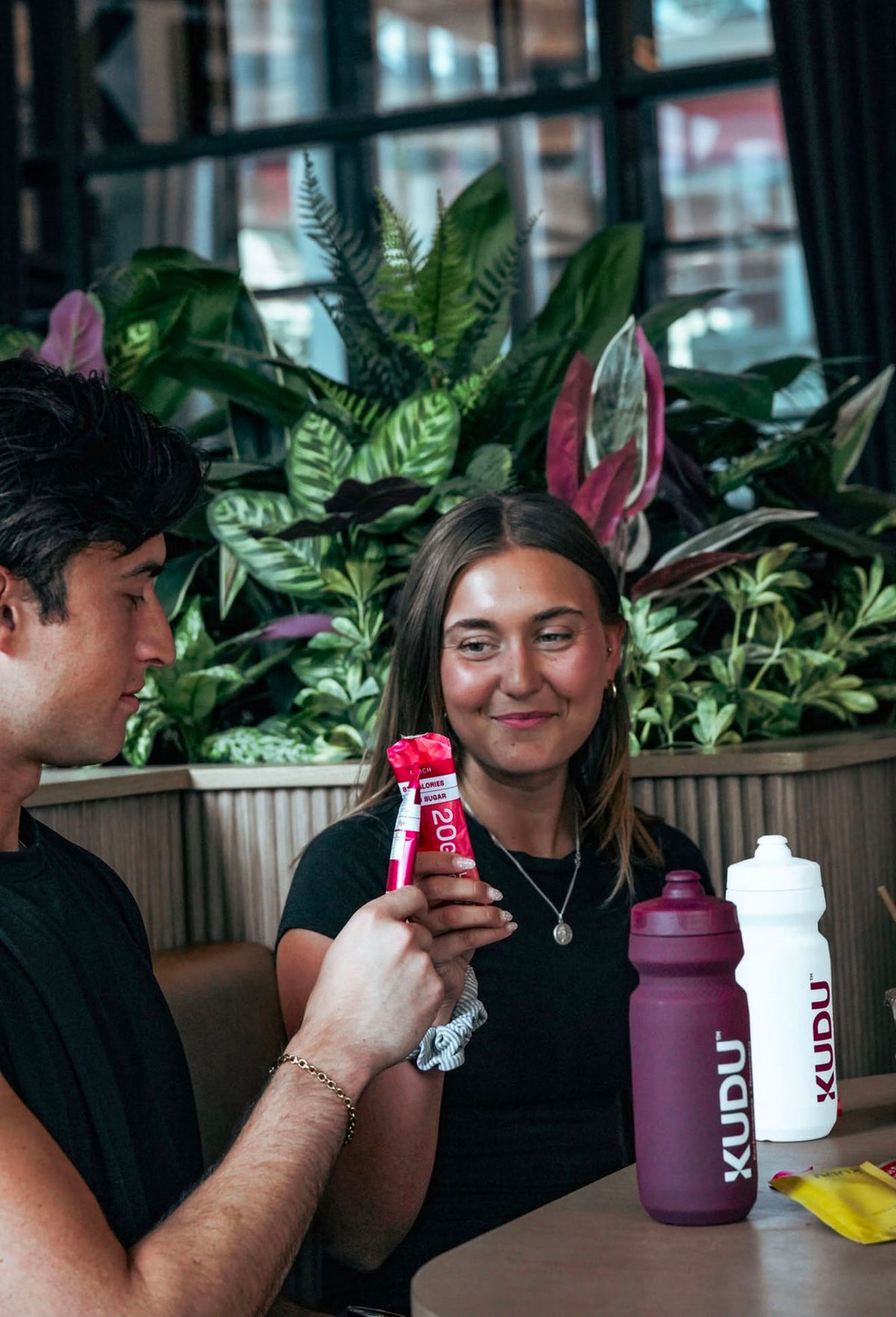
- Coffee plus a shot. Keep the coffee as coffee and take a 20g ready-to-drink sachet alongside it. No mixing, guaranteed dose, and it travels to the gym. This is what KUDU liquid collagen is designed for.
- Move the dose to pre-training. If joints or tendons are the goal, the timing matters more than the drink. See best time to take collagen.
Does coffee affect collagen?
There is a separate question about whether caffeine harms your own collagen. Laboratory studies on skin cells show high caffeine concentrations can reduce collagen synthesis, but at doses far above what reaches skin from drinking coffee. Population studies do not show coffee drinkers have worse skin ageing after adjusting for sun and smoking. Coffee does not cancel out a collagen supplement.
Does collagen coffee break a fast?
Yes. Collagen is protein with calories, and 10g in a coffee is around 40 calories. Black coffee is fasting-safe; collagen coffee is not. See does collagen break a fast.
Get a 20g shot to go with your coffee →
KUDU is 20,000mg of hydrolysed bovine collagen per sachet, 85 calories, 0g sugar, in four flavours, ready to drink. No scoop, no clumps, full dose.
Collagen in coffee: FAQs
Does hot coffee destroy collagen powder?
No. Hydrolysed collagen peptides are stable at brewing temperature (85 to 95°C). Breaking peptide bonds needs prolonged heat well above boiling.
At what temperature does collagen break down?
Native collagen unwinds at about 40°C, but that is irrelevant to supplements, which are already hydrolysed. The peptides survive normal cooking and boiling; degradation needs sustained temperatures far above 100°C or hours of acid plus heat.
How much collagen should I put in coffee?
15g to 20g if it is your only daily dose and you want joint, tendon or muscle benefits. 5g covers skin only.
Can I put collagen in tea or porridge?
Yes, for the same reason. Heat at kitchen temperatures does not damage hydrolysed collagen.
Does collagen in coffee break a fast?
Yes. It is protein with calories. Black coffee is fine; collagen coffee ends the fast.
Related reading
- Does collagen break a fast?
- Liquid collagen vs powder
- Hydrolysed collagen vs collagen peptides
- How much collagen per day
Sources
- Gelatin Manufacturers Institute of America. Gelatin handbook: extraction temperatures and stability.
- León-López A et al. Hydrolyzed collagen: sources and applications. Molecules 2019.
- Iwai K et al. Identification of food-derived collagen peptides in human blood after oral ingestion of gelatin hydrolysates. J Agric Food Chem 2005.
- Proksch E et al. Oral supplementation of specific collagen peptides has beneficial effects on human skin physiology. Skin Pharmacol Physiol 2014.
 20g per shot
Ready to try it?
20g Liquid Collagen Protein
4.7 from 495 reviews
- 20g hydrolysed bovine collagen per shot
- Ready to drink in two sips. 85 kcal, 0g sugar
- Informed Sport certified
Pick a flavour
£34.95 for 14
or £1.99 a shot on subscription
Free UK delivery over £50 · 60-day money-back guarantee · Pause or cancel any time