

Collagen starts working within an hour of drinking it, but you will not see anything for a few weeks. Hydrolysed collagen peptides appear in your bloodstream 1 to 2 hours after a dose. Measurable skin changes show up at 4 to 8 weeks, nails at 12 to 24 weeks, and joint, tendon and muscle benefits at 12 weeks and beyond, provided you take a proper dose every day. Stop at week three because "nothing happened" and you have paid for the hardest part and skipped the payoff.
This guide lays out the timeline week by week using the actual trial durations, explains why each tissue takes as long as it does, and lists the four things that make collagen work faster. It applies to any hydrolysed collagen, bovine or marine, powder or liquid. Where doses matter we say so.
Quick answer: how long collagen takes to work
- 1 to 2 hours: collagen peptides peak in the blood
- 2 to 4 weeks: subtle changes some people notice (skin feels less dry, nails chip less)
- 4 to 8 weeks: skin elasticity and hydration improve in trials
- 8 to 12 weeks: joint discomfort during activity falls; muscle and body-composition changes with training
- 12 to 24 weeks: nail growth, tendon and ligament adaptation, ankle stability
- 6 to 12 months: bone density changes
What happens in the first hour
Hydrolysed collagen is collagen that has already been broken into short chains of two or three amino acids. That is why it works at all: whole collagen (think gelatin that has not been hydrolysed) is a large protein your gut has to dismantle, but hydrolysed peptides are small enough to be absorbed largely intact. Human studies detect hydroxyproline-containing peptides in plasma within 1 to 2 hours of a dose, with levels staying raised for several hours.
This is the window that matters for anyone using collagen around training. Shaw and colleagues at the Australian Institute of Sport gave athletes 15g of vitamin C enriched gelatin one hour before six minutes of rope skipping and measured roughly double the collagen synthesis marker in the blood compared with placebo. The peptides were circulating while the tendons were being loaded. Nothing visible changes in hour one, but the process starts there. See when to take collagen for the biggest effect.
Weeks 1 to 4: nothing to see yet, and that is normal
Skin cells turn over roughly every 4 weeks, nails grow around 3mm a month, and tendon collagen turns over far more slowly than either. In the first month the raw material is arriving daily but the tissue that would show it has not been rebuilt yet. Some people report their skin feels less tight and dry after two or three weeks, which is consistent with the hydration measurements in the trials, but it is not something a camera would catch.
The one thing that does change in weeks 1 to 4 is protein intake. A 20g collagen sachet is 20g of protein, so people who were under-eating protein often feel the difference in recovery and hunger before any collagen-specific effect appears.
Weeks 4 to 8: skin is first
Skin is the most studied outcome and the fastest to respond. In the Proksch trial (Skin Pharmacology and Physiology, 2014) women aged 35 to 55 took 2.5g or 5g of collagen peptides daily. At 4 weeks skin elasticity had already improved compared with placebo, and by 8 weeks the difference was statistically clear, with a further improvement in hydration. Other placebo-controlled trials at 2.5g to 10g report the same 8 to 12 week window for elasticity, hydration and fine lines.
What you may notice: skin feels more supple, makeup sits differently, dry patches ease. What you will not notice: dramatic wrinkle changes. Those studies measured percentage changes in elasticity, not transformations.
Weeks 8 to 12: joints, muscle and recovery
This is where the training-related benefits arrive, and where a bigger dose matters.
- Joint discomfort: in the Zdzieblik 2017 trial, physically active adults with activity-related knee discomfort took 5g of collagen peptides daily. At 12 weeks the collagen group reported significantly less pain during activity than placebo.
- Muscle and body composition: three separate 12-week trials (older men, premenopausal women, and recreationally active men) combined 15g of collagen peptides with resistance training three times a week and found greater gains in fat-free mass and strength than training alone.
- Recovery from hard sessions: the Clifford 2019 trial used 20g a day and saw less muscle soreness and faster recovery of jump performance within 9 days. This is the exception to the "wait 12 weeks" rule: soreness benefits can show inside a fortnight if the dose is high enough.
Weeks 12 to 24: nails, tendons and ligaments
Nails and connective tissue are slow. The Hexsel nail trial ran for 24 weeks on 2.5g a day and reported 12% faster nail growth and 42% fewer broken nails, with benefits persisting a month after stopping. The Achilles tendinopathy trial (Praet 2019) paired 2.5g of collagen with daily calf exercises for 6 months. The chronic ankle instability trial (Dressler 2018) used 5g for 6 months and saw improved stability and fewer re-injuries.
Tendon collagen has a half-life measured in years, so 3 to 6 months is genuinely how long it takes to remodel. If your goal is a niggling Achilles, patellar tendon or ankle, plan for six months of daily collagen plus the loading exercise that tells the tendon where to put it. Our guide to collagen for tendonitis covers the protocol.
6 to 12 months: bone
Bone is the slowest tissue of all. The one strong trial here (König 2018) gave postmenopausal women 5g of collagen peptides daily for 12 months and measured improved bone mineral density at the spine and femoral neck versus placebo. If bone is the goal, collagen is a year-long commitment alongside calcium, vitamin D and weight-bearing exercise.
The collagen timeline, by goal
| Goal | First measurable change | Dose the trials used | Minimum commitment |
|---|---|---|---|
| Skin hydration and elasticity | 4 to 8 weeks | 2.5g to 10g | 12 weeks |
| Muscle soreness after training | 1 to 2 weeks | 20g | Ongoing |
| Joint discomfort during activity | 12 weeks | 5g to 10g | 12 weeks |
| Strength and body composition (with training) | 12 weeks | 15g | 12 weeks |
| Nail growth and strength | 12 to 24 weeks | 2.5g | 24 weeks |
| Tendon and ligament pain | 12 to 24 weeks | 2.5g to 5g plus loading exercise | 6 months |
| Bone density | 12 months | 5g | 12 months |
Four things that make collagen work faster
1. Take enough
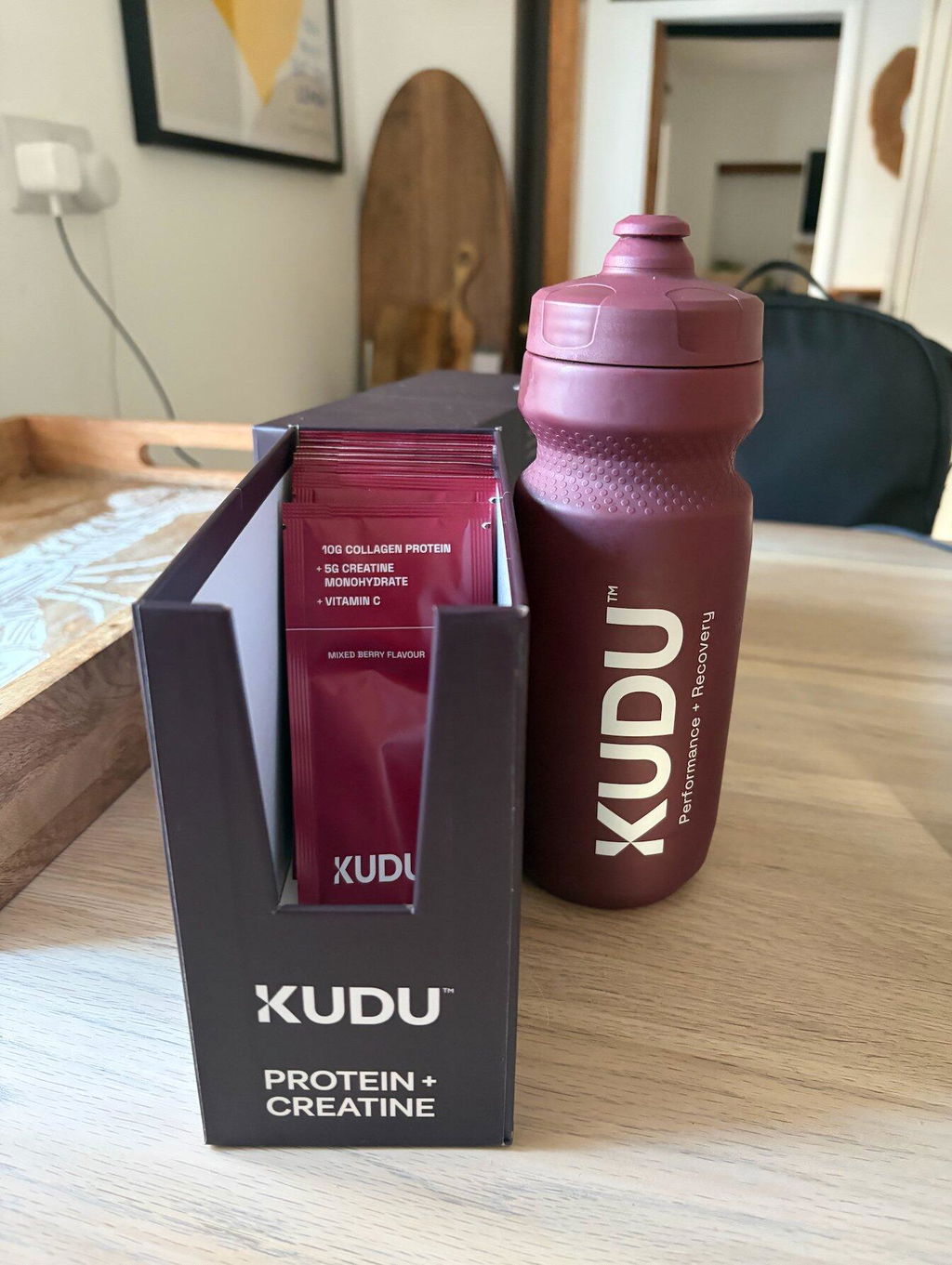
The single biggest reason people conclude collagen "did nothing" is dose. A 2.5g beauty shot will not touch a sore knee, and gummies rarely deliver more than 1g to 2g. If your goals include joints, tendons or training, aim for 10g to 20g a day. One KUDU sachet is 20g, which covers every row of the table above in one go. Full dosing guide: how much collagen per day.
2. Take it every day
Every trial above dosed daily. Tissue remodelling responds to a steady supply, not to a big dose twice a week. This is the argument for a format you will actually finish: a two-sip sachet gets taken on the mornings a scoop-and-shake does not.
3. Load the tissue you want to change
The tendon, ligament and muscle trials all combined collagen with exercise. Collagen provides the amino acids; loading tells the body where to lay them down. Taking your dose 30 to 60 minutes before training puts the peptides in circulation while the tissue is being stressed.
4. Get enough vitamin C and total protein
Vitamin C is a cofactor for collagen synthesis, which is why the Shaw protocol paired gelatin with it. Most people get enough from food, but a diet low in fruit and veg blunts the effect. Total protein matters too: collagen is not a complete protein, so keep it to around a third of your daily intake and get the rest from complete sources.
How to run a 12-week collagen trial on yourself
- Pick one measurable goal: skin photos in the same light, a nail growth mark, a pain score out of 10 for a specific joint, or your recovery the day after a hard session.
- Record week 0.
- Take 20g every day for 12 weeks. Morning or pre-training, whichever you will not forget.
- Check at weeks 4, 8 and 12. Expect skin first, joints and recovery last.
- Decide at week 12, not week 3.
Start a 12-week trial with KUDU 20g shots →
KUDU's box of 14 is exactly two weeks of daily 20g doses, ready to drink, 85 calories, 0g sugar and Informed Sport certified. It comes with a 60-day money-back guarantee, which covers the first two months of the timeline above.
How long does collagen take to work: FAQs
How long does collagen take to work on skin?
Trials show measurable improvements in skin elasticity at 4 weeks and clearer changes in elasticity and hydration at 8 weeks, at doses of 2.5g to 10g a day. Give it 12 weeks before judging.
How long does collagen take to work for joints?
Around 12 weeks for activity-related joint discomfort at 5g to 10g a day. Tendon and ligament problems take 3 to 6 months and need loading exercise alongside the collagen.
Can collagen work in 2 weeks?
Only for muscle soreness and recovery, where a 20g daily dose reduced soreness within 9 days in one trial. Skin, nails and joints need longer.
What happens if I stop taking collagen?
Benefits fade gradually as the tissue turns over. The nail trial found improvements persisted 4 weeks after stopping. There is no rebound effect; you simply return to your baseline supply over a few months.
Does liquid collagen work faster than powder?
Not per gram. Hydrolysed collagen is absorbed the same way regardless of format. Liquid works faster in practice only because people take it more consistently and because ready-to-drink sachets tend to carry a bigger dose than a flavoured scoop.
Related reading
- How much collagen per day? Doses from 10 studies
- Best time to take collagen
- How collagen is absorbed
- Collagen for skin: does it really work?
Sources
- Proksch E et al. Oral supplementation of specific collagen peptides has beneficial effects on human skin physiology. Skin Pharmacol Physiol 2014.
- Hexsel D et al. Oral supplementation with specific bioactive collagen peptides improves nail growth and reduces symptoms of brittle nails. J Cosmet Dermatol 2017.
- Zdzieblik D et al. Improvement of activity-related knee joint discomfort following supplementation of specific collagen peptides. Appl Physiol Nutr Metab 2017.
- Clifford T et al. The effects of collagen peptides on muscle damage, inflammation and bone turnover following exercise. Amino Acids 2019.
- Shaw G et al. Vitamin C enriched gelatin supplementation before intermittent activity augments collagen synthesis. Am J Clin Nutr 2017.
- Praet SFE et al. Oral supplementation of specific collagen peptides combined with calf-strengthening exercises in Achilles tendinopathy. Nutrients 2019.
- Dressler P et al. Improvement of functional ankle properties following supplementation with specific collagen peptides in athletes with chronic ankle instability. J Sports Sci Med 2018.
- König D et al. Specific collagen peptides improve bone mineral density and bone markers in postmenopausal women. Nutrients 2018.
- Zdzieblik 2015, Kirmse 2019, Jendricke 2019: collagen peptides plus resistance training and body composition.