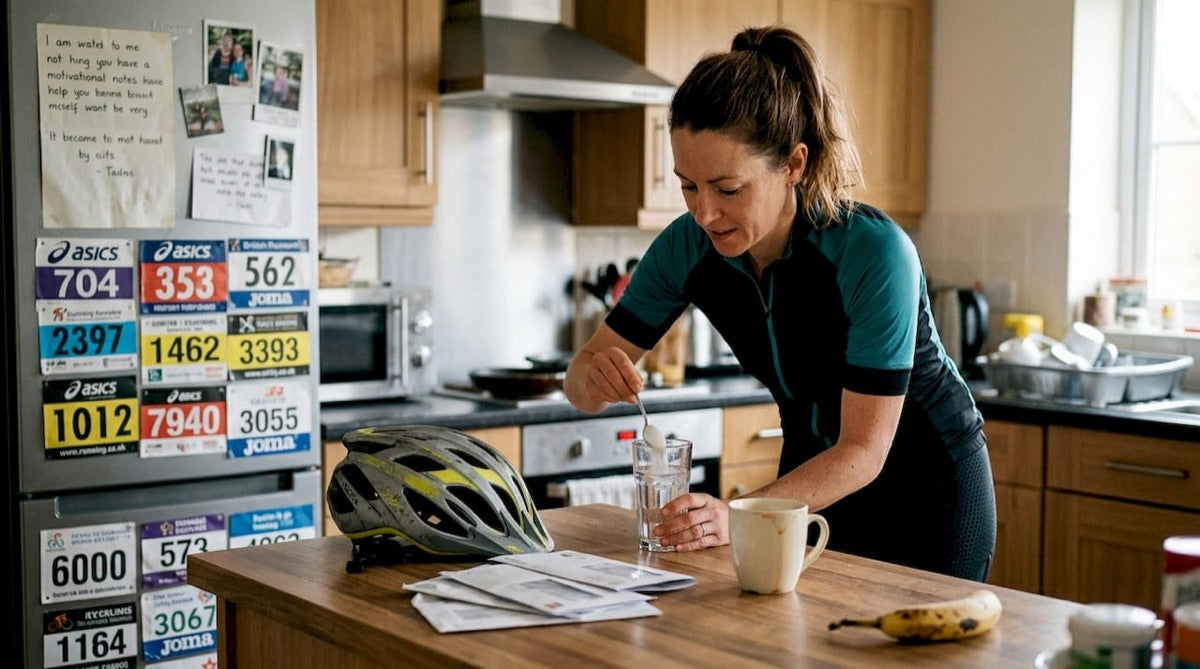

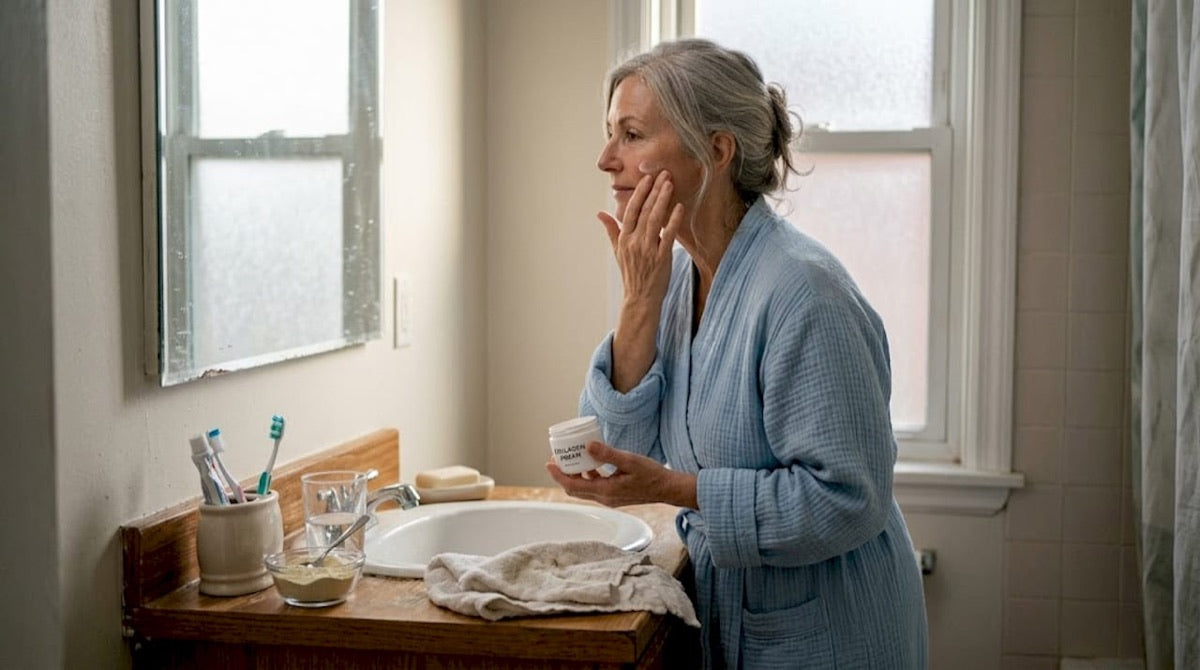
Menopause is the single biggest collagen event in a woman's life. Oestrogen drives collagen production in skin, bone, cartilage, tendons and the pelvic floor, and when it falls, so does collagen: skin loses roughly 30% of its collagen in the first five years after menopause, then about 2% a year after that. The symptoms show up as joint aches that arrive from nowhere, thinner and drier skin, slower recovery from exercise, and the bone loss that eventually becomes osteopenia.
Supplementing hydrolysed collagen cannot replace oestrogen, and this article is not a substitute for a conversation about HRT. What collagen can do is supply the raw materials the body is now short of, and there is a specific set of trials in perimenopausal and postmenopausal women that show what to expect. This guide goes through them by symptom.
Quick answer: collagen during and after menopause
- Skin: 2.5g to 10g daily improved elasticity and hydration in 8 to 12 weeks in women aged 35 to 65
- Joints: 5g to 10g daily reduced joint pain over 12 to 24 weeks
- Muscle: 15g daily with resistance training improved strength and lean mass in women
- Bone: 5g daily for 12 months improved bone mineral density in postmenopausal women
- Practical dose: one 20g sachet a day covers every one of those
Why collagen falls at menopause
Oestrogen receptors sit on the fibroblasts that make collagen in skin and on the cells that build bone and cartilage. As oestrogen declines through perimenopause, collagen synthesis slows and collagen breakdown speeds up. Brincat's classic 1987 study measured skin collagen in postmenopausal women and found the steep early loss that has been quoted ever since: around 30% in the first five years. Bone follows the same curve, which is why fracture risk climbs in the decade after the final period. Cartilage and tendon get less attention but behave the same way, and this is the likely reason joint pain is reported by more than half of women in perimenopause.
Joint pain in perimenopause
New joint pain, often in the hands, knees, hips and shoulders, is one of the most common perimenopausal symptoms and one of the least discussed. Hydrolysed collagen has the most relevant trials here. In adults with knee osteoarthritis, 10g daily for 6 months reduced pain versus placebo. In active adults with activity-related knee pain, 5g daily for 12 weeks did the same. The effect takes 12 weeks to show and needs to be paired with strength training, which is independently one of the best treatments for menopausal joint pain and bone loss. Full detail in does collagen help joint pain.
Skin, hair and nails
This is the best-studied area. In the Proksch trials, women aged 35 to 55 taking 2.5g of collagen peptides daily showed improved skin elasticity at 4 weeks and greater improvement at 8 weeks, and a separate arm measured reduced eye wrinkle depth and increased skin collagen at 8 weeks. A 2019 trial in women aged 45 to 65 at 2.5g daily found improved hydration, elasticity and density at 12 weeks. For nails, 2.5g daily over 24 weeks increased growth and reduced breakage. Hair evidence is weaker and mostly mechanistic; see collagen for hair and nails.
Muscle: the menopause symptom nobody warns you about
Muscle mass falls faster after menopause and it is harder to build. The Jendricke 2019 trial gave premenopausal women 15g of collagen peptides daily alongside resistance training three times a week for 12 weeks; the collagen group gained more fat-free mass and hand-grip strength and lost more fat than training alone. A 2015 trial in older men found the same at 15g. Collagen is not a complete protein, so it works best on top of an adequate protein intake (around 1.2g to 1.6g per kilo of body weight a day for women over 45), but it is a convenient way to add 20g of protein that also serves connective tissue.
Bone density: the 12-month trial
The König 2018 trial is the one that matters for bone. 131 postmenopausal women with reduced bone density took 5g of specific collagen peptides or placebo daily for 12 months. The collagen group showed a significant increase in bone mineral density at the spine and femoral neck, while the placebo group continued to lose bone, and blood markers shifted towards bone formation. It is one trial, and collagen sits alongside calcium, vitamin D, resistance training and, where appropriate, HRT, not instead of them. But the direction is clear and the dose (5g) is easily covered.
Collagen and HRT
There is no interaction between collagen and HRT; collagen is a food protein. Women on HRT tend to preserve more skin and bone collagen, and supplementing on top simply adds substrate. Women who cannot or choose not to take HRT have the most to gain from covering the collagen shortfall directly.
A daily protocol for women over 45
- One 20g hydrolysed collagen sachet every day. This covers the skin dose eight times over, the joint and bone doses two to four times over, and the 15g muscle dose. Consistency for 12 weeks is what produced results in every trial above.
- Take it before exercise on training days. 30 to 60 minutes before a strength session or a walk puts the peptides in circulation while joints and tendons are loaded.
- Two strength sessions a week. Non-negotiable for bone and joints. Collagen helps the tissue respond; it does not replace the stimulus.
- Protein at every meal, calcium and vitamin D checked. Collagen adds 20g to your protein total but is not complete on its own.
- Reassess at 12 weeks for skin and joints, 6 months for muscle, 12 months for bone.
Start with 14 days of KUDU 20g collagen →
KUDU liquid collagen is 20,000mg of hydrolysed bovine collagen per ready-to-drink sachet, 85 calories, 0g sugar, and comes with a 60-day money-back guarantee. If you also lift, Collagen + Creatine adds the 5g of creatine that is increasingly recommended for women's muscle, bone and mood through menopause.
Collagen and menopause: FAQs
Does collagen help with menopause symptoms?
It helps the symptoms caused by collagen loss: joint pain, thinning skin, brittle nails, slower recovery and bone density. It does not affect hot flushes, sleep or mood, which are driven by hormones.
How much collagen should a woman take during menopause?
The trials used 2.5g for skin and nails, 5g for bone and joints, and 15g for muscle. One 20g sachet daily covers all of them.
How long does collagen take to work after menopause?
Skin 8 to 12 weeks, joints 12 to 24 weeks, muscle 12 weeks with training, bone 12 months.
Can I take collagen with HRT?
Yes. There is no interaction. Collagen is a dietary protein.
Is collagen or creatine better for menopausal women?
They do different jobs. Collagen supplies connective tissue and skin; creatine supports muscle strength, bone and cognition. Many women over 45 benefit from both, which is why KUDU makes a combined sachet.
Related reading
- Does collagen help joint pain?
- Signs of collagen deficiency every woman should know
- How long does collagen take to work?
- Collagen and creatine together
Sources
- Brincat M et al. Skin collagen changes in postmenopausal women receiving different regimens of estrogen therapy. Obstet Gynecol 1987.
- Proksch E et al. Oral supplementation of specific collagen peptides has beneficial effects on human skin physiology. Skin Pharmacol Physiol 2014; and Oral intake of specific bioactive collagen peptides reduces skin wrinkles. Skin Pharmacol Physiol 2014.
- König D et al. Specific collagen peptides improve bone mineral density and bone markers in postmenopausal women. Nutrients 2018.
- Jendricke P et al. Specific collagen peptides in combination with resistance training improve body composition and regional muscle strength in premenopausal women. Nutrients 2019.
- Benito-Ruiz P et al. Collagen hydrolysate for improving joint comfort. Int J Food Sci Nutr 2009.
- Smith-Ryan AE et al. Creatine supplementation in women's health: a lifespan perspective. Nutrients 2021.
More collagen guides
 20g per shot
Ready to try it?
20g Liquid Collagen Protein
4.7 from 495 reviews
- 20g hydrolysed bovine collagen per shot
- Ready to drink in two sips. 85 kcal, 0g sugar
- Informed Sport certified
Pick a flavour
£34.95 for 14
or £1.99 a shot on subscription
Free UK delivery over £50 · 60-day money-back guarantee · Pause or cancel any time
More on this topic: Collagen for joints & tendons →