


TL;DR:
- Proper supplement dosing is crucial for safety and effectiveness, requiring adherence to official guidelines and accurate label reading. Confusing units like milligrams and micrograms can lead to dangerous errors, especially with potent vitamins like D and B12. Consumers should verify ingredient amounts, avoid proprietary blends, and seek professional advice to ensure safe and reliable supplementation.
Supplement dosing is defined as the recommended daily intake of a nutrient or active compound, calibrated to deliver health benefits without causing harm. Getting this right matters far more than most people realise. The UK government, the Food Standards Agency (FSA), and the Committee on Toxicity all publish dosage guidelines that set safe upper limits for specific nutrients. Ignore those limits and you risk side effects ranging from nausea and headaches to, in serious cases, liver injury. Understanding supplement dosing is the foundation of any safe and effective supplementation routine, whether you are an athlete, a wellness enthusiast, or someone exploring collagen for skin and joint health.
What do supplement dosage guidelines mean?
Supplement dosage guidelines are the official benchmarks that define how much of a nutrient is safe and effective for most adults. Two terms appear most often on UK labels: the Recommended Dietary Allowance (RDA) and the Nutrient Reference Value (NRV). The NRV is the figure you will see printed on UK supplement packaging. It represents the amount of a nutrient considered sufficient for the average healthy adult, expressed as a percentage of a daily target.
The NRV is a population average, not a personal prescription. Your actual requirement depends on age, sex, body weight, health status, and whether you take prescribed medication. A 25-year-old male athlete and a 60-year-old woman with osteoporosis may both read “100% NRV” on a vitamin D label and have very different physiological needs.
Authorities set safe upper intake levels using toxicology studies and clinical trials. The Committee on Toxicity, for example, established an upper limit of 40 micrograms per day for calcidiol (a form of vitamin D) to protect consumers from overuse when unsupervised. That upper limit is not a target. It is a ceiling beyond which risk rises sharply.
Key dosing terms to know:
- NRV (Nutrient Reference Value): the daily intake sufficient for most healthy adults, shown as a percentage on UK labels.
- RDA (Recommended Dietary Allowance): a similar concept used in older UK and US literature; often used interchangeably with NRV in consumer contexts.
- Upper Tolerable Intake Level (UL): the maximum daily amount unlikely to cause harm in healthy adults.
- µg / mcg: micrograms. One microgram equals one thousandth of a milligram.
- mg: milligrams. Confusing mg with mcg creates a 1,000-fold dosing error, which is a serious risk with potent vitamins like D and B12.
Pro Tip: Always check the unit next to the dose figure on your label. “10 mg” and “10 mcg” look similar but represent doses that differ by a factor of 1,000.
How do supplement labels communicate dosing information?
A supplement label carries more dosing information than most people read. The supplement facts panel lists the serving size, the amount per serving for each ingredient, and the percentage of the NRV that amount represents. Reading all three columns together gives you the full picture.

The serving size is where many people go wrong. A product may list an impressive amount of an ingredient per 100g, but the actual serving size might be 5g. The dose you consume per sachet or capsule is what matters, not the headline figure on the front of the pack.
Proprietary blends are a common source of confusion. A blend lists a total weight for a group of ingredients but hides the individual amounts of each active compound within it. A “Sleep Complex” weighing 500mg might contain 450mg of magnesium oxide and only 50mg of the active botanical you actually wanted. You cannot verify the dose of any single ingredient in a proprietary blend.
Standardised extracts are the better choice. A label reading “Ashwagandha extract standardised to 5% withanolides” tells you exactly how much active compound you are getting. That specificity is what allows you to compare doses against clinical research.
Red flags to watch for on any supplement label:
- No serving size stated clearly.
- Proprietary blend with no individual ingredient breakdown.
- Units that switch between mg and mcg without explanation.
- No maximum daily dose warning where one is legally required.
- No batch number or certification seal.
Pro Tip: Cross-reference the dose on your label with the dose used in published clinical trials for that ingredient. If the label dose is a fraction of the studied dose, the product is unlikely to deliver the claimed benefit.
What are the dosing considerations for specific ingredients and demographics?
Ingredient-specific dosing limits exist because nutrients and bioactive compounds behave very differently in the body. A single safe upper limit does not apply across all supplements.
Vitamin D is the clearest example. The UK government recommends 10 micrograms daily for adults and children over one year old, with breastfed infants advised 8.5–10 micrograms per day. Clinical studies show that doses between 5 and 60 µg per day are generally well tolerated, with serum calcium levels remaining stable in controlled trials. The upper limit of 40 µg per day exists because unsupervised use above that threshold raises the risk of hypercalcaemia.
Novel ingredients carry stricter restrictions. The FSA’s assessment of tetrahydrocurcuminoids, a compound derived from turmeric, limits intake to 140 mg per day for adults aged 18 and over. Pregnant and breastfeeding women are excluded entirely due to the risk of hepatotoxicity in susceptible individuals. That exclusion reflects a broader principle: regulatory limits are set for healthy adults and do not automatically extend to vulnerable groups.
| Ingredient | Recommended daily dose | Upper limit / restriction |
|---|---|---|
| Vitamin D (cholecalciferol) | 10 µg | 40 µg/day (Committee on Toxicity) |
| Tetrahydrocurcuminoids | Up to 140 mg | Adults 18+ only; excluded in pregnancy and lactation |
| Berberine (plant preparations) | Not established | Risk of genotoxicity and liver injury; data gaps remain |
The “natural” label does not guarantee safety. Herbal supplements can present risks of genotoxicity or liver injury at doses that are not yet clearly defined. Data gaps mean consumers may unknowingly take risky amounts of botanical ingredients. This is especially relevant for children, older adults, pregnant women, and anyone taking prescribed medication, all of whom face a higher risk of adverse reactions or drug interactions.
Consulting a GP or registered dietitian before starting any new supplement is the most reliable way to establish a dose appropriate for your individual health status. The supplement compliance guide published by Kudunutrition covers the 2026 UK regulatory framework in detail for those who want the full regulatory picture.
What practical steps help you dose supplements safely?
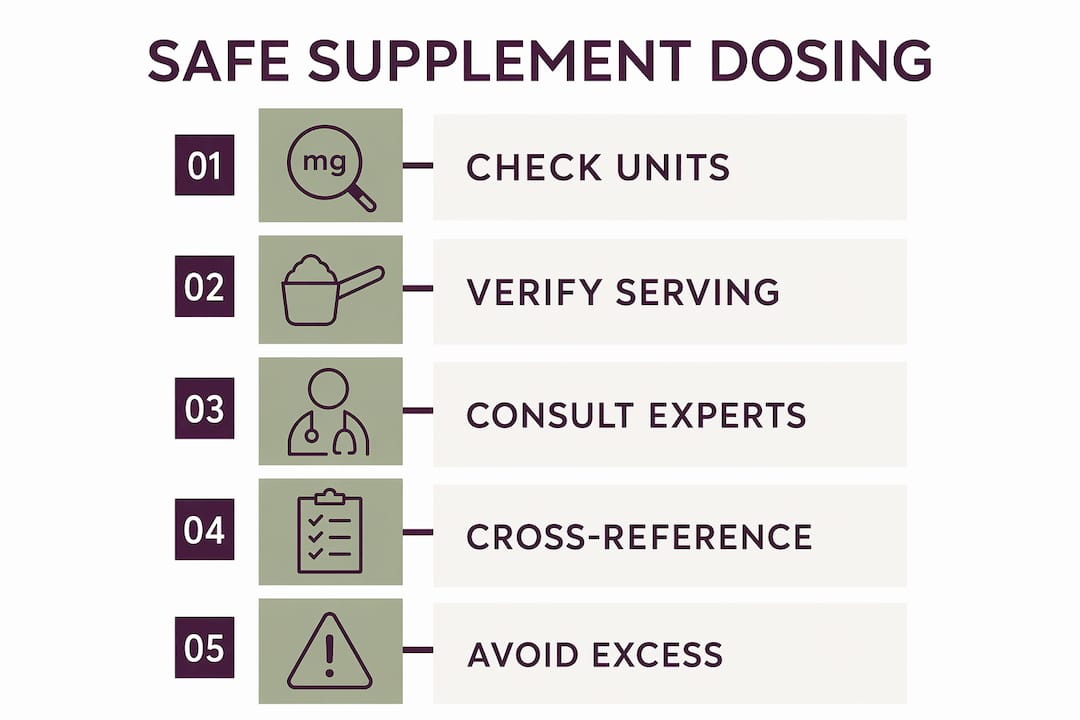
Safe supplement dosing comes down to five consistent habits. None of them require specialist knowledge. All of them reduce your risk substantially.
-
Consult a healthcare professional first. The UK government advises stopping supplements immediately if you feel unwell and seeking professional advice rather than adjusting the dose yourself. If you take prescribed medication, a pharmacist can screen for interactions before you begin.
-
Follow the label dose exactly. The recommended dose on a supplement label represents the amount tested for safety and efficacy. Doubling the dose does not double the benefit. For many nutrients, it increases toxicity risk instead.
-
Check for quality certification. Supplements are regulated as food, not medicines, in the UK. That means no pre-market safety approval is required. Certifications like GMP (Good Manufacturing Practice) and Informed Sport go beyond the legal minimum and provide independent verification of ingredient identity, dose accuracy, and contamination testing.
-
Understand your units before you buy. Confirm whether the dose is in mg or mcg. For potent vitamins and minerals, the difference is not trivial. A label that lists vitamin B12 at “1,000 mg” rather than “1,000 mcg” contains either a printing error or a dangerous formulation.
-
Avoid proprietary blends when dose accuracy matters. If you are dosing for a specific health outcome, such as joint support or athletic recovery, you need to know exactly how much of each active ingredient you are consuming. A proprietary blend makes that impossible.
Pro Tip: When assessing a new supplement, search for the ingredient name plus “clinical trial dose” to find the amount used in published research. If the label dose is less than a quarter of the studied dose, the product is unlikely to produce a meaningful effect.
For athletes in particular, the sports supplement safety guide from Kudunutrition outlines the specific risks and quality markers relevant to competitive sport.
Key takeaways
Correct supplement dosing requires matching the right dose to the right person, verified by credible certification and read accurately from a transparent label.
| Point | Details |
|---|---|
| Follow official dose limits | UK authorities set upper intake levels based on toxicology; exceeding them raises real health risks. |
| Units determine safety | Confusing mg with mcg creates a 1,000-fold error; always confirm the unit before taking a supplement. |
| Proprietary blends obscure doses | Without individual ingredient amounts, you cannot verify you are getting a clinically relevant dose. |
| Vulnerable groups need extra caution | Pregnant women, children, and those on medication face higher risks and require professional guidance. |
| Certification signals quality | GMP and Informed Sport seals confirm dose accuracy and ingredient integrity beyond legal minimums. |
Why dosing literacy is the skill most supplement buyers overlook
Most people who buy supplements read the front of the pack and stop there. I have seen this pattern repeatedly, and it is the single biggest source of disappointment and, occasionally, harm in the supplement category.
The front of a supplement pack is marketing. The back is information. The serving size, the unit of measurement, the NRV percentage, the certification seal, and the maximum daily dose warning are all printed on the back for a reason. They are the data points that determine whether a product is safe and effective for you specifically.
What surprises me most is how often the unit confusion catches people out. Vitamin D is a perfect example. The difference between 10 µg and 10 mg is not a rounding issue. It is a 1,000-fold difference in dose. A product formulated at 10 mg of vitamin D3 per serving would deliver 25 times the upper tolerable intake in a single dose. That is not a hypothetical risk.
The regulatory framework in the UK is evolving. The 2026 FSA guidance on novel ingredients like tetrahydrocurcuminoids shows that authorities are tightening restrictions as new evidence emerges. That is a positive development, but it also means the supplement you bought two years ago may now carry updated dosing restrictions you have not seen. Checking the current label and the FSA’s novel foods register periodically is a habit worth building.
My honest view is that the best supplement brands make dosing easy. Transparent labels, standardised extracts, and third-party certification are not premium features. They are the baseline standard every consumer should expect. If a brand cannot tell you exactly how much of each active ingredient is in a serving, that is the answer.
— Sam
Kudunutrition’s approach to transparent collagen dosing
Knowing the exact dose in every serving should not require detective work. Kudunutrition builds that transparency into every product from the start.
Each 20g liquid collagen protein sachet delivers a clearly stated, clinically relevant dose of collagen protein, with no proprietary blends and no hidden fillers. The range carries Informed Sport certification, which means every batch is independently tested for dose accuracy and banned substance contamination. For health-conscious consumers, athletes, and anyone prioritising skin, joint, and bone health, that level of verification removes the guesswork that undermines so many supplement routines. Browse the full collagen protein range to find the format and flavour that fits your daily routine.
FAQ
What is the difference between NRV and RDA?
The NRV (Nutrient Reference Value) is the standard used on UK supplement labels and represents the daily intake sufficient for most healthy adults. The RDA (Recommended Dietary Allowance) is an older term used in US and earlier UK literature; both concepts refer to the same population-level daily target.
How much vitamin D should I take daily?
The UK government recommends 10 micrograms of vitamin D per day for adults and children over one year old. The Committee on Toxicity sets the upper limit at 40 micrograms per day; exceeding that without medical supervision raises the risk of hypercalcaemia.
Why do proprietary blends make dosing harder?
Proprietary blends list a combined weight for a group of ingredients without disclosing the individual amounts. This makes it impossible to confirm whether any single active compound is present at a dose shown to be effective in clinical research.
Are natural supplements always safe to take?
Natural does not mean risk-free. Some herbal supplements carry risks of genotoxicity or liver injury, and safe dose levels for many botanical ingredients have not been fully established. The FSA advises caution, particularly for pregnant women, children, and people taking prescribed medication.
What should I do if I feel unwell after taking a supplement?
Stop taking the supplement immediately and consult a GP or pharmacist. The UK government advises against adjusting the dose yourself. A healthcare professional can assess whether the supplement is interacting with any medication or underlying health condition.