

The best collagen for a woman in the UK is the one that matches her goal, her diet and the dose used in the research on that goal. For skin, studies used 2.5g to 10g a day. For joints and tendons they mostly used 5g to 15g, and trials pairing collagen with strength training used about 15g. If you don't eat beef, choose marine collagen, and if you are vegan, no collagen supplement fits.
Quick answer
Pick by goal first, then by source. For skin, 2.5g to 10g of hydrolysed collagen a day matches the trials, and marine or bovine both work. If you train, studies on tendons and joints used 5g to 15g, often before exercise, and KUDU's 20g shot covers that in one sachet. Pescatarians should buy marine. Over 55 and lifting three times a week? Collagen with creatine is worth a look. Collagen has no authorised health claims, so treat every benefit below as research, not a promise.
Find your collagen in three questions
Answer three questions and the picker gives you a format, a daily amount based on the studies, and an honest product pick. If KUDU isn't right for you, it says so.
Collagen picker
Which collagen suits you?
1. Your age
2. Your main goal
3. Your diet
For joints and tendons, trials used 5g to 15g of hydrolysed collagen a day. If you eat beef, a 20g liquid shot covers that in one sachet. Pescatarians should choose marine collagen, and vegans should know collagen only comes from animals.
The best collagen for women, by goal
"Best" depends on what you want collagen for. The studies behind each goal used different doses, so a product that suits one goal can be a poor buy for another.
| Main goal | Daily amount in the studies | Best format | Marine or bovine? |
|---|---|---|---|
| Skin elasticity and hydration | 2.5g to 10g | Any: liquid, powder or capsule | Either |
| Joints and tendons when you train | 5g to 15g | Liquid shot or powder, before training | Either; bovine is cheaper per gram |
| Bone after menopause | 5g (one 12-month trial) | Powder or liquid, daily | Either |
| Strength training and recovery | About 15g, plus enough total protein | Liquid shot or collagen with creatine | Either |
Skin
Skin is where collagen research is strongest. A 2014 trial gave women aged 35 to 55 either 2.5g or 5g of collagen peptides a day for eight weeks and measured skin elasticity. A 2021 meta-analysis pooled 19 studies and over 1,000 people. Most used 2.5g to 10g, for 8 to 12 weeks. You don't need a big dose for skin, so a 5g to 10g product is the value choice if skin is your only goal.
Joints and tendons
Women who run, lift or play sport load their tendons and joints hard. Studies here used larger amounts. A 2008 trial in athletes used 10g a day for 24 weeks, a 2017 trial gave young athletes with knee pain 5g a day for 12 weeks, and a 2017 lab study gave 15g of gelatin with vitamin C an hour before exercise. KUDU's 20g Liquid Collagen shot covers the top of that range in one sachet. These are findings, not guarantees.
Bone
A 2018 trial followed 131 postmenopausal women with reduced bone density for 12 months. Those taking 5g a day of specific collagen peptides had better bone mineral density readings than those on a placebo. That is one trial with one specific peptide, so it is a promising signal rather than settled advice. Strength training, calcium and vitamin D remain the foundations. Our collagen and bone density guide covers the detail.
Training and recovery
Collagen is a protein, but it is an incomplete one. It lacks tryptophan and has little leucine. A 2020 trial in older women found whey protein raised muscle protein synthesis while collagen peptides did not. So if muscle is the goal, get most of your protein from complete sources and use collagen alongside, not instead. A 2019 trial in premenopausal women who strength trained found 15g of collagen a day led to slightly greater gains in fat-free mass and strength than placebo, which is interesting but early.
Collagen by age: under 40, 40 to 55, and over 55
Under 40
Your own collagen production is still relatively high. If you train hard, the training-dose research is most relevant to you. If you don't, a modest skin dose is plenty.
40 to 55
This is when perimenopause usually starts. Falling oestrogen affects skin thickness and bone turnover, and many women notice changes in their skin first. Studies on collagen in this group are mostly about skin. Our guide to collagen and the menopause looks at the evidence in more depth, and our list of signs of collagen loss every woman should know explains what changes and why.
Over 55
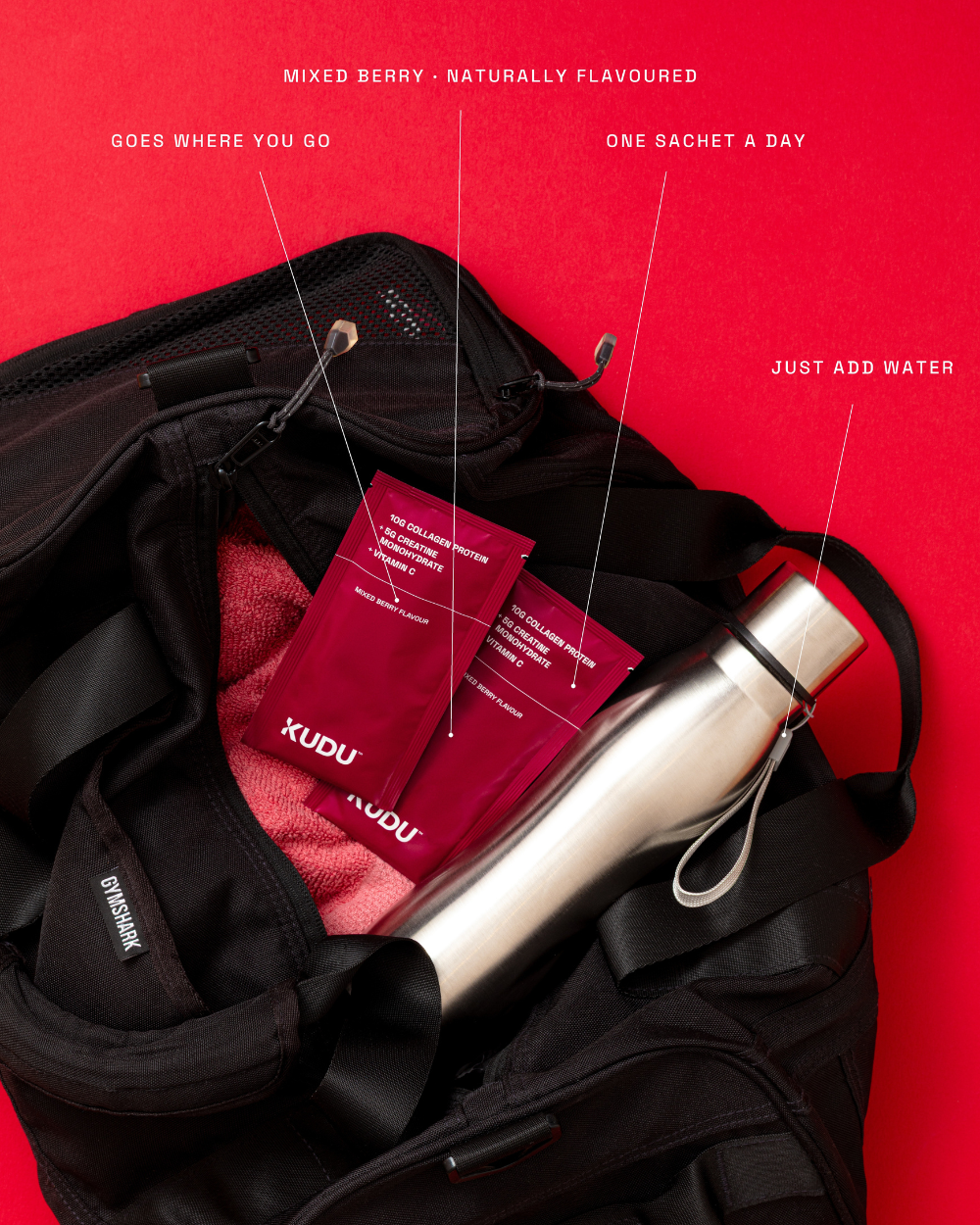
Keeping muscle and strength becomes the priority, and resistance training does most of the work. This is where creatine is worth knowing about. Daily creatine consumption can enhance the effect of resistance training on muscle strength in adults over the age of 55. That claim applies to at least 3g of creatine a day, with resistance training at least three times a week for several weeks, at 65% to 75% of the most you can lift once. Our Collagen + Creatine sachets give 10g of collagen and 5g of creatine monohydrate in one drink. For more, read collagen for over-50s.
Marine or bovine: which collagen is best for women?
Neither is better for women in general. Marine collagen comes from fish skin and is mainly type I, the main type in skin. Bovine collagen provides types I and III and is used in many sports-science trials. Choose by diet first:
- You eat beef: either works, and bovine usually costs less per gram.
- You are pescatarian: marine is your only option. Our Zooki vs Revive vs Absolute Collagen comparison shows which gives the most collagen for your money.
- You are vegan: collagen only comes from animals. Products sold as vegan collagen are plant blends that contain no collagen. Read is collagen vegan?
- You have a fish allergy: avoid marine collagen.
What to look for on the label
- Dose in grams or mg per serving. If a brand hides it, move on. Check it matches the research for your goal.
- Price per 10g of collagen. Divide the price per serving by the grams. This is the only fair way to compare a 5g sachet with a 20g one.
- Hydrolysed collagen or collagen peptides. These are the forms used in the studies.
- Sugar. Several liquid collagens are sugar-free. There is no need to drink sugar with your collagen.
- Testing. If you compete in a drug-tested sport, choose a product on the Informed Sport register.
- Beauty extras. Added hyaluronic acid or biotin push up the price. Decide whether you want them.
Safety first: if you are pregnant or breastfeeding, have a kidney condition or take medication, speak to your GP before starting collagen or creatine.
FAQ
What is the best collagen for women over 50 in the UK?
One with a clear dose of hydrolysed collagen that you will take daily. For skin, 2.5g to 10g matches the trials. If you also strength train, around 15g matches the training studies, and over 55 the creatine claim above applies if you lift three times a week.
Is marine collagen better for women?
Not in general. It suits pescatarians and is mainly type I. Bovine provides types I and III and usually costs less per gram.
How much collagen should a woman take a day?
Studies used 2.5g to 10g for skin, 5g to 15g for joints and tendons, and about 15g alongside strength training. Our collagen dosage guide goes through each goal.
When is the best time to take collagen?
For skin, any time. For training, studies often gave it 30 to 60 minutes before exercise. Consistency matters more than the clock.
Can I take collagen while pregnant?
Speak to your GP or midwife first. There is little research on collagen supplements in pregnancy.
Is there a vegan collagen?
No. Collagen only comes from animals. Vegan products sold as collagen alternatives are plant blends.
Related reading
- Collagen and the menopause
- Collagen for over-50s
- Signs of collagen deficiency every woman should know
- Marine vs bovine collagen
Sources
- Proksch E et al. (2014). Oral supplementation of specific collagen peptides has beneficial effects on human skin physiology. Skin Pharmacology and Physiology, 27(1), 47–55.
- de Miranda RB, Weimer P, Rossi RC (2021). Effects of hydrolyzed collagen supplementation on skin aging: a systematic review and meta-analysis. International Journal of Dermatology, 60(12), 1449–1461.
- Clark KL et al. (2008). 24-week study on the use of collagen hydrolysate as a dietary supplement in athletes with activity-related joint pain. Current Medical Research and Opinion, 24(5), 1485–1496.
- Zdzieblik D et al. (2017). Improvement of activity-related knee joint discomfort following supplementation of specific collagen peptides. Applied Physiology, Nutrition, and Metabolism, 42(6), 588–595.
- Shaw G et al. (2017). Vitamin C-enriched gelatin supplementation before intermittent activity augments collagen synthesis. American Journal of Clinical Nutrition, 105(1), 136–143.
- König D et al. (2018). Specific collagen peptides improve bone mineral density and bone markers in postmenopausal women: a randomized controlled study. Nutrients, 10(1), 97.
- Jendricke P et al. (2019). Specific collagen peptides in combination with resistance training improve body composition and regional muscle strength in premenopausal women. Nutrients, 11(4), 892.
- Oikawa SY et al. (2020). Whey protein but not collagen peptides stimulate acute and longer-term muscle protein synthesis with and without resistance exercise in healthy older women. American Journal of Clinical Nutrition, 111(3), 708–718.
- Commission Regulation (EU) 2017/672, creatine and muscle strength in adults over 55, legislation.gov.uk/eur/2017/672; GB Nutrition and Health Claims Register.
 20g per shot
Ready to try it?
20g Liquid Collagen Protein
4.7 from 495 reviews
- 20g hydrolysed bovine collagen per shot
- Ready to drink in two sips. 85 kcal, 0g sugar
- Informed Sport certified
Pick a flavour
£34.95 for 14
or £1.99 a shot on subscription
Free UK delivery over £50 · 60-day money-back guarantee · Pause or cancel any time