

TL;DR:
- Nutrition certification in the UK verifies expertise through accredited qualifications ranging from Level 2 to Level 6. Registering with professional bodies like the AfN or BANT confirms competence and enhances credibility in the field.
Nutrition certification is the formal process through which individuals obtain recognised credentials verifying their expertise in nutrition science and practice. In the UK, this spans qualifications from introductory Level 2 certificates to degree-level programmes at Level 6, all governed by the Regulated Qualifications Framework (RQF). Bodies such as the Association for Nutrition (AfN) and the British Association for Nutrition and Lifestyle Medicine (BANT) set the standards that separate credible practitioners from those without verified scientific grounding. Whether you are a personal trainer, a wellness coach, or someone considering a full career change, understanding what nutrition certification means is the first step to choosing the right path.
What is nutrition certification and why does it matter?
Nutrition certification is a structured, assessed qualification that confirms a person understands nutrition science at a defined level of depth. The RQF provides the framework, with Level 2 to Level 4 qualifications covering foundational knowledge through to applied science for health and fitness professionals. This matters because the title “nutritionist” is not legally protected in the UK. Without a recognised credential, anyone can call themselves a nutritionist, which creates real risk for the public.
The importance of nutrition certification lies in accountability. Certified practitioners have been assessed against national occupational standards, which means clients and employers can trust their advice. For fitness professionals, a Level 4 award is often the minimum expected by gyms and health clubs. For those advising on clinical or therapeutic nutrition, a Level 6 qualification becomes the baseline for professional registration.
Certification also signals commitment. Completing an accredited programme requires time, study, and often practical placement. That investment communicates seriousness to employers and clients alike, and it opens doors to professional bodies that further validate your standing.
What types of nutrition certification programmes exist in the UK?
UK nutrition qualifications follow the RQF, which organises learning by complexity and depth. The level you choose depends on your current knowledge, career goals, and how much time you can commit.

Level 2 certificates are the entry point. They cover basic nutritional principles, macronutrients, and healthy eating guidelines. These qualifications suit beginners, support workers in social care, and fitness instructors who want a grounding in nutrition without committing to a full degree. Level 2 and Level 4 certificates are accredited by Ofqual and recognised nationally, making them a credible starting point for careers in fitness, health, and sports coaching.
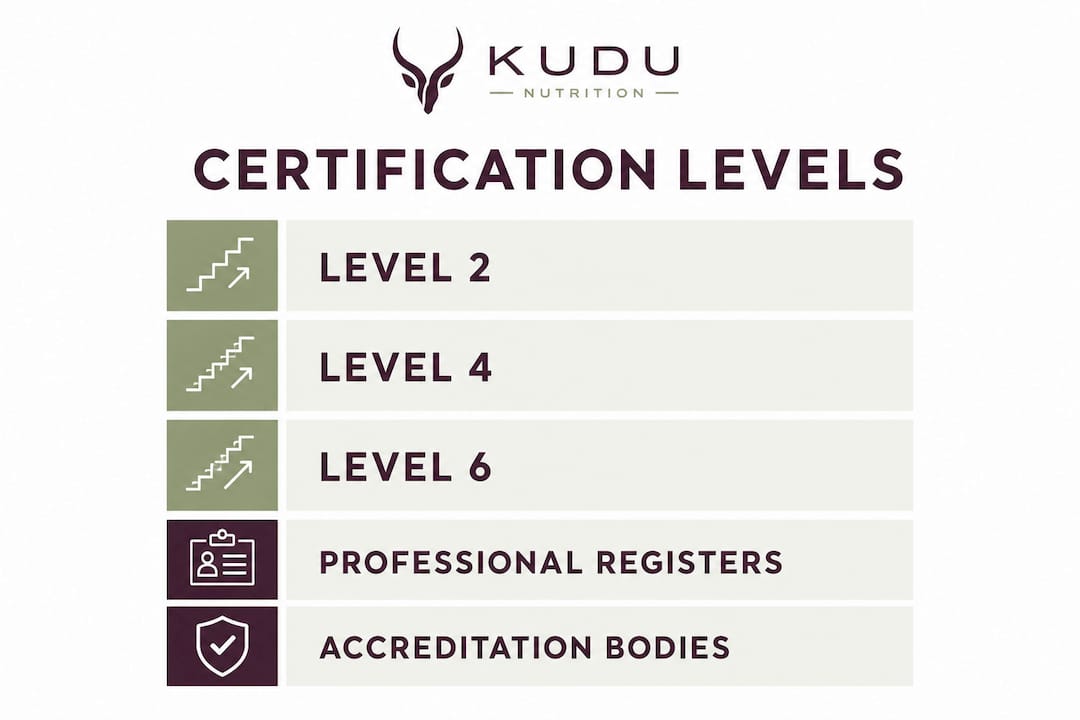
Level 4 awards go deeper into nutritional science, covering topics such as micronutrient function, dietary assessment, and client consultation skills. These are the standard for personal trainers and health coaches who want to give evidence-based dietary guidance within their scope of practice.
Level 6 qualifications, such as a BSc (Hons) Nutrition, represent the highest tier of nutrition certification outside postgraduate study. A UK BSc (Hons) Nutrition degree typically takes three years, with placement options ranging from 20–30 days to a full one-year sandwich year. This level is required for full membership of BANT and for applying to the AfN’s UK Voluntary Register of Nutritionists (UKVRN).
| Qualification level | Target learner | Typical outcome |
|---|---|---|
| Level 2 certificate | Beginners, support workers, fitness instructors | Foundational nutrition knowledge |
| Level 4 award | Personal trainers, health coaches | Evidence-based dietary guidance within scope |
| Level 6 degree (BSc Hons) | Career nutritionists, therapists | Eligibility for AfN and BANT registration |
The table above shows how each level serves a different audience. Choosing the wrong level wastes time and money. Choosing the right one accelerates your career.
Pro Tip: Before enrolling, check whether the course is listed on the Ofqual Register of Regulated Qualifications. If it is not, the qualification may not be recognised by professional bodies or employers.
How do accreditation bodies validate nutrition certifications?
Three organisations shape the credibility of nutrition certification in the UK: the AfN, BANT, and the Nutritional Therapy Education Commission (NTEC).
The AfN operates the UK Voluntary Register of Nutritionists (UKVRN). AfN registration is the only independent verification proving scientific knowledge and competence for nutritionists in the UK. This distinction matters because it separates trained professionals from enthusiasts without verified credentials. Employers in the NHS, public health, and food industry increasingly expect AfN registration as a baseline.
BANT sets membership requirements for nutritional therapists. Full BANT membership requires a Level 6 qualification, a standard introduced in september 2020. This raised the bar significantly and aligned BANT membership with degree-level education. Practitioners who trained before this change were given a transition period to meet the new standard.
NTEC accredits nutritional therapy courses and links directly to two registration routes. NTEC-accredited courses allow graduates to apply directly for the Complementary and Natural Healthcare Council (CNHC) register and BANT membership. Courses without NTEC accreditation require practitioners to build extensive clinical experience and a portfolio before applying for registration. That is a significant additional burden worth factoring into your course choice.
Key questions to ask before enrolling on any nutrition certification course:
- Is the course accredited by NTEC, Ofqual, or another recognised body?
- Does completion make you eligible for AfN, BANT, or CNHC registration?
- Does the course include supervised practical or clinical hours?
- Is the awarding body listed on a national register?
Pro Tip: Email the course provider and ask directly which professional registers their qualification grants access to. A reputable provider will answer clearly and in writing.
How does nutrition certification differ from being a dietitian?
The distinction between a nutritionist and a dietitian is one of the most misunderstood areas in UK health practice. The title “dietitian” is legally protected and requires registration with the Health and Care Professions Council (HCPC). Dietitians manage clinical conditions such as renal disease, eating disorders, and cancer-related malnutrition. Working without HCPC registration while calling yourself a dietitian is a criminal offence.
The title “nutritionist” carries no such legal protection. Anyone can use it. This is precisely why voluntary registration with the AfN or CNHC carries so much weight. AfN registration distinguishes practitioners who have met rigorous competence standards from those who have not.
The Registered Nutritionist (RNutr) credential, awarded by the AfN, is the closest equivalent to a protected title for nutritionists. It signals that the holder has a degree-level qualification and at least three years of evidence-based professional practice. That combination of education and experience is what makes RNutr status meaningful.
Key criteria for understanding title usage in the UK:
- Dietitian: HCPC registration required; legally protected title; clinical scope of practice
- Registered Nutritionist (RNutr): AfN registration required; voluntary but rigorous; public health and education focus
- Nutritional Therapist: BANT or CNHC registration recommended; Level 6 qualification for full BANT membership
- Nutrition Adviser or Coach: No regulated title; Level 2 or Level 4 certification typical; limited scope of practice
Understanding these distinctions protects both practitioners and the people they advise. Practising outside your scope of practice carries professional and legal consequences.
How to get nutrition certified: practical steps
Choosing the right nutrition certification starts with an honest assessment of your goals. If you want to advise gym clients on general healthy eating, a Level 4 award is sufficient and achievable within months. If you want to work in public health, research, or therapeutic nutrition, a Level 6 degree is the minimum viable qualification.
Follow these steps to move from interest to certification:
- Define your career goal. Identify whether you need a Level 2, Level 4, or Level 6 qualification based on the roles you are targeting.
- Check accreditation. Confirm the course is accredited by Ofqual, NTEC, or a recognised awarding body before paying any fees.
- Complete required study and placements. For Level 6 qualifications, practical experience is critical. A BSc (Hons) Nutrition includes placement options that reinforce real-world skills and strengthen your registration application.
- Apply for professional registration. Once qualified, apply to the AfN, BANT, or CNHC depending on your specialism. Becoming a Registered Nutritionist requires a portfolio documenting three years of professional practice assessed against AfN competence standards.
- Commit to continuing professional development (CPD). All professional bodies require ongoing CPD to maintain registration. This keeps your knowledge current and your registration active.
Roles accessible at each level vary considerably. Level 2 graduates often move into fitness instruction, social care, or community health support. Level 4 holders work as nutrition coaches, health advisers, and personal trainers with a nutrition specialism. Level 6 graduates access roles in public health nutrition, research, clinical settings, and private nutritional therapy practice.
Pro Tip: Start building your professional portfolio from day one of your studies. Document client interactions, case studies, and CPD activities. A well-organised portfolio is the single biggest factor in a successful RNutr application.
Understanding why nutritional data matters is also part of developing the evidence-based mindset that professional bodies expect from registered practitioners.
Key takeaways
Nutrition certification in the UK is most credible when it is accredited by a recognised body and supported by professional registration with the AfN, BANT, or CNHC.
| Point | Details |
|---|---|
| Certification levels vary | RQF Levels 2 to 6 serve different learners, from beginners to degree-level practitioners. |
| Accreditation determines registration eligibility | Only courses accredited by NTEC, Ofqual, or equivalent bodies grant access to professional registers. |
| Dietitian is a protected title | HCPC registration is legally required; nutritionist is unregulated but verifiable through AfN. |
| RNutr requires three years of practice | AfN registration demands a portfolio evidencing three years of professional, evidence-based work. |
| CPD is non-negotiable | All major professional bodies require ongoing development to maintain active registration status. |
The uncomfortable truth about nutrition certification standards
The nutrition certification space in the UK is genuinely uneven, and I think most people researching it underestimate how wide that gap is. I have spoken with practitioners who hold impressive-sounding qualifications that no professional body recognises. They paid significant fees, completed real coursework, and still cannot register with the AfN or BANT. That is a painful and avoidable outcome.
The voluntary nature of the UKVRN is both its strength and its weakness. It means the AfN cannot compel anyone to register, so the public cannot assume that every person calling themselves a nutritionist has been assessed. What it does mean is that AfN registration is increasingly valued by employers precisely because it is rigorous and independent. The market is slowly sorting itself out.
My honest view is that the nutrition profession is moving towards greater accountability, and that is a good thing. Evidence-based training, voluntary registers, and the raising of BANT’s membership threshold to Level 6 are all signs of a maturing field. If you are entering this space now, you are doing so at a moment when the standards are rising and the credentials that meet those standards will carry more weight, not less. Choose your certification with that trajectory in mind.
— Sam
Nutrition products for certified wellness professionals
Certified nutritionists and wellness professionals need products they can recommend with confidence. Kudunutrition’s 20g Collagen Protein Supplements are Informed Sport certified, which means every batch is tested for banned substances. That level of supplement quality assurance matters when you are advising clients on what to put in their bodies.

Each liquid collagen sachet delivers 20g of collagen protein to support joint health, skin integrity, and fitness recovery. For practitioners working with active clients or those managing musculoskeletal health, these sachets offer a credible, evidence-backed option to include in a nutrition plan. Explore the full range at Kudunutrition and find the right product for your clients’ goals.
FAQ
What is nutrition certification in the UK?
Nutrition certification is a formal qualification verifying expertise in nutrition science, ranging from Level 2 introductory certificates to Level 6 degree programmes within the Regulated Qualifications Framework. Accredited certifications enable practitioners to register with professional bodies such as the AfN or BANT.
Is nutrition certification worth it for fitness professionals?
A Level 4 nutrition award is widely recognised by gyms and health clubs and provides the evidence-based grounding needed to advise clients on diet within a fitness context. For those seeking career progression into public health or therapeutic nutrition, a Level 6 qualification offers significantly greater scope.
What are the requirements for nutrition certification at degree level?
A BSc (Hons) Nutrition typically requires three years of full-time study, including practical placements, and is the minimum qualification for full BANT membership and AfN registration as a Registered Nutritionist.
Can I study nutrition certification online?
Many Level 2 and Level 4 nutrition certification courses are available online through Ofqual-accredited providers, offering flexible study options without compromising national recognition. Level 6 degree programmes may combine online learning with in-person placements depending on the institution.
What is the difference between a nutritionist and a dietitian?
The title “dietitian” is legally protected and requires HCPC registration, while “nutritionist” is unregulated. Voluntary registration with the AfN as a Registered Nutritionist is the recognised way to demonstrate verified competence without holding a protected title.