

Most supplement myths rest on a kernel of truth stretched too far in one direction or another. The reality is more nuanced: some people genuinely need supplements, most do not need as many as they take, and almost nobody needs the megadoses that wellness influencers promote. Here is what the science and UK official guidance actually say.
Common myths at a glance:
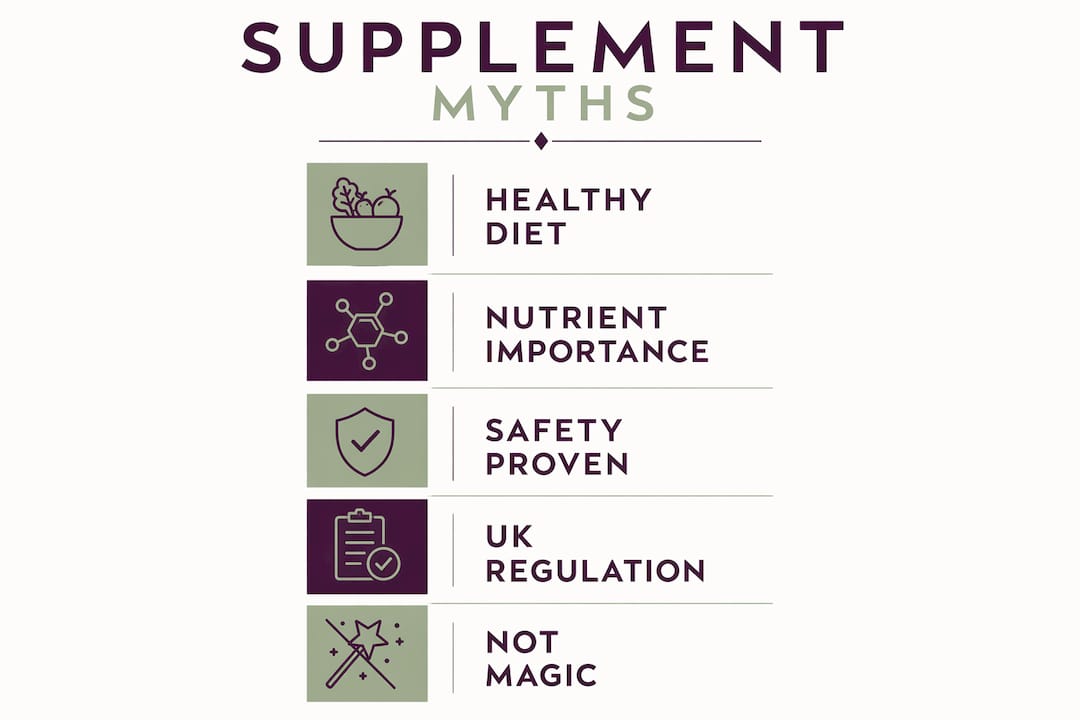
- Myth: A healthy diet means you never need supplements. Fact: Certain groups, including pregnant women and older adults, require specific supplements regardless of diet quality.
- Myth: Nutrient shortfalls are no big deal. Fact: Deficiencies in vitamin D and iron carry real physiological consequences.
- Myth: Supplements are unsafe. Fact: Most are safe when used correctly, though they carry fewer pre-market safety checks than medicines.
- Myth: The supplement industry is unregulated in the UK. Fact: The Food Supplements (England) Regulations 2003 set legal composition and labelling standards.
- Myth: Supplements replace healthy habits. Fact: No supplement compensates for poor diet, inactivity, or untreated medical conditions.
Table of Contents
- Myth 1: You don’t need supplements if you eat a healthy diet
- Myth 2: Nutrient shortfalls don’t really matter
- Myth 3: Supplements aren’t proven to be safe
- Myth 4: The supplement industry isn’t regulated in the UK
- Myth 5: Supplements are a ‘magic bullet’ that let you ignore other healthy habits
- What UK health professionals actually say about supplements
- How to use supplements wisely: key truths
- Specific supplement myths the science has settled
- Can supplements interact with your medications?
- Are natural and synthetic supplements equally effective?
- How to evaluate supplement quality and certifications
- Key takeaways
- FAQ
Myth 1: You don’t need supplements if you eat a healthy diet
For most adults eating a genuinely varied diet, this is largely true. Official UK guidance states that most people should obtain nutrients from food, but carves out clear exceptions where supplementation is recommended regardless of diet quality.
The two most cited examples are vitamin D and folic acid. During autumn and winter, sunlight in the UK is too weak for the skin to synthesise adequate vitamin D, so everyone should consider a daily vitamin D supplement during the months with insufficient sunlight for natural synthesis. Folic acid supplementation is recommended for anyone trying to conceive and during early pregnancy, as dietary sources alone rarely meet the elevated demand during neural tube development.
Beyond these, specific population groups need year-round supplementation: breastfed babies from birth and young children require vitamin D supplementation, and people who are housebound or cover most of their skin outdoors. Athletes training at high intensity may also have elevated micronutrient requirements that a standard diet struggles to meet.
| Group | Recommended supplement | Notes |
|---|---|---|
| Pregnant women / trying to conceive | Folic acid supplementation is recommended before and during early pregnancy | Before conception and first 12 weeks |
| Everyone (autumn/winter) | Vitamin D supplementation is recommended during autumn and winter months | |
| Breastfed babies | Vitamin D supplementation is recommended from birth for breastfed babies | |
| Young children | Are advised to take vitamins including A, C, and D daily throughout the year | |
| Housebound / care home residents | People who have limited sun exposure should consider vitamin D supplementation year-round | |
| Athletes with high training loads | Variable | Seek professional advice |
Myth 2: Nutrient shortfalls don’t really matter
They do, and the UK population is not immune. Vitamin D deficiency is particularly prevalent during low-sunlight months, contributing to bone weakness, muscle fatigue, and impaired immune function. Iron deficiency is the most common nutritional deficiency globally, and in the UK it disproportionately affects women of reproductive age, with symptoms ranging from persistent tiredness to reduced cognitive performance.
The physiological consequences compound over time. Prolonged vitamin D insufficiency raises the risk of osteomalacia in adults and rickets in children. Chronic iron deficiency progresses to anaemia, reducing oxygen delivery to muscles and the brain. These are not abstract risks.
Signs that a shortfall may be affecting you:
- Persistent fatigue not explained by sleep or stress
- Frequent infections or slow wound healing
- Bone pain or muscle weakness
- Difficulty concentrating or low mood
Supplements play a legitimate corrective role here, but the starting point should be identifying the deficiency through a GP or blood test rather than self-prescribing. Correcting a confirmed deficiency with a targeted supplement is very different from taking a broad-spectrum product on a hunch.

Myth 3: Supplements aren’t proven to be safe
The more accurate statement is that supplements are regulated differently to medicines, which creates a specific and important gap. Food supplements in the UK are not required to prove safety or efficacy before going on sale. Manufacturers must not produce unsafe or misleading products, but there is no pre-market approval process equivalent to what a pharmaceutical drug undergoes.
This matters in practice. Manufacturing standards for supplements are less stringent than for medicines, which can lead to batch variability and, in some cases, undeclared ingredients. A product may contain more or less of an active substance than the label states.
Practical safety risks to know:
- Ingredient quantities can vary between batches
- Undeclared substances may be present, particularly in products manufactured outside the UK or EEA
- Fat-soluble vitamins (A, D, E, K) accumulate in the body and can reach toxic levels with excess intake
- Some supplements interact with prescribed medications
Pro Tip: Before buying any supplement, check whether the manufacturer holds a third-party quality certification such as Informed Sport, which tests for banned substances and verifies ingredient accuracy. This is one of the most reliable signals of manufacturing rigour available to UK consumers.

Myth 4: The supplement industry isn’t regulated in the UK
This myth is simply wrong, though the regulation is less stringent than many people assume. The Food Supplements (England) Regulations 2003 set legal requirements for composition, labelling, and the permitted vitamins and minerals that may be used. Equivalent regulations apply in Scotland, Wales, and Northern Ireland.
The Food Standards Agency (FSA) oversees food products, including supplements. Manufacturers, importers, and retailers all carry legal responsibility for compliance. Critically, supplements cannot make medicinal claims, meaning a product cannot legally state it treats, prevents, or cures any disease or condition.
| Regulatory area | Who is responsible | Key requirement |
|---|---|---|
| Composition | Manufacturer / importer | Only permitted vitamins and minerals may be used |
| Labelling | Manufacturer / retailer | Must not be misleading; must state “food supplement” |
| Health claims | Manufacturer | Only authorised claims from the GB NHC register permitted |
| Safety reporting | FSA / Local Authority | Consumers can report concerns to their Local Authority |
| Medicinal claims | MHRA | Prohibited on food supplements |
There is no requirement to register a supplement before sale, which is where the “unregulated” perception originates. But operating without registration is not the same as operating without rules. Any supplement that fails to meet compositional or labelling standards is breaking the law.
Myth 5: Supplements are a ‘magic bullet’ that let you ignore other healthy habits
Health experts are consistent on this point. Over-reliance on supplements can mask symptoms and delay proper medical diagnosis. Someone taking high-dose vitamin B12 because they feel fatigued, for example, may be postponing investigation of an underlying condition that needs treatment.
Supplements are adjuncts, not replacements. No pill compensates for a diet built around ultra-processed food, chronic sleep deprivation, or physical inactivity. The physiological benefits of exercise, whole foods, and adequate sleep operate through mechanisms that no supplement currently replicates.
Nutritionists also flag the social media dimension: exaggerated claims about supplements circulate rapidly online, creating the impression that a single product can transform health outcomes. The reality is that supplements work best when they address a specific, confirmed gap, and they work least when used as a substitute for the harder work of lifestyle change.
Pro Tip: If you are considering a supplement because of a symptom, speak to your GP first. Symptoms are information. Suppressing them with a supplement before understanding their cause is not a wellness strategy.
What UK health professionals actually say about supplements
The Specialist Pharmacy Service, which provides medicines guidance to NHS professionals, frames supplements clearly: they are appropriate for supplementing a normal diet or addressing a confirmed deficiency, but using them to treat a medical condition carries similar professional and legal implications to supplying an unlicensed medicine.
Guy’s and St Thomas’ NHS Foundation Trust advises patients not to take herbal products or dietary supplements alongside prescribed medicines without first consulting their clinical team, noting that supplements can make medicines less effective or increase the risk of side effects.
What professionals consistently recommend:
- Confirm a deficiency through testing before starting a supplement
- Disclose all supplements to your GP, especially if you are on prescribed medication
- Avoid high-dose supplements unless specifically advised by a healthcare professional
- Choose products from reputable UK-based suppliers with verifiable quality standards
- Do not switch brands mid-course without checking ingredient equivalence
Kudunutrition’s approach reflects this professional consensus. Its liquid collagen products carry Informed Sport certification, an independent quality standard that verifies ingredient accuracy and screens for contamination, giving consumers a concrete quality signal rather than a marketing claim.
How to use supplements wisely: key truths
The myths covered above share a common thread: they either overstate or understate what supplements can do. The evidence points to a middle ground.
Summary of what the science and UK guidance confirm:
- Supplements fill specific gaps; they do not upgrade an already adequate diet
- Vitamin D and folic acid are the two supplements most widely recommended by UK public health bodies, for defined groups and seasons
- The regulatory framework exists but does not include pre-market efficacy testing, so quality varies by manufacturer
- Fat-soluble vitamins accumulate and can cause toxicity at high doses; professional advice before high-dose use is not optional
- “Natural” on a label is a marketing term, not a safety guarantee
- Interactions with prescribed medications are real and can be clinically significant
- Third-party certification (such as Informed Sport) is the most accessible quality signal for UK consumers
Specific supplement myths the science has settled
“Multivitamins prevent disease.” Large-scale trials, including those reviewed by the NHS, have not found that multivitamin supplementation prevents cardiovascular disease or cancer in people who are not deficient. They may help fill dietary gaps, but they do not function as disease prevention tools.
“Higher doses are always better.” This is wrong for fat-soluble vitamins and several minerals. Excess vitamin A is teratogenic in pregnancy. Too much iron causes gastrointestinal damage. The Expert Group on Vitamins and Minerals (EVM) published voluntary safe upper levels precisely because the dose-response relationship for many nutrients is not linear.
“Natural supplements are safer than synthetic ones.” The source of a nutrient does not determine its safety profile. Natural labelling is a marketing term with no clinical meaning. Herbal supplements, for instance, can have potent physiological effects and interact with medications just as synthetic compounds do. Turmeric, ginseng, and flaxseed all appear on clinical caution lists for people with hormone-sensitive conditions.
“If a supplement is sold in a pharmacy, it must be safe.” Pharmacies stock food supplements, not just medicines. A product’s presence on a pharmacy shelf does not mean it has undergone pre-market safety evaluation.
Can supplements interact with your medications?
Yes, and the interactions can be clinically significant. Guy’s and St Thomas’ NHS Foundation Trust explicitly recommends that patients taking prescribed medicines avoid herbal products and many dietary supplements without prior consultation. The mechanisms vary: some supplements reduce drug absorption, others accelerate metabolism, and some amplify drug effects to dangerous levels.
St John’s Wort is the most studied example, reducing the effectiveness of anticoagulants, antidepressants, and oral contraceptives. Vitamin K affects warfarin’s anticoagulant action directly. High-dose antioxidants may interfere with chemotherapy agents. For anyone on a regular prescription, disclosing supplement use to their GP is not a formality; it is a clinical necessity. You can find more detail on sports supplement safety in Kudunutrition’s dedicated guide.
Are natural and synthetic supplements equally effective?
For most vitamins and minerals, the body processes natural and synthetic forms similarly, though there are exceptions. Vitamin E from food (d-alpha-tocopherol) is absorbed more efficiently than the synthetic form (dl-alpha-tocopherol). Folate from food is absorbed less efficiently than synthetic folic acid, which is why folic acid is the form used in supplementation guidelines for pregnancy.
The practical takeaway is that the form matters more than the source. Checking the specific compound on the label, rather than relying on “natural” or “synthetic” as a proxy for quality, gives a more accurate picture of what you are actually taking. For guidance on supplement dosing safety, Kudunutrition’s 2026 guide covers the key considerations.
How to evaluate supplement quality and certifications
Third-party certification is the most reliable quality signal available to UK consumers, because it provides independent verification that a product contains what the label claims and nothing it does not. Informed Sport tests for over 250 substances on the World Anti-Doping Agency (WADA) prohibited list and verifies ingredient accuracy. NSF International Certified for Sport offers a comparable standard used widely in professional sport.
Beyond certification, buying from UK-based suppliers reduces the risk of products that do not comply with UK food standards. The FSA’s guidance advises particular caution with supplements purchased from online marketplaces, where the seller’s identity and the product’s origin may be unclear. Checking that any health claims on a product appear on the Great Britain Nutrition and Health Claims (NHC) register is a quick, free verification step any consumer can take. For a deeper look at what quality assurance means for collagen specifically, Kudunutrition’s piece on certified collagen supplements is worth reading.
Key takeaways
Most people do not need a broad supplement stack; they need one or two targeted products matched to a confirmed deficiency, chosen from a reputable UK supplier with verifiable quality standards.
| Point | Details |
|---|---|
| Diet covers most needs | Supplements are necessary for specific groups and seasons, not as a universal upgrade to any diet. |
| Vitamin D and folic acid are the priority | UK public health bodies recommend these for defined populations, including pregnant women and everyone in autumn and winter. |
| Regulation exists but has limits | The Food Supplements (England) Regulations 2003 set legal standards, but pre-market efficacy testing is not required. |
| High doses carry real risks | Fat-soluble vitamins accumulate and can cause toxicity; professional advice is needed before exceeding standard doses. |
| Third-party certification matters | Informed Sport certification is the most accessible quality signal for UK consumers buying supplements. |
FAQ
Is there any evidence that supplements work?
Yes, for specific deficiencies and populations. Vitamin D supplementation reduces bone loss in deficient individuals, and folic acid in early pregnancy significantly reduces neural tube defect risk. Evidence for broad-spectrum supplementation in people without deficiencies is much weaker.
What two supplements should never be taken together?
High-dose calcium and iron compete for absorption and are best taken at different times of day. St John’s Wort combined with many prescription medicines, including anticoagulants and antidepressants, can cause clinically significant interactions and should not be taken together without medical supervision.
What are red flags for supplements?
Key red flags include medicinal claims on the label (illegal for food supplements in the UK), no clear manufacturer address, prices significantly below comparable products, and no third-party certification. Products manufactured outside the UK or EEA warrant extra scrutiny.
Why do dietitians caution against protein powder?
Most dietitians’ concern is not with protein powder itself but with unnecessary use. People who already meet their protein needs through food gain little from adding powder, and taking multiple supplements can lead to unintentional nutrient excess. For athletes with genuinely elevated protein requirements, a quality product from a certified supplier is a practical option, not a risk.
If you are looking for a supplement that meets the quality bar described here, Kudunutrition’s liquid collagen protein carries Informed Sport certification, is made in the UK, and delivers collagen protein per sachet with full ingredient transparency. For those combining collagen with creatine, the collagen and creatine daily sachets offer both in a single, certified product.