


For UK supplement buyers, third-party testing is the most reliable accessible signal that a product contains what the label promises and is free from key contaminants. AIScored analysed a large sample of Amazon UK supplements and found a significant portion carried zero third-party certifications, with certified products scoring higher on average for both ingredient quality and label accuracy. Schemes such as Informed Sport require per-batch testing before a product can carry their mark, which means every single production run is checked, not just a one-off sample at launch.
Independent labs typically verify three things:
- Ingredient identity: confirming the substance in the capsule or sachet is what the label claims, using chromatographic or DNA-based methods
- Ingredient quantity (potency): measuring whether the stated dose is actually present, using techniques such as HPLC
- Contaminants: screening for heavy metals, pesticides, microbial pathogens, and undeclared pharmaceuticals or banned substances
Pro Tip: If a brand will not share a batch Certificate of Analysis (CoA) or a certifier database entry when you ask, treat that silence as a red flag. Reputable brands have nothing to hide.
Key takeaways
Third-party testing is the strongest accessible quality signal for UK supplement buyers because it provides independent verification of label accuracy, potency, and contaminant levels that no self-issued document can replicate.
| Point | Details |
|---|---|
| Voluntary, not mandatory | The FSA requires safety and accurate labelling but does not mandate independent pre-sale testing. |
| Scale of the gap | 40% of 781 Amazon UK supplements analysed by AIScored carried zero third-party certifications. |
| Strongest mark for athletes | Informed Sport requires per-batch testing, blind retail monitoring, and site audits before certification. |
| Verify, don’t assume | Check the certifier’s public database and match the batch number on your CoA to the product in hand. |
| Kudunutrition | Carries Informed Sport certification on every batch of its UK-made liquid collagen protein sachets. |
Table of Contents
- What independent testing actually verifies in finished supplements
- Why third-party testing matters more for UK buyers right now
- Which UK-recognised certification marks actually guarantee what
- What third-party certification does not guarantee
- How to check a supplement’s third-party testing claims in the UK
- A practical checklist for buying supplements more safely in the UK
- How Kudunutrition applies these standards in practice
- What to do if you think a supplement is unsafe or mislabelled
- The single reason I prioritise third-party testing above everything else
- Kudunutrition’s liquid collagen: certified, transparent, UK-made
- Sources
- FAQ
What independent testing actually verifies in finished supplements
Third-party testing checks identity, potency, and safety of finished products, not just raw materials. That distinction matters because a manufacturer can source quality ingredients and still produce a finished product that is under-dosed, contaminated during blending, or mislabelled.
Identity testing uses methods such as near-infrared spectroscopy or DNA barcoding to confirm the botanical or compound is genuine. Potency assays, typically HPLC (high-performance liquid chromatography), measure whether the active ingredient is present at the declared level. Contaminant screens go further still, covering heavy metals (lead, cadmium, arsenic), pesticide residues, microbial pathogens such as E. coli and Salmonella, and undeclared stimulants or banned substances.
Certified products scored notably higher than uncertified products in AIScored’s analysis, reflecting better label accuracy and ingredient quality
There is also an important structural difference between batch-by-batch testing and facility audits or GMP (Good Manufacturing Practice) certification. Batch testing is a snapshot of a specific production run. GMP audits assess whether the manufacturing processes and controls are consistently capable of producing safe, accurately labelled products. Both matter: GMP without batch testing leaves gaps; batch testing without process controls is an unreliable shortcut. The supplement purity levels guide explains how these verification tiers map to consumer risk.
Why third-party testing matters more for UK buyers right now
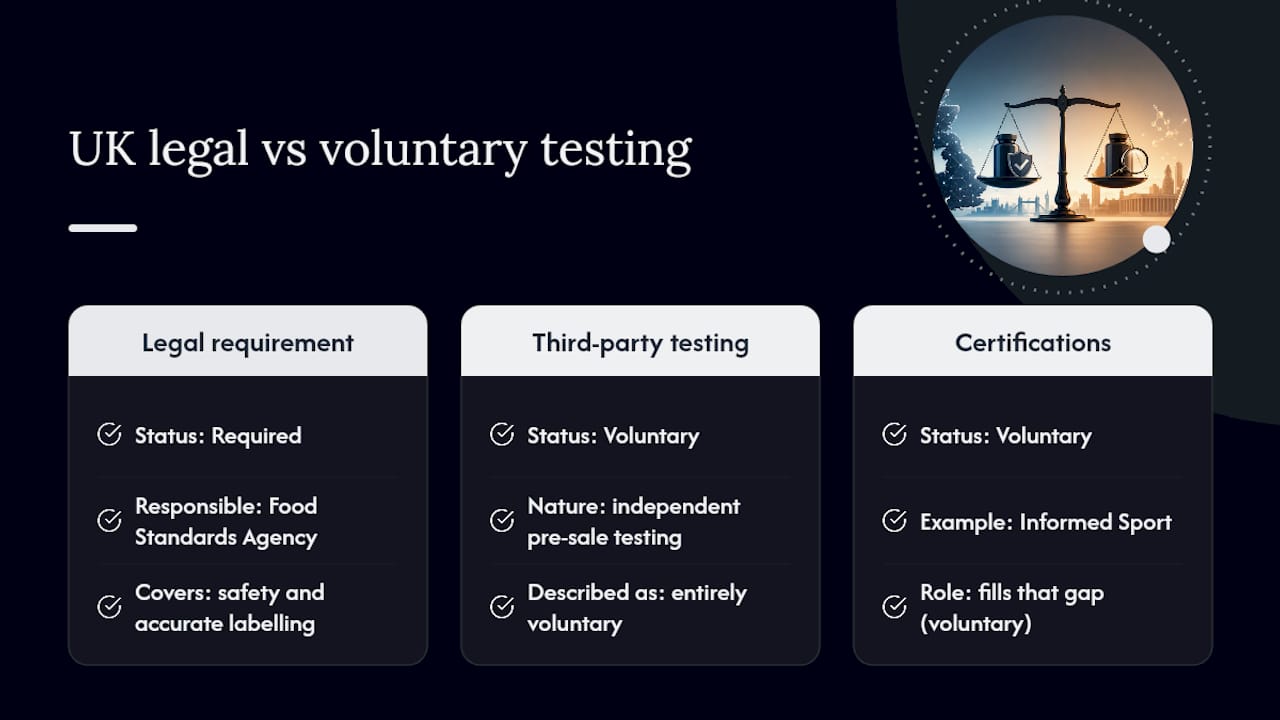
The UK treats supplements as food under the Food Standards Agency’s remit, which means manufacturers must ensure safety and accurate labelling, but independent third-party testing before sale is entirely voluntary. There is no legal requirement for a brand to have a single batch independently verified before it reaches a UK shelf or Amazon listing.
The Advertising Standards Authority enforces accurate marketing claims and can require removal of non-compliant advertising, but it acts after the fact. Neither the FSA nor the ASA mandates pre-market independent testing. That regulatory gap is precisely why voluntary certification carries so much weight as a consumer signal.
Marketplace listings compound the problem. A product page can display a professional logo and confident health claims without any independent verification behind them. Post-Brexit, the UK also no longer benefits from EU-level coordinated market surveillance in the same way, which increases the practical importance of recognising credible certification marks yourself.
Which UK-recognised certification marks actually guarantee what
Some certifications provide meaningfully stronger assurance because they require per-batch testing and independent audits, not just a one-time facility inspection.
- Informed Sport: requires every batch to be tested before release, plus ongoing blind retail monitoring (buying products off shelves and retesting them) and manufacturing site audits. The banned-substance panel is extensive, making it the mark athletes rely on most. It is widely considered the highest-rigour option available in the UK market.
- NSF Certified for Sport: a US-originated scheme with strong international recognition, covering banned substances, label claims, and facility audits. Accepted by many professional sports bodies globally, including some UK ones.
- IFOS (International Fish Oil Standards): category-specific to omega-3 products, verifying purity, potency, and oxidation levels in fish oil supplements. Relevant for anyone buying omega-3s rather than a general-purpose mark.
- GMP (Good Manufacturing Practice): a manufacturing process standard, not a finished-product verification. GMP certification confirms a facility follows consistent, controlled processes, but it does not mean every batch has been independently tested for contaminants or label accuracy. It is a necessary baseline, not a substitute for product-level testing.
For athletes subject to anti-doping rules, Informed Sport is the practical minimum. For general consumers, any scheme requiring per-batch independent testing and a public certificate lookup offers meaningfully stronger assurance than GMP alone.
Pro Tip: Check whether the certification applies to the specific product you are buying, not just the brand or facility. A brand can hold Informed Sport certification on one product while selling others that carry no such mark.
What third-party certification does not guarantee
Certification is a strong signal, but it is not absolute proof of perfection. Understanding the limits prevents overreliance.
- Sampling error: a CoA is a snapshot of one batch. If a contamination event occurs mid-run or in a subsequent batch, an earlier CoA will not catch it.
- Scope limits: some schemes test for a defined panel of banned stimulants but not every possible contaminant. A product could pass a banned-substance screen and still contain elevated heavy metals if that was not part of the panel.
- Certificate misuse or forgery: vague “lab tested” claims without a named, accredited lab, or CoAs with no batch number or date, are not the same as genuine certification. Some brands display certificates that do not correspond to the product being sold.
- Supply-chain variability: botanical and algae-based ingredients show large batch-to-batch variability in heavy metal content. A single certified batch does not guarantee the next one sourced from a different harvest will be identical.
- Small producers and imports: artisanal or imported supplements may be unevenly covered by certification schemes, and imported botanical supplements carry specific labelling and safety responsibilities that not all sellers meet.
How to check a supplement’s third-party testing claims in the UK
Verify the certifier’s public database, match a batch number to a CoA, and confirm the lab holds accreditation such as ISO/IEC 17025 or UKAS recognition. Here is the practical sequence:
- Find the certification claim. Look for the certifier logo on the product packaging and the brand’s website. A logo alone is not enough; there should be a verifiable certificate or database entry.
- Locate the CoA and batch number. The CoA should name the independent lab, the test date, the batch number, and the specific parameters tested. A CoA from a manufacturer’s own lab is not independent verification; the lab must be a third party.
- Check the certifier’s public database. Informed Sport, for example, maintains a searchable product database. Enter the product name or batch number and confirm it appears.
- Confirm lab accreditation. The testing lab should hold ISO/IEC 17025 accreditation or be recognised by UKAS (United Kingdom Accreditation Service). You can search the UKAS directory at ukas.com.
- Watch for red flags. Vague “independently tested” claims with no lab name, CoAs with missing dates or batch numbers, and batch numbers that do not match the product in your hand are all warning signs.
Pro Tip: Save screenshots of the CoA, the certifier database entry, and the batch number before contacting a retailer or reporting a problem. Evidence gathered before a dispute is far more useful than trying to reconstruct it afterwards.
A practical checklist for buying supplements more safely in the UK
Use this before completing any online or in-store purchase:
- Look for a recognised certification mark (Informed Sport, NSF Certified for Sport, IFOS for omega-3s) rather than generic “lab tested” wording
- Request or find the CoA for the specific batch you are buying, not a generic certificate
- Prefer products with per-batch testing over those with facility-only GMP certification
- Confirm the testing lab is accredited (ISO/IEC 17025 or UKAS-listed)
- Check whether the brand publishes retention sample policies and site audit summaries
- For multi-compound products, check whether all key ingredients are covered by the testing panel, not just the headline active
- For single-ingredient products (collagen, creatine, omega-3), the risk profile is generally simpler, but contaminant screening still matters, particularly for marine or botanical sources
The supplement label reading guide covers how to interpret what you find on packaging once you have the CoA in hand.
How Kudunutrition applies these standards in practice
Kudunutrition’s liquid collagen protein sachets carry Informed Sport certification, meaning every batch is tested before release against a comprehensive banned-substance panel, with blind retail monitoring and manufacturing site audits as part of the programme. That is the full-rigour model described earlier in this article, applied to a UK-made product.
The trust signals Kudunutrition publishes include:
- Per-batch Informed Sport testing with a public certificate lookup
- Clear labelling for athletes, with the Informed Sport mark on product packaging
- Manufacturing in the UK under GMP-compliant conditions
- Product pages that explain the testing protocols and what the certification covers
For any brand, the practical question to ask is: can you show me the CoA for the batch I am buying, and can I verify it in the certifier’s database? If the answer is yes, that is the standard to hold them to.
What to do if you think a supplement is unsafe or mislabelled
Stop using the product immediately, gather evidence, and contact the retailer and brand. Keep the product, packaging, and any remaining sachets as physical evidence.
- Contact the retailer and brand in writing, citing the batch number, purchase date, and your concern
- Report misleading advertising claims to the Advertising Standards Authority via their online complaints form
- Report food safety concerns to your local Trading Standards office or environmental health team; the FSA provides signposting at food.gov.uk
- For health effects, contact NHS 111 or your GP; for serious reactions, seek emergency care
- Keep records: screenshots of the product listing, the CoA (or its absence), purchase confirmation, and dates. Local Trading Standards can escalate to the FSA for serious cases
The sports supplement safety guide covers additional steps specific to athletes concerned about banned substances.
The single reason I prioritise third-party testing above everything else
I prioritise third-party testing because it is the only check that sits outside the financial interest of the seller. A brand can write whatever it likes on a label. A manufacturer can issue its own CoA. But an accredited independent lab has no stake in the result.
That independence is what changes the calculation for athletes and everyday users alike. For an athlete, a contaminated supplement can end a career. For someone buying a collagen supplement to support joint health, a mislabelled product is at best a waste of money and at worst a safety risk. Third-party certification does not eliminate every risk, but it shifts the odds meaningfully. The brands that invest in it are telling you something about how they operate, not just what they sell.
Kudunutrition’s liquid collagen: certified, transparent, UK-made
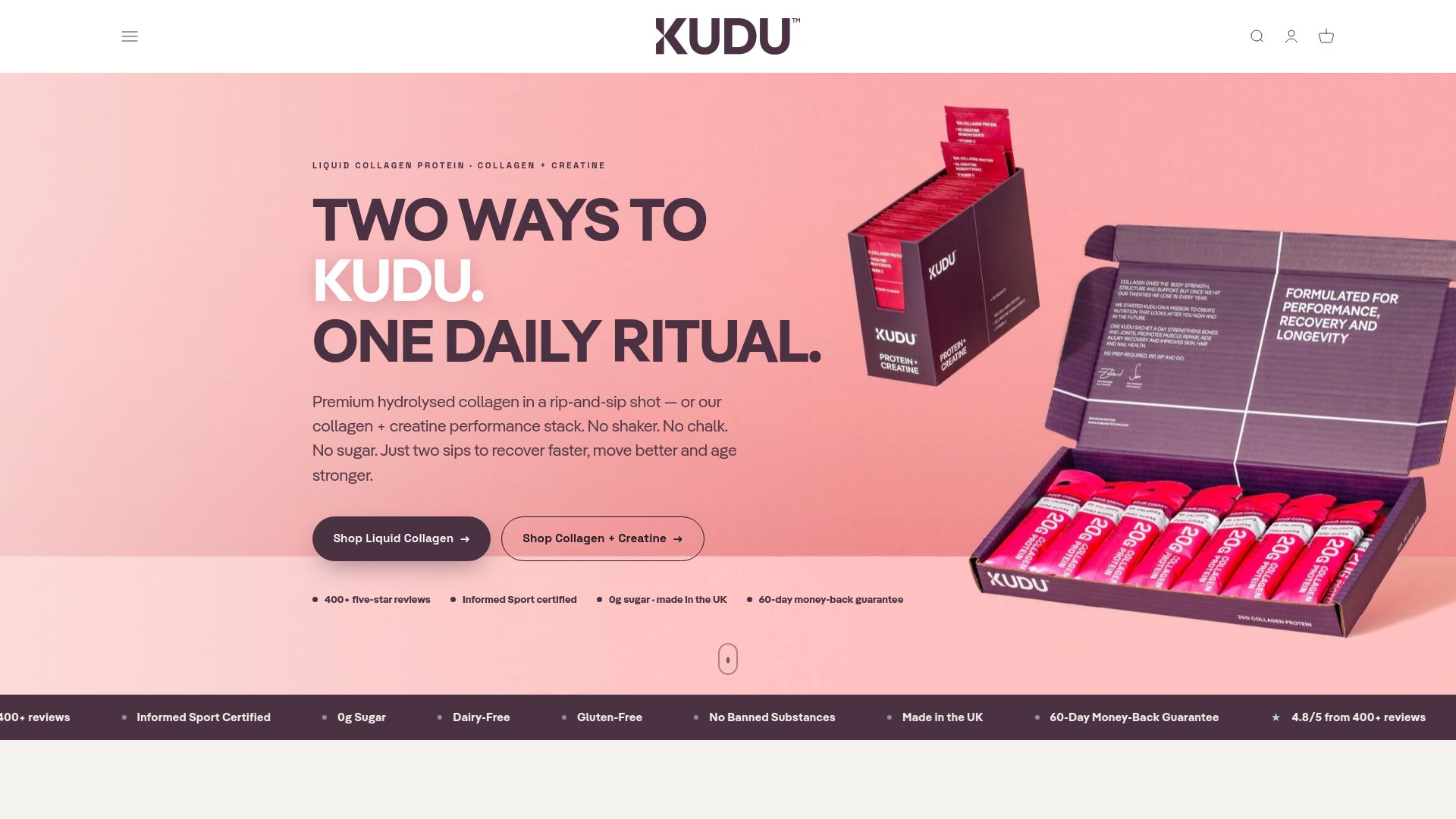
Kudunutrition’s 20g liquid collagen protein sachets carry Informed Sport certification on every batch, manufactured in the UK with full label transparency. If the article’s checklist is your standard, these sachets meet it: per-batch testing, a public certifier database entry, and clear athlete-safe labelling. Browse the 20g collagen protein range or try the starter box to see the certification detail on the product page before you commit.
Sources
- The Certification Black Hole (2026) — AIScored
- The benefits — Informed Sport
- What food supplements are and what you need to do as a business to sell them — Food Standards Agency
- Gov
- Understanding food supplements – NHS SPS
FAQ
What does “third-party tested” actually mean for supplements?
It means an independent laboratory, with no financial connection to the manufacturer, has tested the finished product for ingredient identity, potency, and contaminants. The lab’s accreditation (ISO/IEC 17025 or UKAS) determines how much weight the result carries.
Is third-party testing required by law in the UK?
No. The Food Standards Agency requires manufacturers to ensure safety and accurate labelling, but independent pre-sale testing is entirely voluntary. Certification schemes such as Informed Sport fill that gap on a voluntary basis.
How do I verify an Informed Sport certification claim?
Search the Informed Sport public product database using the product name or batch number. If the product and batch appear, the certification is current. A logo on packaging without a matching database entry is not verified.

Does GMP certification mean a product has been independently tested?
No. GMP confirms a facility follows consistent manufacturing processes, but it does not mean individual batches have been independently tested for contaminants or label accuracy. Per-batch testing by an accredited third-party lab is a separate and additional step.
Are Kudunutrition’s collagen sachets third-party tested?
Yes. Kudunutrition’s liquid collagen protein sachets carry Informed Sport certification, which requires per-batch testing before release, blind retail monitoring, and manufacturing site audits.