


Taste is the primary gatekeeper of dietary adherence. If food does not deliver a rewarding sensory experience, most people stop eating it, regardless of how nutritious it is. “Taste” here means the full picture: flavour, texture, aroma, and chemesthesis (the burn of chilli, the cool of mint). Research from the PREDIMED-Plus cohort confirms that sensory preferences are a robust correlate of Mediterranean diet adherence in young adults, and gut-derived satiety hormones such as GLP-1 are partly triggered by taste receptor activity in the gut wall. The practical upshot is straightforward: audit your most- and least-liked healthy foods this week, then commit to one sensory substitution. That single step is where lasting change begins.
- Taste is multisensory: flavour + texture + aroma + chemesthesis all count
- GLP-1 and other satiety hormones are modulated by taste receptor signalling
- Sensory preferences predict dietary patterns more reliably than nutritional knowledge alone
- One sensory swap per week is a low-effort, high-impact starting point
Key takeaways
Taste is the single most powerful predictor of whether a healthy eating plan becomes a lasting habit, and sensory preferences can be trained over weeks of repeated exposure.
| Point | Details |
|---|---|
| Taste is multisensory | Flavour, texture, aroma, and chemesthesis together determine palatability and adherence. |
| Preferences are trainable | Repeated exposure over 8–15 encounters can meaningfully increase liking for unfamiliar healthy foods. |
| Individual differences matter | Genetics, age, medication, and clinical conditions all alter taste perception and must inform your strategy. |
| Self-audit first | Rating liking across sweet, salty, sour, bitter, and umami takes ten minutes and directs every sensory fix. |
| Four weeks is enough to start | A structured 4-week plan with a liking tracker produces clear data on which meals to keep and which to adjust. |
Table of Contents
- How does taste shape food choice and adherence?
- Why the same diet suits one person but not another
- What does the research say about taste profiles and adherence?
- Practical sensory tactics to make healthy food palatable
- How can you assess your own taste preferences?
- Adapting sensory strategies for altered taste
- Your 4-week sensory-aware adherence plan
- A note from Sam
- Try Kudunutrition’s palatable liquid collagen
- Sources
- FAQ
How does taste shape food choice and adherence?
The pathway from mouth to behaviour is shorter than most people assume. Taste receptors on the tongue and in the gut send signals to the brainstem, which relays them to the limbic system and reward centres. Dopamine release in the nucleus accumbens reinforces eating behaviour when food is palatable, creating a feedback loop that either supports or undermines adherence depending on whether the food is enjoyable.
Flavour is not taste alone. Research confirms that palatability is the integrated result of aroma (orthonasal and retronasal), taste (sweet, salty, sour, bitter, umami), texture (creaminess, crunch, viscosity), and chemesthesis. Remove any one of these and the eating experience degrades. A smoothie that smells appealing but has a gritty texture often gets abandoned after a few days, not because the person lacks willpower but because the sensory experience is incomplete.
Sensory pathway in brief: Taste/aroma/texture → brainstem → limbic and reward centres → satiety hormone release (GLP-1, CCK, PYY) → feeding regulation → eating behaviour.
Satiety hormones add another layer. GLP-1, CCK, and PYY are released partly in response to taste receptor activation in the gut, meaning a palatable meal can trigger stronger satiety signalling than a nutritionally identical but bland one. A narrative review on sensory personalisation proposes that integrating individual sensory profiles with physiological monitoring could meaningfully improve adherence, particularly in older adults whose taste sensitivity has declined.
Why the same diet suits one person but not another
Individual sensory profiles vary enormously, and that variation explains why a diet that works brilliantly for one person feels punishing for another. The differences fall into two broad groups.
Non-modifiable factors:
- Genetics: TAS2R38 gene variants determine bitter sensitivity; supertasters find cruciferous vegetables intensely bitter, which directly affects vegetable intake
- Age: Taste bud density and olfactory acuity decline from the fifth decade onward, reducing perceived flavour intensity
Modifiable or semi-modifiable factors:
- Smoking: Blunts taste sensitivity, particularly for sweet and salty; quitting partially restores it within weeks
- Medication: ACE inhibitors, metformin, and certain antibiotics alter taste perception; this is a common, under-reported driver of poor diet compliance
- Repeated exposure: Liking for unfamiliar flavours increases with exposure, making this the most accessible lever for most people
- Sensory education: Training attention to aroma and texture shifts appreciation for complex healthy flavours
Clinical conditions add further complexity. Sjögren’s syndrome reduces saliva production, making dry-textured foods unpleasant and hard to swallow. Chemotherapy-related dysgeusia often produces metallic or bitter distortions. Metabolic syndrome is associated with distinct taste-profile clusters that correlate with less healthy dietary patterns. Sudden or severe taste loss, or a clear change following a new prescription, warrants referral to a GP or dietitian rather than self-managed sensory tweaks.
What does the research say about taste profiles and adherence?
The overall picture is this: sensory preferences are meaningfully associated with dietary patterns and can predict some adherence trends, but findings vary by cohort, design, and diet type.
- A cross-sectional study found that bitter and sweet taste preferences were strongly associated with Mediterranean diet adherence in young adults, with sensory liking outperforming lifestyle variables as a predictor
- A clinical trial showed that baseline food preferences did not predict 48-week weight loss between low-fat and low-carbohydrate diet arms; however, early increases in diet-congruent preferences were associated with later weight loss specifically on the low-carbohydrate arm
- A school-based sensory education intervention improved adolescent willingness to try unfamiliar healthy snacks, though daily habit change was limited over the short trial period
- A sensory-healthy eating model review argues that sensory cues shape perceived healthiness and that cultural beliefs about whether healthy food tastes good moderate these effects
The honest limitation: most studies are observational or short-term. Randomised controlled trial evidence on sensory-led dietary interventions is still thin, and mechanistic work linking specific taste profiles to long-term adherence outcomes remains preliminary.
Practical sensory tactics to make healthy food palatable
The direct recommendation: build meals around your existing sensory preferences first, then expand gradually. Forcing unfamiliar flavours from day one is the fastest route to abandonment.
- Sensory layering: Combine contrasting textures (creamy + crunchy) and temperatures (warm grain base + cold yoghurt) in one meal to increase hedonic value without adding undesirable nutrients
- Umami enhancement: Add miso paste, nutritional yeast, or a small amount of parmesan to legumes and vegetables; umami signals satiety and increases palatability of low-fat dishes
- Acid and brightness: A squeeze of lemon or a splash of apple cider vinegar sharpens flat-tasting dishes and reduces the need for salt
- Toasting spices and seeds: Dry-toasting cumin, coriander, or pumpkin seeds before adding them releases volatile aromatics that dramatically improve perceived flavour complexity
- Texture swaps: Replace mushy textures (overcooked vegetables) with roasted or raw alternatives; texture is often the hidden reason a healthy food gets rejected
- Palatable format: Ready-to-drink formats, such as liquid collagen sachets, remove preparation friction and deliver a consistent sensory experience, which supports routine-building
- Track liking alongside adherence: Rate each meal 1–5 for enjoyment; meals scoring below 3 need a sensory adjustment, not more willpower
Pro Tip: Sprinkle toasted sesame seeds and a few drops of toasted sesame oil over steamed greens. The aroma alone transforms the experience, and the calorie addition is negligible.
Timeline for preference shifts: Repeated exposure research suggests noticeable liking increases for a new food within 8–15 exposures. Expect weeks 1–3 to feel effortful, weeks 4–8 to feel neutral, and months 2–3 to feel genuinely enjoyable for most palate-compatible choices. Longer engagement with health support strengthens behaviour maintenance, so patience with the process is evidence-based, not wishful thinking.
How can you assess your own taste preferences?
A simple self-audit captures the most useful information for improving adherence, and it takes about ten minutes.
- Rate your liking (1–5) for one prototypical food in each category: sweet, salty, sour, bitter, umami
- Note texture preferences: do you prefer crunchy, creamy, chewy, or smooth?
- Identify your three most-avoided healthy foods and write down the specific sensory reason (too bitter, wrong texture, no aroma)
- Note any recent changes in taste (new medication, illness, pregnancy) that might explain current preferences
Clinicians use taste strips and standardised tastant solutions to map sensitivity thresholds more precisely, which is useful when altered taste is suspected. For most people, the self-audit above is sufficient to start making targeted changes.
Nutrigenomics can add a complementary layer. DNA-based insights into bitter sensitivity (TAS2R38), sweet preference, and fat perception can inform which sensory adjustments are likely to stick. A nutrigenomics checklist is a practical starting point for readers who want to go deeper. Treat genetic data as a guide, not a prescription; behavioural assessment remains the primary tool.

Adapting sensory strategies for altered taste
Altered taste requires targeted sensory work to preserve intake and adherence, not generic healthy-eating advice.
- Older adults: Reduced taste sensitivity responds well to umami enrichment, stronger aromatics (fresh herbs, citrus zest), and varied textures; avoid relying on salt or sugar to compensate
- Chemotherapy-related dysgeusia: Metallic distortions are often reduced by cold or room-temperature foods, plastic rather than metal cutlery, and tart flavours (citrus, tamarind); refer to the oncology dietitian for individualised guidance
- Sjögren’s syndrome: Moisture is the priority; sauces, broths, and soft textures make eating manageable; dry crackers and dense proteins are typically the first foods abandoned
- Smokers and recent quitters: Expect a recalibration period; flavours may seem overwhelming initially as sensitivity returns
- Metabolic disease: Taste-profile clusters associated with metabolic syndrome suggest a preference for high-fat, high-sugar combinations; gradual sensory substitution (lower-sugar palatable swaps) is more effective than abrupt removal
Adding excessive salt or sugar to improve palatability in any of these groups carries its own risks. A dietitian, speech and language therapist, or oncology team should be involved when clinical conditions are driving the taste change.
Your 4-week sensory-aware adherence plan
A focused 4-week sensory plan can shift liking and improve adherence noticeably, even before preferences fully consolidate.
- Week 1: Complete the self-audit above; identify one low-scoring healthy food and apply one sensory fix (texture swap, umami addition, acid brightening); begin the tracker below
- Week 2: Eat the adjusted food at least three times; note liking score each time; introduce a second sensory swap for a different food
- Week 3: Add sensory layering to one main meal per day (contrast of texture and temperature); experiment with one new aromatic (fresh herb, toasted spice)
- Week 4: Review tracker; foods scoring 3+ are keepers; foods still below 3 need a different sensory lever or a substitution with a nutritionally similar alternative
Simple adherence and liking tracker:
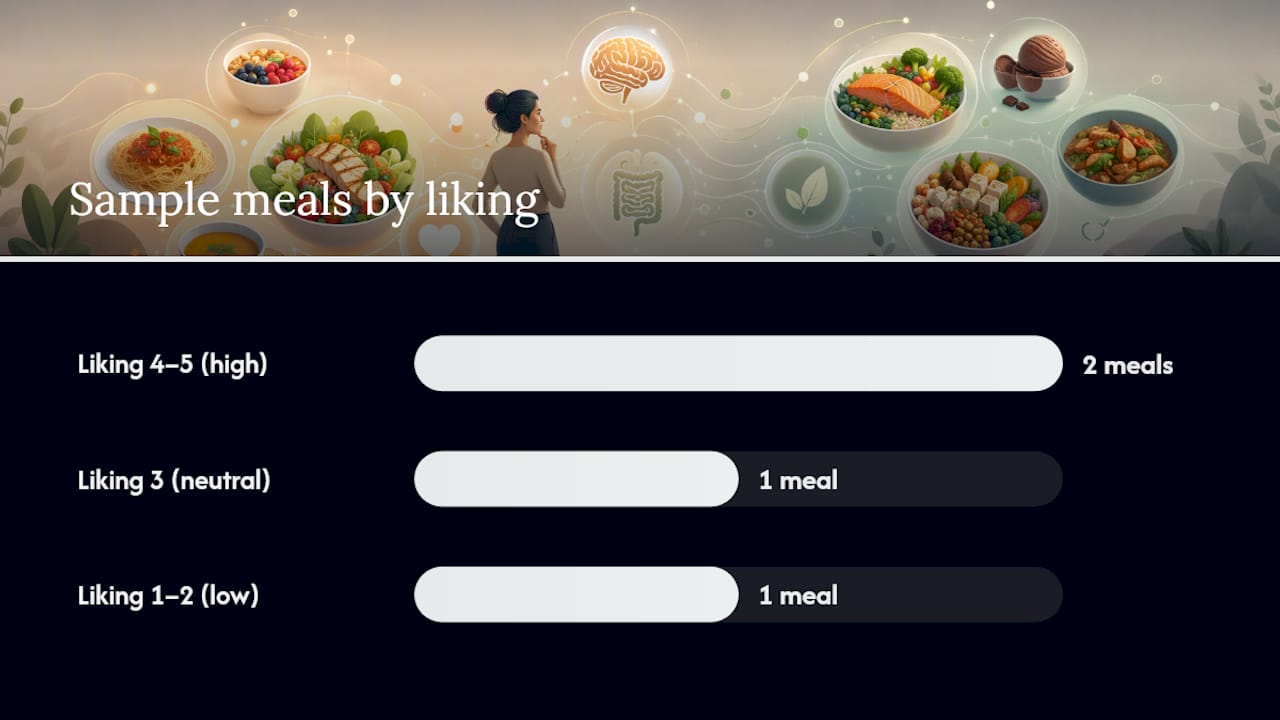
| Day | Meal | Liking (1–5) | Adhered? (Y/N) |
|---|---|---|---|
| 1 | Lunch | 3 | Y |
| 2 | Dinner | 4 | Y |
| 3 | Lunch | 2 | N |
| 4 | Dinner | 4 | Y |
After four weeks, patterns become clear: meals with liking scores of 4–5 almost always show adherence; meals at 2 or below rarely do. Use that data to iterate, not to judge. The goal is a repertoire of genuinely enjoyable healthy meals, built one sensory adjustment at a time.
A note from Sam
The most underrated insight in nutrition science is that taste is trainable. Most people assume their palate is fixed, but the evidence says otherwise: repeated, positive sensory experiences with healthy food genuinely shift liking over weeks. You do not need to overhaul your diet in one go. Pick one food, apply one sensory fix, and eat it consistently for two weeks. That is the whole plan to start.
For practical recipe ideas that put these principles into action, the Kudunutrition Nutrition Guide is a useful companion. And if you want a palatable, ready-to-drink format that removes the sensory guesswork from supplementation entirely, the KUDU liquid collagen range is worth exploring.
Try Kudunutrition’s palatable liquid collagen

If you want a supplement that actually tastes good enough to take every day, Kudunutrition’s liquid collagen sachets are formulated with flavour in mind. Available in Orange and Sour Cherry, each 63ml sachet delivers 20g of collagen protein, is Informed Sport certified, and is made in the UK. Start with the Starter Box to test which flavour fits your palate before committing to a subscription.
Sources
- Taste, Nutrition, and Health
- From liking to following: the role of food preferences, taste perception, and lifestyle factors in adherence to the Mediterranean diet among young individuals
- Behavioural and service factors that support sustained dietary change
This article is general information, not a substitute for advice from a qualified doctor. Consult a qualified healthcare professional about your own circumstances before acting on anything here.
FAQ
Does taste really affect long-term dietary adherence?
Yes. Sensory preferences are among the strongest predictors of whether a person continues eating a particular diet, outperforming nutritional knowledge in several cohort studies.
How many exposures does it take to start liking a new healthy food?
Research on repeated exposure suggests liking begins to increase meaningfully after roughly 8–15 encounters with the same food, though individual variation is wide.
Can medication change how healthy food tastes?
Yes. ACE inhibitors, metformin, and several antibiotics are known to alter taste perception, which can reduce palatability of previously enjoyed foods and undermine diet compliance. Speak to your GP if you suspect a medication is affecting your appetite or food enjoyment.
What is the quickest sensory fix for a bland healthy meal?
Adding umami (miso, nutritional yeast, parmesan) or acid (lemon juice, vinegar) is the fastest way to increase palatability without adding significant calories or undesirable nutrients.
When should altered taste be assessed by a professional?
Sudden taste loss, a metallic or distorted taste following a new prescription, or taste changes linked to a clinical condition such as Sjögren’s or cancer treatment all warrant referral to a GP, dietitian, or relevant specialist rather than self-managed adjustments.