
Creatine works the same way in women as in men. It tops up the creatine stored in your muscles, and at 3g a day creatine increases physical performance in successive bursts of short-term, high intensity exercise. Most women need 3–5g a day, it will not make you bulky on its own, and you do not need a special "women's" version.
For years most creatine research was done on young men, so a lot of what women hear about it is guesswork or marketing. This guide sorts the evidence from the myths, shows you how much to take, and is honest about what creatine will not do.
Quick answer
Yes, women can take creatine, and the dose is the same: 3–5g of creatine monohydrate a day, every day. No loading phase is needed. Expect little or no change on the scale with 3–5g a day; any early gain is mostly water inside the muscle, not fat. If you are pregnant, breastfeeding, have a kidney condition or take medication, speak to your GP first.
Myth or fact
Tap a card for the evidence
Most women need 3–5g of creatine a day. One 5g serving covers it.
What does creatine do for women?
Your muscles use a molecule called phosphocreatine to refuel during short, hard efforts: a heavy set, a sprint, a hill, a fast rally. Supplementing raises the creatine stored in muscle, which means more fuel for those efforts. That is where the one authorised benefit comes from: creatine increases physical performance in successive bursts of short-term, high intensity exercise, with the effect seen at 3g a day.
Researchers are also studying creatine in women for other reasons. A 2021 review by Smith-Ryan and colleagues looked across the female lifespan, covering areas such as:
- Strength and lean mass with training. Studies suggest creatine alongside resistance training can lead to larger strength gains than training alone in women, as in men.
- Later life. Trials in older and postmenopausal women have looked at muscle, strength and bone, with mixed results. We cover this in creatine for menopause and women over 40.
- Brain and mood. Small, early studies have looked at creatine and brain energy. It is an interesting research area, not a reason to take it.
The review also notes that women tend to eat less meat and fish than men, so they usually get less creatine from food. That is one reason researchers think women could have more to gain from supplementing, though the trials so far are smaller than the men's.
How much creatine should a woman take?
The same as anyone else: 3–5g of creatine monohydrate a day. The dose is set by bodyweight and training, not by sex. The International Society of Sports Nutrition's bodyweight figure is 0.03g per kg a day, which for most women works out below 3g, so a 5g serving clears it comfortably.
| Your weight | 0.03g/kg | Daily dose to take | Time to full muscle stores |
|---|---|---|---|
| 55kg (8st 9lb) | 1.7g | 3–5g | About 3–4 weeks |
| 65kg (10st 3lb) | 2.0g | 3–5g | About 3–4 weeks |
| 75kg (11st 11lb) | 2.3g | 3–5g | About 3–4 weeks |
| 85kg (13st 5lb) | 2.6g | 5g | About 3–4 weeks |
You can skip the loading phase. Taking 20g a day for a week fills your stores faster, but it is the main cause of the water weight and stomach upsets people complain about. Our creatine dose guide covers loading, timing and when 10g makes sense.
Will creatine make me gain weight or look bloated?
This is the number one worry, so here are the facts. Creatine pulls water into your muscle cells along with it. Studies have found body weight can rise by around 1–2kg in the first week of a 20g-a-day loading phase, and much less at 3–5g a day. That water sits inside the muscle, not under the skin, which is why it does not show up as puffiness for most people.
Creatine itself has essentially no calories, so it cannot make you gain fat. A KUDU Collagen + Creatine sachet is 44 kcal, almost all from the collagen protein.
If you weigh yourself daily, expect the scale to wobble by a few hundred grams in the first fortnight, then settle. We go into the detail, and how to keep it to a minimum, in does creatine cause bloating?
Creatine and your menstrual cycle
Researchers are interested in the cycle because female hormones appear to influence how the body makes and stores creatine. The Smith-Ryan review suggests oestrogen may play a part, and some scientists have proposed that creatine needs could change across the cycle and in pregnancy.
None of that has turned into dosing advice yet. There is no evidence that you should stop or change your dose on your period. The simplest approach, and the one used in the trials, is the same dose every day.
Creatine at 40, 50 and beyond
Muscle and strength decline from mid-life, and faster around menopause, which is why many of the newer creatine studies in women focus on this stage. There is also a second authorised claim that applies to some readers: for adults over 55 who do resistance training at least three times a week, daily creatine consumption can enhance the effect of resistance training on muscle strength. It needs 3g a day and progressive training at 65–75% of your one-rep max. Our creatine for menopause guide has a checker for those conditions, and collagen and menopause covers the other half of the picture.
Do you need a creatine made for women?
No. Creatine marketed to women is creatine monohydrate, sometimes with extras added and a higher price. When you compare products, check three things:
- Creatine per serving. At least 3g a day, ideally 3–5g. Some products split this across several capsules or gummies.
- Form. Creatine monohydrate has the evidence. Other forms have not been shown to work better.
- Cost per gram. Plain powder is the cheapest; see our sachets vs powder vs gummies comparison.
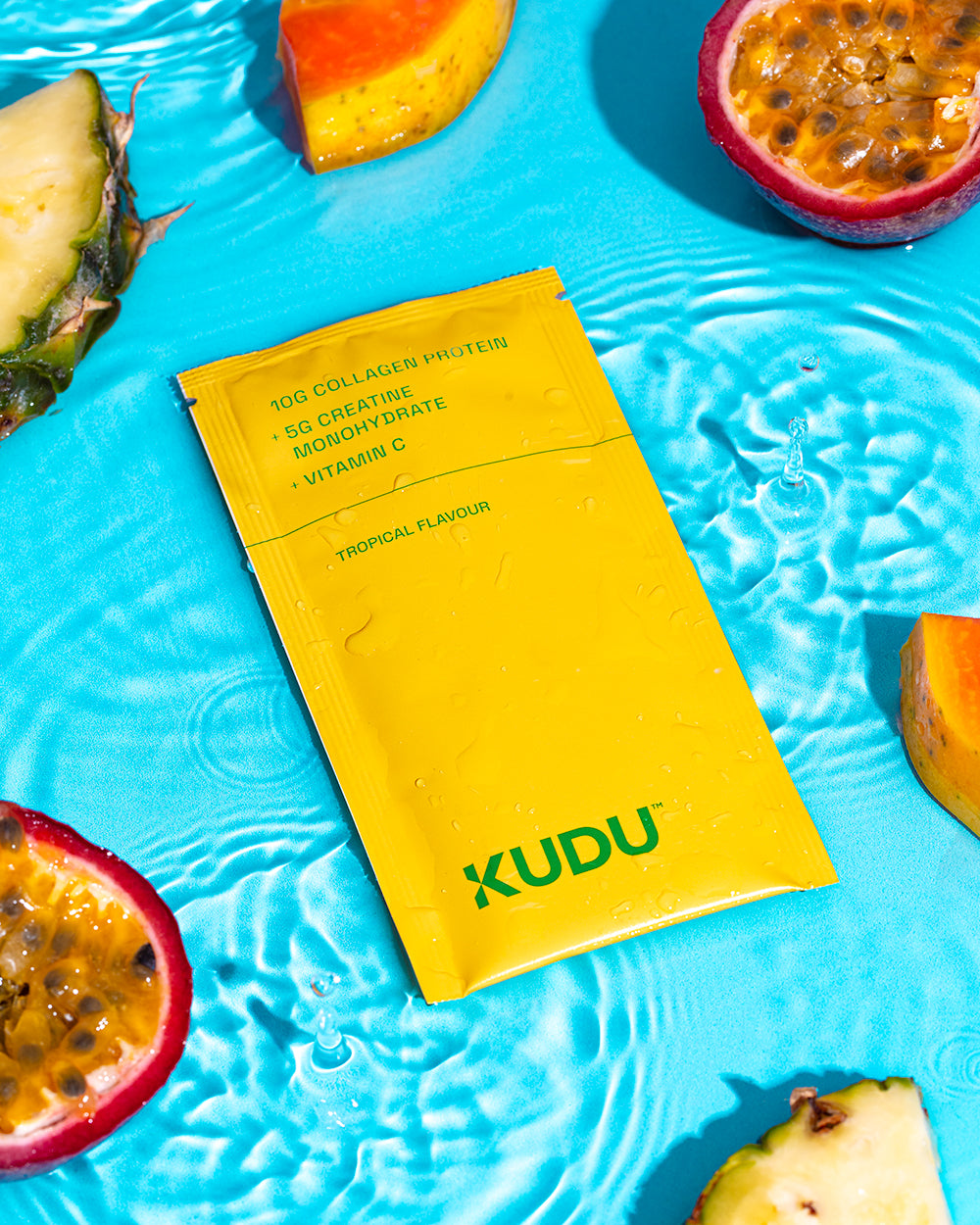
Our own sachet pairs 5g of creatine with 10g of collagen and vitamin C, at 44 kcal. We built it for women and men who lift and run, because strength training loads tendons and ligaments as well as muscle, and collagen has been studied alongside training for connective tissue. That is research, not a promise: collagen has no authorised health claims, and no trials have tested the two together. It is £59.95 for 30 (£2.00 a sachet) and it is not Informed Sport certified, so pick a batch-tested creatine if you compete in drug-tested sport. Browse the Collagen + Creatine range.
Who should not take creatine?
Creatine monohydrate at 3–5g a day has a long safety record in healthy adults. Speak to your GP before you start if you are pregnant, trying to conceive or breastfeeding, if you have a kidney condition, or if you take regular medication. Creatine can raise creatinine on a blood test, so tell your doctor you take it.
FAQ
Does creatine make women gain fat?
No. Creatine has essentially no calories. Any early weight change is water stored in the muscle, and at 3–5g a day it is usually small.
Will creatine help me lose weight?
No, and be wary of anyone who says it will. Creatine is about performance in short, intense efforts. Some studies in women who train show changes in lean mass, but it is not a weight-loss supplement.
Is creatine safe for women long term?
Studies lasting up to several years in healthy adults have not found problems at normal doses. The usual cautions apply: pregnancy, breastfeeding, kidney conditions and medication mean a GP conversation first.
Does creatine interact with the pill?
We are not aware of research showing an interaction. If you take any medication, including hormonal contraception or HRT, a quick check with your GP or pharmacist is sensible.
Can I take creatine and collagen together?
Yes. They are separate nutrients and there is no known reason not to combine them. See collagen and creatine together for dose and timing.
Related reading
- How much creatine per day?
- Creatine for menopause and women over 40
- Collagen and menopause
- Can you take collagen and creatine together?
Sources
- Smith-Ryan AE, Cabre HE, Eckerson JM, Candow DG (2021). Creatine supplementation in women's health: a lifespan perspective. Nutrients, 13(3):877.
- Kreider RB et al. (2017). International Society of Sports Nutrition position stand: safety and efficacy of creatine supplementation in exercise, sport, and medicine. Journal of the International Society of Sports Nutrition, 14:18.
- Antonio J et al. (2021). Common questions and misconceptions about creatine supplementation: what does the scientific evidence really show? Journal of the International Society of Sports Nutrition, 18:13.
- van der Merwe J, Brooks NE, Myburgh KH (2009). Three weeks of creatine monohydrate supplementation affects dihydrotestosterone to testosterone ratio in college-aged rugby players. Clinical Journal of Sport Medicine, 19(5):399–404.
- Lak M et al. (2025). Does creatine cause hair loss? A 12-week randomized controlled trial. Journal of the International Society of Sports Nutrition, 22(1).
- Commission Implementing Regulation (EU) 2017/672 (retained in GB law), creatine and muscle strength in adults over 55.
 2-in-1
Ready to try it?
Collagen + Creatine Sachets
60-day money-back guarantee
- 10g collagen + 5g creatine monohydrate
- Plus vitamin C. Mix with water, done
- No tub, no scoop. 30 sachets
Pick a flavour
£59.95 for 30
or £1.59 a serving on subscription
Free UK delivery over £50 · 60-day money-back guarantee · Pause or cancel any time