

Creatine can cause bloating, but mostly when you take a lot of it at once. The usual culprits are a loading phase of 20g a day and single large doses, which can bring water weight and an upset stomach in the first week. At 3–5g a day with no loading, most people notice little or nothing.
"Bloating" also covers two different things: water stored in your muscles, which shows on the scale, and gut symptoms like cramps and wind. They have different causes and different fixes. The chart below shows why skipping the loading phase is the simplest way to avoid both.
Quick answer
Skip the loading phase and take 3–5g a day, mixed in plenty of water. Loading at 20g a day fills your muscles in about a week, but it is when most water weight (often 1–2kg) and stomach upset happen. 3–5g a day reaches the same full stores in about four weeks with far less of either. Creatine water sits mainly inside muscle, not under the skin.
Creatine saturation chart
How fast your muscles fill, and when bloating happens
Loading (20g a day) fills muscle creatine stores in about 6 days but is when most water weight and stomach upset happen. 3–5g a day reaches the same level in about 4 weeks.
Why does creatine make some people feel bloated?
There are two separate effects, and it helps to know which one you are feeling.
- Water in the muscle. Creatine is stored in muscle, and water moves in with it. This shows up as a small rise on the scale and sometimes a "fuller" feeling in the muscles. It is not fat and it is not the puffy, under-the-skin water most people mean by bloating.
- Gut symptoms. Large single doses, or powder that has not dissolved, can draw water into the gut and cause cramps, wind or loose stools. This is about how much you take at once, not about creatine being hard on the stomach in general.
Both are strongly linked to dose. That is the good news, because dose is the thing you control.
Is creatine water weight under the skin?
Mostly no. A 2003 study by Powers and colleagues found creatine raised total body water without changing the balance between water inside and outside cells. In other words, the extra water moved in proportion, with the muscle, rather than pooling under the skin the way fluid retention does.
A 2021 review of common creatine myths by Antonio and colleagues reached a similar view: short-term increases in body water are mainly in muscle, and longer studies do not show creatine causing the kind of water retention people worry about. If your face or ankles are visibly puffy, look for another cause and mention it to your GP if it persists.
Loading vs no loading: which bloats more?
The classic study here is Hultman and colleagues (1996). It showed two routes to the same full muscle stores: 20g a day for 6 days, or 3g a day for 28 days. The faster route is the one people feel.
| Approach | Daily creatine | Full stores in | Water weight | Stomach upset risk |
|---|---|---|---|---|
| Loading | 20g (four 5g doses) for 5–7 days, then 3–5g | About 1 week | Often 1–2kg in week one | Highest |
| No loading | 3–5g every day | About 3–4 weeks | Small and gradual | Low |
Loading only makes sense if you have an event in under a month and want full stores fast. For everyone else, the slower route gets you to the same place with less fuss. Our creatine dose calculator shows both routes for your bodyweight.
Stomach upset: why dose size matters
A 2008 study of 59 professional footballers compared creatine taken as one 10g dose, two 5g doses, or a placebo for 28 days. Diarrhoea was reported by 56% of the single 10g group and 29% of the split-dose group. The split group was no different from placebo.
The practical lesson is simple: keep each dose to about 5g, and if you take more, split it across the day. Make sure it is fully mixed, too. Creatine monohydrate does not dissolve instantly in cold water, and a gritty last mouthful is undissolved creatine heading for your gut.
How to take creatine without bloating
- Skip the loading phase. 3–5g a day is enough for almost everyone.
- Keep doses to 5g. If you take 10g, split it into two doses.
- Mix it well in plenty of liquid. 250–300ml is a good guide. Warm drinks dissolve it faster.
- Take it with food or a drink you are already having if your stomach is sensitive.
- Give it two weeks. Any small water change usually settles as your stores level off.
- Drink normally through the day. There is no need to force extra water, but do not let yourself get dehydrated.
What to expect in your first month
On 3–5g a day with no loading, here is what most people notice, and what they do not.
- Week 1: usually nothing you can feel. Your muscle stores are filling slowly. If the scale moves, it is by a few hundred grams at most for most people, and day-to-day swings from food, salt and sleep are bigger.
- Weeks 2–3: stores keep rising. Some people notice their muscles feel a little fuller. Stomach symptoms at this dose are uncommon; if you have them, check the dose is fully dissolved and try taking it with a meal.
- Week 4 onwards: stores are close to full and level off, and so does any water that came with them. From here, a daily dose simply keeps them topped up.
If you loaded instead, the same story is squeezed into the first week, which is why it is more noticeable.
Why a 5g sachet is the low-bloat route
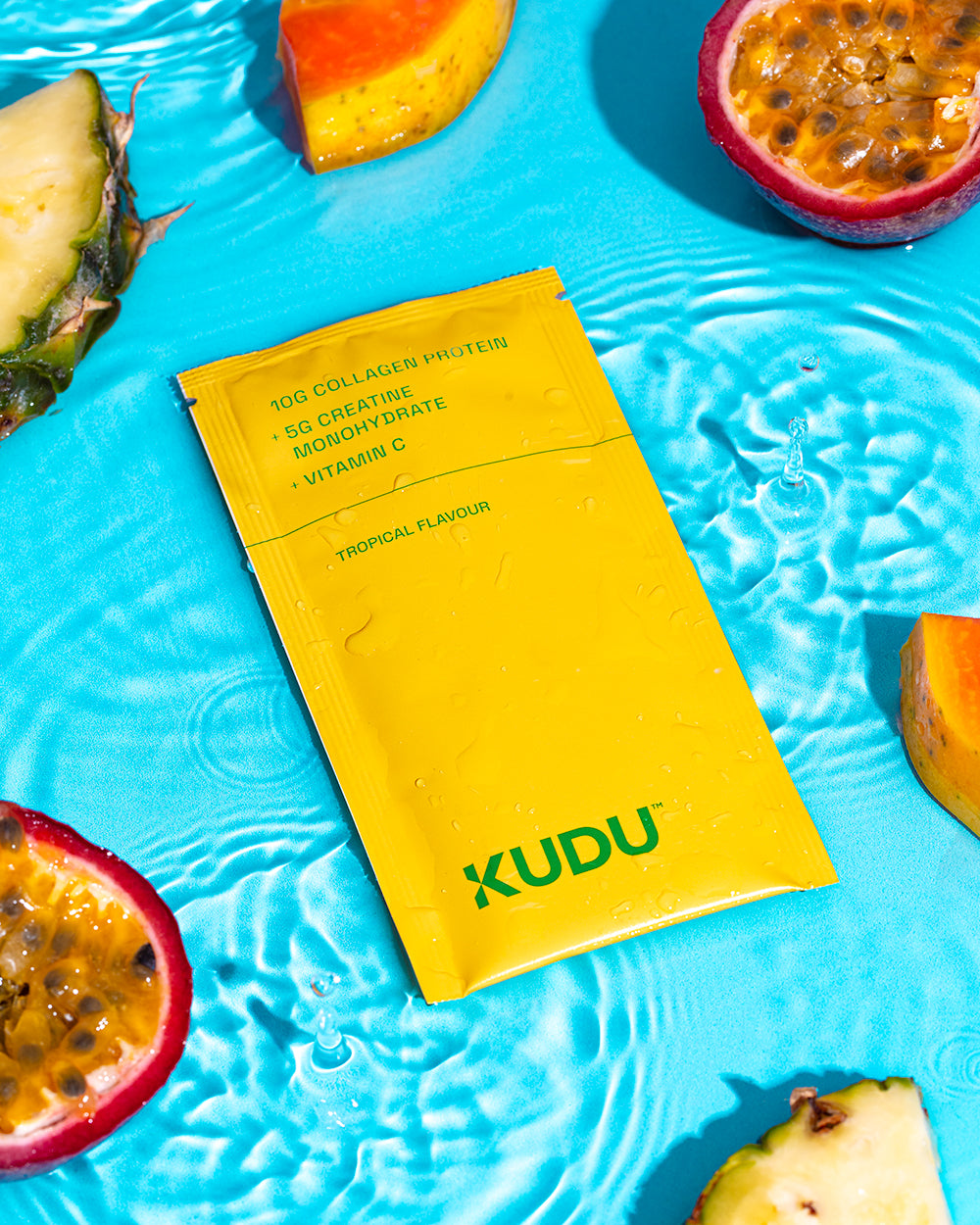
A daily KUDU Collagen + Creatine sachet is the no-loading approach by design: 5g of creatine monohydrate, pre-measured, mixed with water. With it come 10g of hydrolysed collagen and vitamin C, at 44 kcal and 0.1g of sugar, so it adds very little to your day beyond the creatine and collagen. It is £59.95 for 30 (£2.00 a sachet), and it is not Informed Sport certified.
The performance case for creatine is the same however you take it: creatine increases physical performance in successive bursts of short-term, high intensity exercise, with the benefit seen at 3g a day. Each sachet has 5g. If you want the cheapest possible creatine and do not mind measuring, plain powder costs less; we compare the options in sachets vs powder vs gummies.
When the bloating is not the creatine
If you started creatine at the same time as other changes, look at those too. Common bloating triggers include whey or milk-based shakes if you are sensitive to lactose, sugar alcohols such as sorbitol or xylitol in some "zero sugar" products, a sudden jump in fibre, and the normal hormonal changes of the menstrual cycle. Persistent bloating, pain or a change in bowel habit is worth a GP visit whatever you are taking.
As with any creatine product, speak to your GP first if you are pregnant or breastfeeding, have a kidney condition or take medication.
FAQ
How long does creatine bloating last?
Water weight from loading usually peaks in the first week and then holds steady rather than growing. Gut symptoms from large doses tend to stop as soon as you reduce or split the dose.
Does creatine make your face puffy?
It should not. Research suggests creatine water is held mainly inside muscle. Puffiness in the face is more likely to have another cause, such as salt, alcohol, sleep or hormones.
Will I lose the water weight if I stop creatine?
Yes. Muscle creatine drifts back to baseline over roughly four to six weeks after stopping, and the water stored with it goes too.
Does creatine HCl cause less bloating?
It is often marketed that way, but there is little good evidence that it beats a sensible 3–5g dose of creatine monohydrate. The dose and the loading phase matter far more than the form.
Is creatine bloating different for women?
The mechanism is the same. Some women notice cycle-related bloating more, so judge creatine over a full cycle rather than a few days. See creatine for women for more.
Related reading
- How much creatine per day?
- Creatine for women
- Can you take collagen and creatine together?
- Collagen + Creatine hub
Sources
- Hultman E et al. (1996). Muscle creatine loading in men. Journal of Applied Physiology, 81(1):232–237.
- Powers ME et al. (2003). Creatine supplementation increases total body water without altering fluid distribution. Journal of Athletic Training, 38(1):44–50.
- Ostojic SM, Ahmetovic Z (2008). Gastrointestinal distress after creatine supplementation in athletes: are side effects dose dependent? Research in Sports Medicine, 16(1):15–22.
- Antonio J et al. (2021). Common questions and misconceptions about creatine supplementation: what does the scientific evidence really show? Journal of the International Society of Sports Nutrition, 18:13.
- Kreider RB et al. (2017). International Society of Sports Nutrition position stand: safety and efficacy of creatine supplementation in exercise, sport, and medicine. Journal of the International Society of Sports Nutrition, 14:18.
 2-in-1
Ready to try it?
Collagen + Creatine Sachets
60-day money-back guarantee
- 10g collagen + 5g creatine monohydrate
- Plus vitamin C. Mix with water, done
- No tub, no scoop. 30 sachets
Pick a flavour
£59.95 for 30
or £1.59 a serving on subscription
Free UK delivery over £50 · 60-day money-back guarantee · Pause or cancel any time